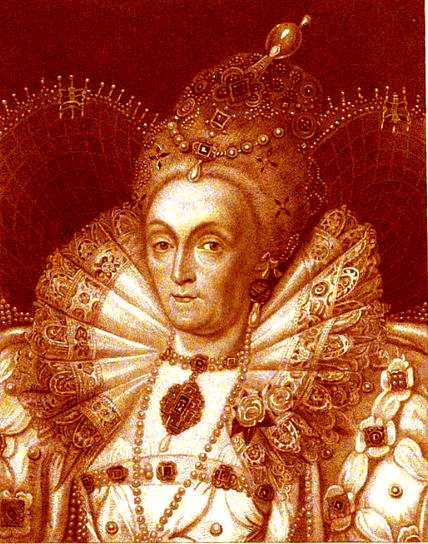
Elizabeth I (7 September 1533 – 24 March 1603) was Queen of England and
Queen of Ireland from 17 November 1558 until her death. Sometimes called The
Virgin Queen, Gloriana, or Good Queen Bess, Elizabeth was the fifth and last
monarch of the Tudor dynasty.
The reign of Elizabeth may be
conveniently divided into three periods.
During the first, the enemies of
her government and of the Protestant religion labored by secret conspiracies
to undermine both, until they were disconcerted not less by the vigilance of
her ministers, than by the fall and imprisonment of Mary Queen of Scots, in
whose person all their plots centered
In the second period, Elizabeth's
foreign enemies were preparing, as their domestic troubles gave them leisure,
to crush her by open force, till in the ever-memorable eighty-eight the
invincible Armada was defeated by the bravery of her subjects.
The third period, though not one
of peace, was one in which the English government was freed from the fear of
its enemies, and when the cause of Protestantism was triumphant.
Elizabeth succeeded to the crown of
England at an extremely critical period, when new feelings, new principles, new
interests, were springing up on every side, which promised no small difficulties
to, and required no little wisdom and conduct in, the monarch who was called to
govern them. On one side the spirit of commercial adventure, the thirst of
knowledge and discovery, were every day making amazing advances, and with them
were bringing as a matter of course the demand for popular government and free
institutions. On another side the stream of reformation, which had long run with
a steady and powerful current, after being temporarily dammed up, was ready to
break out with a fury that required great prudence to guide it within its banks.
Amidst all these changes, the frame of society was itself undergoing an
important change. The policy of the Tudors, in breaking the neck of the old
feudal aristocracy, had been gradually bringing forward a new class, which has
been since known as the ' English gentlemen.' In Scotland, the reformation had
advanced even more rapidly than in England, but the power of the king had not
been able to break down the old system of clanship, and the consequence was a
series of wider divisions, more bitter feuds, and more irreparable confusion,
than had perhaps ever before been witnessed amongst that proverbially turbulent
people. In England, Providence had raised men to advise and govern, who were
peculiarly fitted for the occasion, and had given them, in the person of a
woman, a ruler with that greatness of mind and firmness of character which was
able to stifle all those personal jealousies that were tearing in pieces the
surrounding nations. The great cause in which they were embarked, that of
religious reformation and civil freedom from the degrading despotism of papacy,
was to them a link of union which no considerations could break.
There can be no more convincing proof of the greatness of Elizabeth's mind, than
the self-humility with which her wisest counselors bowed to her judgment, and
the facility with which all allowed themselves to be ruled. The great Burghley,
after a life spent in the closest communion with her, declared in his old age,
that " in all graces, by nature, by calling, by long experience, she was of such
perfection as none can attain unto ;" and on many occasions, even when her
opinion differed from his own, he acknowledges in private his entire confidence
in the accuracy of her judgment. Her ministers, who knew the dangers with which
she was constantly surrounded, and her consciousness of them, and indeed all her
contemporaries, joined in admiration of the calm resignation which she ever
manifested. It was, indeed, an extraordinary thing, to see a monarch surrounded
on every side by plots and conspiracies, who never concealed herself from the
view of her subjects, or shrunk for a moment from her public duties. But the
plots which threatened Elizabeth's life were the work of foreign and not of
domestic enemies.
Almost the first act of Elizabeth's reign was the establishment of the
Protestant religion throughout the realm, which, amid the general disgust that
had been raised by the violent proceedings of the Catholics during Mary's reign,
caused a universal satisfaction. But abroad, the feeling was very different—the
Pope, as the supreme head of the Catholic world, declared the new Queen of
England to be illegitimate, and prepared, by what he considered his prescriptive
right, to transfer her crown to some worthier member of the church— the King of
Spain, equally governed by the hatred of the Protestants, was further instigated
by his ambition, but for a time he flattered and courted with the hope of an
easier and unobstructed conquest—while the King of France, whose power was
already strong in Scotland by the regency of Mary of Guise, looked still further
by advancing the claims of Mary Stuart, who was united with the heir of France,
to the crown of England. At the same time, the cause of Elizabeth became that of
the Protestants throughout Europe, and in the position they were then in, she
seemed as one raised up by Heaven for their support. In France, and in the
Netherlands, (then an appendage to Spain,) they were already beginning to take
courage, and in Scotland the Protestant nobles took up arms with the avowed
object, not less of putting down papacy, than of ridding themselves of French
interference. At the same time that the domestic dissensions amongst her
neighbors delivered Elizabeth from the immediate danger with which her enemies
seemed to threaten her, by giving them work at home, they embarrassed extremely
her foreign relations; for the resources of her kingdom were so much reduced by
the bad government of her predecessors, that she was neither willing nor able to
undertake a great war; and at the same time if she left the Protestants in other
countries to their fate, she only hastened its approach, while at the same time
she allowed the ramparts which defended her to be overthrown. It was fortunate
in these circumstances that she had advisers and ambassadors, who far exceeded
those of her enemies in faithfulness, conduct, and honesty, and yet were
inferior to none of them in that far-sighted policy, and sometimes even in the
deep cunning which the circumstances required. It would have been impossible to
discover men more fitted than Randolph, Smith, and Throgmorton, for their
missions in Scotland and France, from whence, during the first part of the
reign, the greatest dangers impended.
During the earlier years of
Elizabeth's reign, it was France whose designs required most the jealous
attention of the English government. The turbulence of the Protestants in
Scotland, which may be well excused by the faithless and treacherous dealings of
their opponents, afforded a good excuse for the transporting of French troops to
support the authority and enforce the decrees of the Regent and the Queen ; but
the pompous usurping of the arms of England, their boasting pretensions, and
many other circumstances, could leave no doubt either of the ulterior views of
France, or that Mary Stuart was not only a willing, but a zealous instrument in
the hands of the Catholics. Elizabeth was slow to intermeddle, and remained long
undecided, until the pressing instances of her counsellors determined her to act
vigorously, and the surrender of Leith and the treaty of Edinburgh, together
with the death of the Queen-mother, drove the French from Scotland. The death of
Mary's husband, the King of France, cut off many of the ambitious projects of
his house ; but still Mary was the instrument of the Catholies, and the French
were unwilling to lose the influence in Scotland which the marriage of James
with Mary of Guise had given them.
There can be no doubt that the
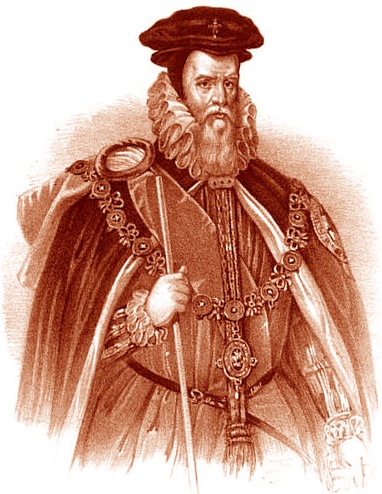
greatest minister of the reign of Elizabeth was Lord Burghley, at the period of
which we are now speaking known simply as Sir William Cecil, but there was
another who bore at the beginning of the reign a very prominent part. Amongst
all the undeserved accusations which have been from time to time lavished upon
Elizabeth's ministers, no one has been so unsparingly slandered as the Earl of
Leicester, at this time known as Lord Robert Dudley. It is by no means in favour
of his accusers, that almost the sole authority for these slanders is found to
be popish libels, and that those same libels contain attacks equally gross upon
the most upright of his contemporaries. Documentary evidence of the most
convincing nature has proved the falsehood of most of the accusations which have
been brought forward against the Earl of Leicester. A letter printed in our
present collection* affords a nearly perfect confutation of the story of the
murder of his own wife, and another absolves him from all concern in the death
of the Earl of Essex. Sharon Turner, who is inclined to vindicate his character,
has an obscure notion that Leicester designedly let his character be involved in
mystery, which we can only interpret as meaning that in his particular case,
when he has not left to posterity a statement of his reasons for everything he
did, we have a right to think the worst; for there is no more mystery shed over
his character than over that of any of his contemporaries, and we see no reason
for believing with the same author that he was first in secret correspondence
with the Papists, and afterwards incurred their hatred by deserting them. His
own letters, as well as the private letters of his contemporaries, even of those
who were not reputed his friends, give us by no means a bad view of his
character, and his own actions proved that he was not wanting in the
qualifications of a statesman. Had it been otherwise, the letter of Lord North
to Burghley, on Leicester's death*—to Burghley who, we are told, despised his
person and knew all his crimes—must have been felt as a piece of bare-faced
mockery. Neither is it at all consistent with Elizabeth's character, whose
temporary displeasure he frequently incurred, that she would have supported to
the last one who is represented as having been both a fool and a rogue. As their
unflinching opponent, he was hated by the Catholics—as an early favorite, he
incurred the jealousy of many of the courtiers, and his character seems to have
been sometimes lowered by an ambition which could condescend to petty intrigues.
So long as there were any hopes that Queen Elizabeth would marry an English
nobleman, all eyes were turned upon the Lord Robert Dudley, but the Queen
herself did not allow such hopes to be entertained long. After the arrival of
Queen Mary in Scotland, it became necessary to seek a husband for her, and
Elizabeth and the Scottish Protestants were equally desirous of the promotion of
the Lord Robert, now created Earl of Leicester, to that honour, as the person
most he was her friend, and because Cecil has noted that in 1565, Leicester and
the Earl of Pembroke were in disgrace for their participation in an attempt to
have the succession declared by parliament. Now if we bear in mind that any
declaration of the parliament must, from their known sentiments, have been
against Mary, it will at once be seen that the one of these assertions goes far
towards contradicting the other, and indeed there are many reasons for thinking
that Melvil's diary, like many other similar productions, is' full of falsehood
and misrepresentation. It is very necessary to ascertain the value and bearing
of our documents before we use them likely to hold her steady to her first
professions of moderation, and to watch over the interests of England and the
Protestants. Leicester seems never to have been very anxious for the match, and
it is probable that he was sufficiently far-sighted to foresee the probable
results. But Mary soon disappointed both her enemies and her friends. The person
in whom the Pope and the Catholics placed their hopes, overthrew herself and her
cause, by giving the rein to her gross passions and wicked propensities. After a
short reign, a scene of bloodshed and the most disgusting crimes, Mary was
deposed and imprisoned by her own subjects, escaped, was defeated, fled from her
country, and became a prisoner in England.
Queen of England
Elizabeth I (7 September 1533 – 24 March 1603) was Queen of England and
Queen of Ireland from 17 November 1558 until her death. Sometimes called The
Virgin Queen, Gloriana, or Good Queen Bess, Elizabeth was the fifth and last
monarch of the Tudor dynasty.
Elizabeth I - the last Tudor monarch - was born at Greenwich on 7
September 1533, the daughter of Henry VIII and his second wife, Anne Boleyn. Her
early life was full of uncertainties, and her chances of succeeding to the
throne seemed very slight once her half-brother Edward was born in 1537. She was
then third in line behind her Roman Catholic half-sister, Princess Mary. Roman
Catholics, indeed, always considered her illegitimate and she only narrowly
escaped execution in the wake of a failed rebellion against Queen Mary in 1554.
Elizabeth succeeded to the throne on her half-sister's death possibly from
cancer in November 1558. She was very well-educated (fluent in six languages),
and had inherited intelligence, determination and shrewdness from both parents.
Her 45-year reign is generally considered one of the most glorious in English
history. During it a secure Church of England was established. Its doctrines
were laid down in the 39 Articles of 1563, a compromise between Roman
Catholicism and Protestantism. Elizabeth herself refused to 'make windows into
men's souls ... there is only one Jesus Christ and all the rest is a dispute
over trifles'; she asked for outward uniformity. Most of her subjects accepted
the compromise as the basis of their faith, and her church settlement probably
saved England from religious wars like those which France suffered in the second
half of the 16th century.
Although autocratic and capricious, Elizabeth had astute political judgment
and chose her ministers well; these included Burghley (Secretary of State),
Hatton (Lord Chancellor) and Walsingham (in charge of intelligence and also a
Secretary of State). Overall Elizabeth's administration consisted of some 600
officials administering the great offices of state, and a similar number dealing
with the Crown lands (which funded the administrative costs). Social and
economic regulation and law and order remained in the hands of the sheriffs at
local level, supported by unpaid justices of the peace.
Elizabeth's reign also saw many brave voyages of discovery, including those
of Francis Drake, Walter Raleigh and Humphrey Gilbert, particularly to the
Americas. These expeditions prepared England for an age of colonisation and
trade expansion, which Elizabeth herself recognised by establishing the East
India Company in 1600.
The arts flourished during Elizabeth's reign. Country houses such as Longleat
and Hardwick Hall were built, miniature painting reached its high point,
theatres thrived - the Queen attended the first performance of Shakespeare's A
Midsummer Night's Dream. The image of Elizabeth's reign is one of triumph
and success. The Queen herself was often called 'Gloriana', 'Good Queen Bess'
and 'The Virgin Queen'. Investing in expensive clothes and jewellery (to look
the part, like all contemporary sovereigns), she cultivated this image by
touring the country in regional visits known as 'progresses', often riding on
horseback rather than by carriage. Elizabeth made at least 25 progresses during
her reign.
However, Elizabeth's reign was one of considerable danger and difficulty for
many, with threats of invasion from Spain through Ireland, and from France
through Scotland. Much of northern England was in rebellion in 1569-70. A papal
bull of 1570 specifically released Elizabeth's subjects from their allegiance,
and she passed harsh laws against Roman Catholics after plots against her life
were discovered. One such plot involved Mary, Queen of Scots, who had fled to
England in 1568 after her second husband's murder and her subsequent marriage to
a man believed to have been involved in his murder. As a likely successor to
Elizabeth, Mary spent 19 years as Elizabeth's prisoner because Mary was the
focus for rebellion and possible assassination plots, such as the Babington Plot
of 1586. Mary was also a temptation for potential invaders such as Philip II. In
a letter of 1586 to Mary, Elizabeth wrote, 'You have planned ... to take my life
and ruin my kingdom ... I never proceeded so harshly against you.' Despite
Elizabeth's reluctance to take drastic action, on the insistence of Parliament
and her advisers, Mary was tried, found guilty and executed in 1587.
In 1588, aided by bad weather, the English navy scored a great victory over
the Spanish invasion fleet of around 130 ships - the 'Armada'. The Armada
was intended to overthrow the Queen and re-establish Roman Catholicism by
conquest, as Philip II believed he had a claim to the English throne through his
marriage to Mary.
During Elizabeth's long reign, the nation also suffered from high prices and
severe economic depression, especially in the countryside, during the 1590s. The
war against Spain was not very successful after the Armada had been beaten and,
together with other campaigns, it was very costly. Though she kept a tight rein
on government expenditure, Elizabeth left large debts to her successor. Wars
during Elizabeth's reign are estimated to have cost over £5 million (at the
prices of the time) which Crown revenues could not match - in 1588, for example,
Elizabeth's total annual revenue amounted to some £392,000. Despite the
combination of financial strains and prolonged war after 1588, Parliament was
not summoned more often. There were only 16 sittings of the Commons during
Elizabeth's reign, five of which were in the period 1588-1601. Although
Elizabeth freely used her power to veto legislation, she avoided confrontation
and did not attempt to define Parliament's constitutional position and rights.
Elizabeth chose never to marry. If she had chosen a foreign prince, he would
have drawn England into foreign policies for his own advantages (as in her
sister Mary's marriage to Philip of Spain); marrying a fellow countryman could
have drawn the Queen into factional infighting. Elizabeth used her marriage
prospects as a political tool in foreign and domestic policies. However, the
'Virgin Queen' was presented as a selfless woman who sacrificed personal
happiness for the good of the nation, to which she was, in essence, 'married'.
Late in her reign, she addressed Parliament in the so-called 'Golden Speech' of
1601 when she told MPs: 'There is no jewel, be it of never so high a price,
which I set before this jewel; I mean your love.' She seems to have been very
popular with the vast majority of her subjects.
Overall, Elizabeth's always shrewd and, when necessary, decisive leadership
brought successes during a period of great danger both at home and abroad. She
died at Richmond Palace on 24 March 1603, having become a legend in her
lifetime. The date of her accession was a national holiday for two hundred
years." -- Text by: Historic
Royal Profiles
A
History of England from the
Defeat of the Armada to the Death of Elizabeth
By Edward Potts Cheyney
Published by Longmans, Green, and co., 1914
The strongest personal influence upon the course of events was undoubtedly that
which was exercised by the queen. In November, 1588, Elizabeth was in the
fifty-fifth year of her age and had been reigning just thirty years. She had
still the erect and spare figure that made so many observers think of her as a
tall woman, though she was but of medium height. She was evidently in the prime
of life. Her activity and endurance were great and her health almost constantly
good. She was always impatient of her ailments, such as they were. Secretary
Cecil writing to Essex that the queen was unable to sign a letter says "The
queen hath now a desperate ach in her right thomb, but will not be knowen of it;
nor the goute it cannot be, nor dare not be, but to signe will not be indured."
Again we hear of her with an inflammation of the chest, and "her mind altogether
averse from physic." 1 Representations of her during this the later period of
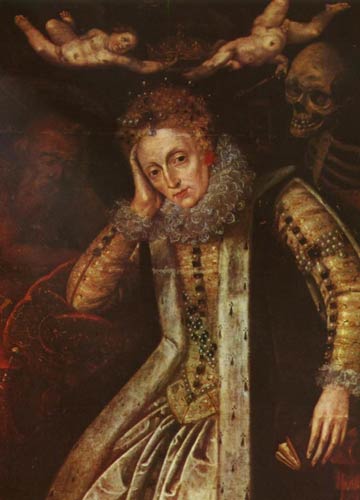
her life show the familiar smooth, somewhat retreating forehead, arched brows,
narrow face, long profile of nose and chin, light eyes and hair, that appear in
paintings, engravings, coins and on her tomb. Contemporary writers describe her
more vividly. Her sharp eyes and features, loud voice, vivacious manner and
constant activity are repeatedly mentioned. She was her father's own daughter
and played the queen well. It was not only her native flatterers speaking in her
presence, but foreign visitors in their private correspondence who described her
royal manner. One speaks of her " terrible eyes," another of her "stately air,"
a third of her "majestic deportment "; a foreign ambassador is daunted by her
anger and leaves her presence in confusion; a courtier records that "When she
smiled it was a pure sunshine that everyone did chuse to baske in if they could;
but anon came a storm from a sudden gathering of clouds, and the thunder fell in
wondrous manner on all alike." l
Her usual manner, however, was pleasant and affable, sometimes even insinuating.
Many of her courtiers she called by their first names, several by fanciful
nicknames she had fastened upon them. Foreigners she often flattered by speaking
to them in terms of intimacy and confidence. She was often merry, not
infrequently uproarious, easily pleased by the coarser forms of humour. "Her
Highnesse loveth merrie tales," is the testimony of a courtier. One gets a
glimpse of her in the midst of the Armada campaign, laughing to excess at the
clown Tarlton playing the god Luz, armed with a flitch of bacon for a shield and
a long staff for a spear, pretending to fight with her little pet dog Perrico de
Faldas and appealing to her to "call off her mastiff." She expressed her
humorous feelings with disconcerting frankness. Sir John Harington, her godson
and long time courtier, records in his memoranda, "The queen loveth to see me in
my last frize jerkin — she spit on Sir Matthew's fringed clothe, and said, 'the
fool's wit has gone to ragges.' Heaven spare me from suche jibing." He quotes
another and a still more characteristic jest of the queen on the subject of
clothes and the duties of clergymen. "One Sunday, April last, my Lord of London
preached to the Queen's Majesty, and seemed to touched on the vanities of
decking the body too finely. Her Majesty told the Ladies, that if the Bishop
held more discourse on such matters, she would fitte him for heaven, but he
should walk thither without a staff, and leave his mantle behind him. Perchance
the bishop hath never sought her Highnesses wardrobe, or he would have chosen
another text." 2
It is hard to judge of Elizabeth's religion. She was certainly not devout. She
seldom talked or apparently thought of religious matters, paid scant respect to
clergymen, and took no interest in the church controversies of the time, except
when they became matters of state. On the other hand, she was regular in all
formal religious observances, her state papers are full of expressions of
recognition of her position as a Christian ruler, and she shared in the practice
of pious appeal and ascription usual at the time. She even composed certain
eloquent prayers for public uses. But her devotion was quite impersonal. In her
times of depression she sought her consolation rather in the classics than in
the Bible. Harington remarks, "Her Highnesses was wont to soothe hir ruffled
temper with reading every morning. . . . She did much admire Seneca's wholesome
advising, when the soul's quiet was flown away." When her ally Henry IV changed
his religion she found refuge and comfort in translating the De Consolatione
Philosophies. A contemporary, though hostile, writer expresses what is probably
a correct judgment of her belief, when he says, " She considers it of the first
importance that she should live peacefully and pleasantly and pass her days in
well-being. She is not greatly influenced by either hatred or love of any
particular religion or sect."
Elizabeth had few generous impulses. No one of the great men of her time, in
literature, learning, civil, military or naval life was fully recognized or
adequately rewarded by her. She was occasionally liberal to her favorites, but
never lavish, except for her own personal adornment or gratification. While her
mariners and soldiers starved, her unpaid servants suffered and patriots found
themselves neglected or disowned, her signature was being affixed to warrants
for £1,700 for a pearl chain for herself, or £1,200 "for a great diamond with a
pendant," or "£761, 45, 4d for fine linen for her Majesty's own person."2 It is
to be remembered that all sums of money named during this period must be
multiplied by a factor which can perhaps be fairly chosen as five or six, to
transform them into modern values, and such sums as those just given, as will
later appear, are not unusual in connection with her personal expenditures. But
in matters not involving money or serious sacrifice on her part, she often spoke
or wrote kindly and thoughtfully, as in a letter of condolence to Lord and Lady
Norris on the "bitter accident" of the death of their two sons in Ireland; or
that to the earl of Pembroke addressed to "My very good old man." Occasionally
we get a still more attractive glimpse of her, as for instance yielding to the
persuasions of her maid of honor Bridget Carew, or pinning up the dress of the
little Lady Talbot, kissing her and taking her with her in the state barge. In a
very real sense also she was conscientious. As the lord keeper testified of her
"She will have her wyndinge sheet unspotted."
Elizabeth's intellectual powers were
moderate. She had been thoroughly educated in her youth and retained the habit
of reading through her whole life. Translations from Horace, Plutarch, Boethius
and Xenophon still remain in her own handwriting to testify to her interest in
the classics. Although she sometimes displays in these translations a royal
disregard of rhythm and even of accuracy, they give no mean impression of her
ability in the use of both her own and the classical languages, a power of which
we have abundant other proof. Besides those that remain, we know she made
translations of many letters of Cicero and Seneca and the whole of Sallust's
Jugurthine War and some parts of Euripides, and most of this was done in the
later years of her life. Some of her speeches, letters and prayers were vigorous
and picturesque, and like most other educated people of her time she wrote some
poetry. On the other hand nothing exists to show that she had any real
appreciation of the higher learning, thought or poetry of her own time.
She showed little originality or power of initiative in statesmanship. All the
bold or constructive ideas of her reign came from her ministers or from entirely
outside the government. Moreover, patriotic as she was, she was slow to respond
to such ideas. Unimaginative and opinionated, she never understood the great
questions, realized the great crises, or perceived the great possibilities of
her position.
She was a hard mistress to serve. Irresolute and yet obstinate, she frequently
refused to act or decide, procrastinated, delayed, hesitated, while her
ministers watched disaster approach or opportunity vanish. Even her most
influential advisers found it impossible to overcome this inveterate trait of
indecision. Their correspondence shows them driven almost to despair in times of
exigency at the queen's vacillation and unreasonableness. An endorsement by a
clerk on a letter of 1600 still exists in faded handwriting, to testify to this
habit. "A letter which Her Majesty willea me to write to her Secretary, and to
send it by post, but before I had fully ended the letter she sent to me to bring
it to her before it was closed, which I did upon the point of six o'clock, and
then Her Majesty having read and scanned it three or four times and sometimes
willing me to send it away, and sometimes altering that purpose, commanded me at
last to stay both the letter and the post." 1
Those ministers who had served her longest naturally conformed themselves most
successfully to the requirements of her character. Burghley writes in 1591 to
the French ambassador, who had retired from the court in vexation at the queen's
behavior, reminding him that they were both servants of an almighty king in
heaven and of great princes upon earth, that both of these must be obeyed, and
that they could only wait in patience till the heavenly ruler should change the
mind of the earthly one. Or again, he writes to Walsingham, "I am very sorry
that our counsels . . . doth not like her — but fiat wluntas sua." Burghley was
inclined to charge her irresolution to her sex. He writes: "Many times she
yeldeth 1 State Papers, Dom., Elizabeth, cckxiv, as overcome with argument, but
yet that which is natural to her sex hundredth resolution. I hope time will gain
that which is necessary. Corda reginarum in manu dei." Occasionally even these
devoted servants lost patience at being held responsible for her vacillation and
its results, as in a letter of Burghley to Walsingham, November, 1588, "All
irresolutions and lucks ar thrown upon us two in all her speeches to everybody.
The wrong is intolerable." * Sometimes she tricked her ministers. One of her
courtiers states that "Her wisest men and best counselors were oft sore troubled
to knowe her wile in matters of State. So covertly did she pass her judgment as
seemed to leave all to their discrete management, and when the businesses did
turn to better advantage, she did moste cunningly commit the good issue to her
own honor and understanding; but when ought fell out contraire to her wile and
intent, the Council were in great strait to defend their own acting and not
blemished the Queen's good judgment." Another official records an additional
weakness. "Amongst her manifold and rare virtues of nature and arte this was the
only detraction, that she had not power to give where it was merited, ... If she
had disposed of twenty or thirty thousand pounds to the comfort of her long worn
thredbare pore old servants, and paid her debts, she had died, as she did, the
mirror of her sex
Her experience was less varied than might at first thought be supposed. Except
for her brother and sister, she was the first English monarch in the long line
since the Norman Conquest who had not crossed the Channel. She never saw
Scotland, Ireland, or Wales, and during her seventy years of life was never more
than one hundred and twenty-five miles from her birthplace. She was even more
than other sovereigns deprived of the stimulation that comes from open
discussion with others on an equal plane. Without parents whom she knew,
husband, brother, sister or child, habituated from girlhood to caution,
reticence, deceit and concealment of her real opinions, separated from all
others by her position, she lived alone, though in a crowded court, and never
spoke to others or heard speech from them such as they used to one another. Most
of the praise and some of the blame directed toward her came to her ears; but it
all came through artful and indirect ways, and she was seldom called upon to
justify the one or to defend herself against the other. Such success as her
administration attained was in spite of her deficiencies as a ruler rather than
a result of her abilities. From repeated dangers the country was extricated only
by good fortune, and golden opportunities in a long series were wasted largely
by the queen's incapacity to see them or unwillingness to make use of them.
Her relations with her ministers and courtiers, her allies and enemies, will
come out more fully later. But it will always remain impossible to give a
complete analysis of Elizabeth's character. A writer of the next generation
says, "For her own mind, what that really was, I must leave, as a thing doubly
inscrutable, both as she was a woman and a queen." 1 But her mind was trebly
inscrutable both as a woman and a queen because of its complexity. Stripped,
however, of the flattery and the abuse of her own time, and tested as far as
possible by what she did and said, Elizabeth stands an unlovely but not an
unheroic figure; exasperating to those who had to work with her and to the
modern student who has to trace her career, but so thoroughly representative of
her own age, so many-sided, so queenly, so long the occupant of a throne, and
above all so fortunate that the extravagant laudation of her own time and the
tradition of her greatness that has survived to ours are easily comprehensible,
however they may fade away on greater familiarity with her mind and her actions.
Unauthorized Site:
This site and its contents are not affiliated, connected,
associated with or authorized by the individual, family,
friends, or trademarked entities utilizing any part or
the subject's entire name. Any official or affiliated
sites that are related to this subject will be hyper
linked below upon submission
and Evisum, Inc. review.
Please join us in our mission to incorporate The Congressional Evolution of the United States of America discovery-based curriculum into the classroom of every primary and secondary school in the United States of America by July 2, 2026, the nation’s 250th birthday. , the United States of America: We The
People. Click Here