Welcome to the Red Room Room Text and photo from by: whitehouse.gov
Furnished in the Empire style of 1810-30, the Red Room--one of
four state reception rooms in the White House--contains several pieces of
furniture from the New York workshop of the French-born cabinetmaker Charles-Honore
Lannuier. Benjamin Latrobe's 1803 drawing of the State Floor indicates that the
Red Room served as "the President's Antichamber" for the Cabinet Room
or President's Library next door. During the Madison
Administration the antechamber became the "Yellow Drawing Room" and
the scene of Dolley
Madison's fashionable Wednesday night receptions. In "the centre of
attraction" said a lady who knew her well, one saw "all these whom
fashion, fame, beauty, wealth or talents, have render'd celebrated." The
room has usually served as a parlor or sitting room; recent Presidents have had
small dinner parties here.
In 1971 the Red Room was decorated, preserving the American
Empire style chosen in 1962 during the Kennedy
Administration. The elegance of the Red Room furniture derives from a
combination of richly carved and finished woods with ormolu mounts (decorative
hardware made of gilded bronze) in characteristic designs such as dolphins,
acanthus leaves, lion's heads, and sphinxes. The furniture displays many motifs
similar to those of the French pieces now in the Blue
Room. Egyptian motifs were extensively used in French Empire furnishings
following Napoleon's 1798-99 campaign in Egypt, and many of these same designs
were adopted by cabinetmakers working in New York, Boston, and Philadelphia.
The furniture in the Red Room dates from the years 1810-1830.
All the fabrics now in the Red Room were woven in the United States from French
Empire designs. The walls are covered by a red twill satin fabric with a gold
scroll design in the border. The furniture, like the American Empire sofa, is
upholstered in a silk of the same shade of red. An early 19th-century design
inspired the draperies (which you do not see in the picture), made of gold satin
with red silk valances and handmade gold-and-red fringe. The carpet--of beige,
red and gold--is a reproduction of an early 19th-century French Savonnerie
carpet in the White House collection; it was made for the room in 1965. The
13-light French Empire chandelier was fashioned from carved and gilded wood in
1805.
Descriptions in contemporary accounts and bills of sale indicate
that Monroe purchased
furnishings for the Red Room, as well as for the present day Blue
Room, in the prevailing Empire style. This style suited Monroe's desire to
furnish the house in a manner that he considered appropriate to the dignity of
the nation.
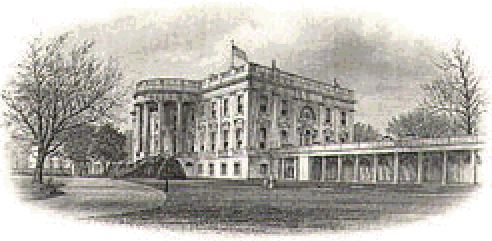
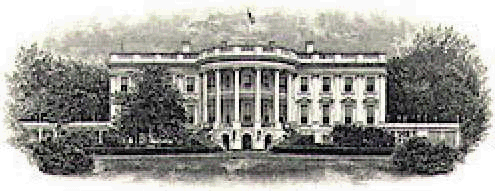
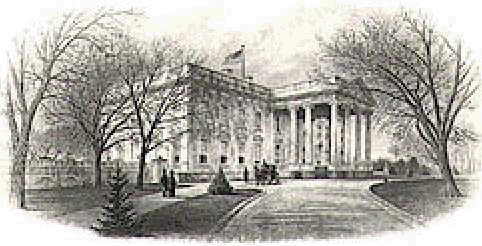
For two hundred years, the White House has stood as a symbol of the
Presidency, the United States government, and the American people. Its history,
and the history of the nation’s capital, began when President George
Washington signed an Act of Congress in December of 1790 declaring that the
federal government would reside in a district "not exceeding ten miles
square…on the river Potomac." President Washington, together with city
planner Pierre L’Enfant, chose the site for the new residence, which is now
1600 Pennsylvania Avenue. As preparations began for the new federal city, a
competition was held to find a builder of the "President’s House."
Nine proposals were submitted, and Irish-born architect James Hoban won a gold
medal for his practical and handsome design.
Construction began when the first cornerstone was laid in October of 1792.
Although President Washington oversaw the construction of the house, he never
lived in it. It was not until 1800, when the White House was nearly completed,
that its first residents, President John Adams and his wife, Abigail, moved in.
Since that time, each President has made his own changes and additions. The
White House is, after all, the President’s private home. It is also the only
private residence of a head of state that is open to the public, free of charge.
The White House has a unique and fascinating history. It survived a fire at
the hands of the British in 1814 (during the war of 1812) and another fire in
the West Wing in 1929, while Herbert Hoover was President. Throughout much of
Harry S. Truman’s presidency, the interior of the house, with the exception of
the third floor, was completely gutted and renovated while the Truman's lived at
Blair House, right across Pennsylvania Avenue. Nonetheless, the exterior stone
walls are those first put in place when the White House was constructed two
centuries ago.
Presidents can express their individual style in how they decorate some parts
of the house and in how they receive the public during their stay. Thomas
Jefferson held the first Inaugural open house in 1805. Many of those who
attended the swearing-in ceremony at the U.S. Capitol simply followed him home,
where he greeted them in the Blue Room. President Jefferson also opened the
house for public tours, and it has remained open, except during wartime, ever
since. In addition, he welcomed visitors to annual receptions on New Year’s
Day and on the Fourth of July. In 1829, a horde of 20,000 Inaugural callers
forced President Andrew Jackson to flee to the safety of a hotel while, on the
lawn, aides filled washtubs with orange juice and whiskey to lure the mob out of
the mud-tracked White House.
After Abraham Lincoln’s presidency, Inaugural crowds became far too large
for the White House to accommodate them comfortably. However, not until Grover
Cleveland’s first presidency did this unsafe practice change. He held a
presidential review of the troops from a flag-draped grandstand built in front
of the White House. This procession evolved into the official Inaugural parade
we know today. Receptions on New Year’s Day and the Fourth of July continued
to be held until the early 1930s.
President Clinton’s open house on January 21, 1993 renewed a venerable
White House Inaugural tradition. Two thousand citizens, selected by lottery,
were greeted in the Diplomatic Reception Room by President and Mrs. Clinton and
Vice President and Mrs. Gore.
The West Wing - This new TV Show averages over a 11 million viewers each
week but what is the west wing?
The West Wing is where the President works and where executive offices are
located. This wing was constructed by Teddy Roosevelt to meet the housing
needs of his rather large family which required the entire second floor for
their living quarters. In 1909, William Taft added an Oval Office to the West
Wing. FDR had the West Wing enlarged and relocated the Oval Office
within the wing in 1934.
In 1948, it was determined that the White House in imminent danger of
collapsing. Harry Truman moved across the street to the Blair House and the
interior was gutted and historic rooms were rebuilt as exact
representations of the originals.
First Lady Jacqueline Kennedy Onassis launched a program to redesign the
White House emphasizing American antiques and artwork.. She is primarily
responsible for making the White House a living museum of American history.
Today over five million cyber tour the White House annually with over 1
million actual visitors.
Some White House Facts
There are 132 rooms, 32 bathrooms, and 6 levels to
accommodate all the people who live in, work in, and visit the White House.
There are also 412 doors, 147 windows, 28 fireplaces, 7 staircases, and 3
elevators.
At various times in history, the White House has been known
as the "President's Palace," the "President's House,"
and the "Executive Mansion." President Theodore Roosevelt
officially gave the White House its current name in 1901.
The White House receives approximately 6,000 visitors a day.
Presidential Firsts… President John Tyler (1841-1845) was
the first President to have his photograph taken… President Theodore
Roosevelt (1901-1909) was not only the first President to ride in an
automobile, but also the first President to travel outside the country when
he visited Panama… President Franklin Roosevelt (1933-1945) was the first
President to ride in an airplane.
With five full-time chefs, the White House kitchen is able
to serve dinner to as many as 140 guests and hors d'oeuvres to more than
1,000.
The White House requires 570 gallons of paint to cover its
outside surface.
For recreation, the White House has a variety of facilities
available to its residents, including a tennis court, a jogging track,
swimming pool, movie theater, billiard room, and a bowling lane
1824 -- South Portico completed, 1829 -- North Portico completed, 1833 --
Running water installed, 1848 -- Natural Gas lighting installed, 1853 --
Central plumbing installed, 1855 -- First kitchen stove, 1873 -- Major
renovations, 1879 -- Telephone Service installed, 1881 -- Elevator
installed, 1891 -- Electric Lighting installed, 1901 -- Conversion of
2nd floor offices, 1902 -- Roosevelt's
Construction of the West Wing, 1909 -- Taft's Oval Office construction,.
1913 -- Creation of the Rose Garden, 1933 -- Swimming pool installed, 1934
-- Oval Office moved, and 1948-52 "Truman" renovation (total
reconstruction of the structure)
Unauthorized Site:
This site and its contents are not affiliated, connected,
associated with or authorized by the individual, family,
friends, or trademarked entities utilizing any part or
the subject's entire name. Any official or affiliated
sites that are related to this subject will be hyper
linked below upon submission
and Evisum, Inc. review.
Please join us in our mission to incorporate The Congressional Evolution of the United States of America discovery-based curriculum into the classroom of every primary and secondary school in the United States of America by July 2, 2026, the nation’s 250th birthday. , the United States of America: We The
People. Click Here