The Jews of Philadelphia: their history
from the earliest settlements
By Henry Samuel Morais
"As rich as
a Jew," that exaggerated saying so often heard, might well have been
substituted, in the American Revolutionary period, as well as in our own day,
by the remark: "As generous as a Jew." Apt illustration is found in the
careers of men who, though of foreign birth, and members of a religious
minority, proved more than loyal in times of need. Aaron Levy, Haym
Solomon, and others loaned extraordinarily large sums towards the cause of the
American colonists in their struggle for independence. But it is Haym Solomon
who deserves a golden page in the history of the United States; for his means
and his services were always at the disposal of the Government. He aided more
than a few statesmen while in distress; he gave plenteously to all; he
exhibited a charity and a philanthropy worthy of all praise.
Haym Solomon's name is on the first list of members of the Congregation
Mickv6h Israel, and in 1783 he served as a trustee of that religious
organization. That he subscribed liberal sums to the worship, goes without
saying. But this was a mere fraction of the total of his bounty. Haym
Solomon was not a native of America, having been born in Lissa, on the
Prussian side of Poland, in 1740, and descended from Portuguese stock. He came
to this country while young, and his patriotism in supporting the colonists
found him a prisoner in New York in 1775, while that city was in possession of
the British. The sufferings he experienced there, told on him subsequently,
notwithstanding that he succeeded in escaping and making his way to
Philadelphia. He had acquired wealth as a banker, and this he freely loaned to
Robert Morris, as the financier of the Revolution. The cause was assisted by
him to the extent of over $350,000. All the war subsidies obtained here from
France and Holland he negotiated, and sold them to American merchants at a
credit of two or three months, receiving for his commission but one fourth of
one per cent. At a certain time he was banker for the French Government. When
Continental money was withdrawn, thereby causing suffering among the poor of
this city, Mr. Solomon distributed $2,000 in specie to relieve distress.
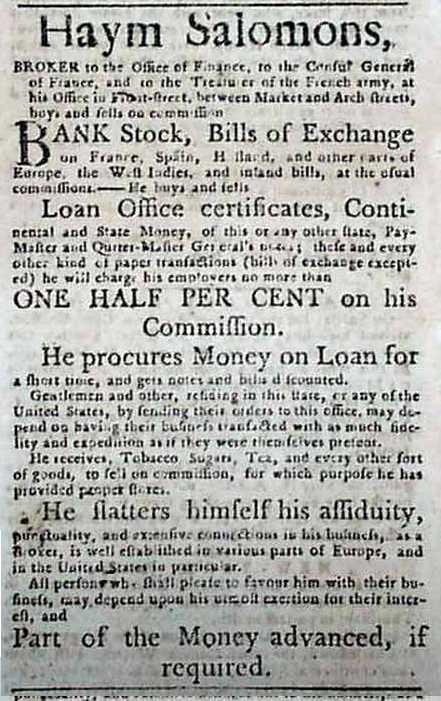
Shameful to say, that, notwithstanding all claims, neither Haym
Solomon, who died in January, 1785, nor his heirs, have to this day, been
reimbursed by a Government that ought long since to have acknowledged its debt
to him who proved one of its main supports in the trying days of the
Revolution. A long array of recipients of Mr. Solomon's bounty might here be
presented. James Madison, afterwards the fourth president of the United
States, writes to Edmund Randolph: "I have for some time past been a pensioner
on the favor of Haym Solomon.'' And again: ''The kindness of our little friend
in Front Street, near the coffee house (Haym Solomon) is a fund that will
preserve me from extremities; but I never resort to it without great
mortification, as he obstinately rejects all recompense. To a necessitous
delegate he gratuitously spares a supply 'out of his private stock. " to
Thomas Jefferson, Arthur Lee, General St . Clair, General Mifflin, Edmund
Randolph, Robert Morris, and others, at home and abroad, were assisted by the
same generous hand. In fact, Haym Solomon's record was such in which he and
his co-religionists as well, have cause for just pride.
| |
|
| |
Haym
Salomon (ca. 1740 - 1785) |
|
 |
by Bob Blythe
 Salomon
(sometimes written as Solomon and Solomons in period documents) was a
Polish-born Jewish immigrant to America who played an important role in
financing the Revolution. When the war began, Salomon was operating as a
financial broker in New York City. He seems to have been drawn early to
the Patriot side and was arrested by the British as a spy in 1776. He was
pardoned and used by the British as an interpreter with their German
troops. Salomon, however, continued to help prisoners of the British
escape and encouraged German soldiers to desert. Arrested again in 1778,
he was sentenced to death, but managed to escape to the rebel capital of
Philadelphia, where he resumed his career as a broker and dealer in
securities. He soon became broker to the French consul and paymaster to
French troops in America. Salomon
(sometimes written as Solomon and Solomons in period documents) was a
Polish-born Jewish immigrant to America who played an important role in
financing the Revolution. When the war began, Salomon was operating as a
financial broker in New York City. He seems to have been drawn early to
the Patriot side and was arrested by the British as a spy in 1776. He was
pardoned and used by the British as an interpreter with their German
troops. Salomon, however, continued to help prisoners of the British
escape and encouraged German soldiers to desert. Arrested again in 1778,
he was sentenced to death, but managed to escape to the rebel capital of
Philadelphia, where he resumed his career as a broker and dealer in
securities. He soon became broker to the French consul and paymaster to
French troops in America.
Salomon arrived in Philadelphia as the Continental Congress
was struggling to raise money to support the war. Congress had no powers
of direct taxation and had to rely on requests for money directed to the
states, which were mostly refused. The government had no choice but to
borrow money and was ultimately bailed out only by loans from the French
and Dutch governments. Government finances were in a chaotic state in 1781
when Congress appointed former Congressman Robert Morris superintendent of
finances. Morris established the Bank of North America and proceeded to
finance the Yorktown campaign of Washington and Rochambeau. Morris relied
on public-spirited financiers like Salomon to subscribe to the bank, find
purchasers for government bills of exchange, and lend their own money to
the government.
From 1781 on, Salomon brokered bills of exchange for the
American government and extended interest-free personal loans to members
of Congress, including James Madison. Salomon married Rachel Franks in
1777 and had four children with her. He was an influential member of
Philadelphia’s Mikveh Israel congregation, founded in 1740. He helped lead
the fight to overturn restrictive Pennsylvania laws barring non-Christians
from holding public office. Like many elite citizens of Philadelphia, he
owned at least one slave, a man named Joe, who ran away in 1780. Possibly
as a result of his purchases of government debt, Salomon died penniless in
1785. His descendants in the nineteenth century attempted to obtain
compensation from Congress, but were unsuccessful. The extent of Salomon’s
claim on the government cannot be determined, because the documentation
disappeared long ago.
In 1941, the George Washington-Robert Morris-Haym Salomon
Memorial was erected along Wacker Drive in downtown Chicago. The bronze
and stone memorial was conceived by sculptor Lorado Taft and finished by
his student, Leonard Crunelle. Although Salomon’s role in financing the
Revolution has at times been exaggerated, his willingness to take
financial risks for the Patriot cause helped establish the new nation.
To learn more:
Laurens R. Schwartz, Jews and the American Revolution: Haym
Salomon and Others (Jefferson, N.C.: McFarland & Co., 1987). |
Haym Solomon (or Salomon)
(1740–1785) was a Polish Jew who immigrated to New York during the period of the
American Revolution, and who became a prime financier of the American side
during the American Revolutionary War against Great Britain. He was born in
Leszno (Lissa), Poland, the son of a rabbi, and after leaving Poland, probably
in 1772 at the time of Polish partition,[1] immigrated to New York City circa
1775. In New York, he sympathized with the Revolutionary movement, and joined
the Sons of Liberty.
During the war, Solomon was twice arrested by the British; in 1776 he was
arrested as a spy and served as a German interpreter for the British
military's Hessian mercenaries. In 1778 Solomon was sentenced to death, but
escaped to Philadelphia,[2] where he acted as a broker for the Office of
Finance. Solomon worked extensively with Robert Morris, the Superintendent for
Finance for the Thirteen Colonies, and is mentioned nearly seventy-five times
in Morris' personal correspondence relating to the financing of the
Revolution.[3] Solomon also provided financial services to Continental
Congressional delegates James Madison and James Wilson,[4] and during the War
became the broker to the French consul, the treasurer of the French Army that
aided the Continental Army, and the fiscal agent of the French minister to the
United States.[5]
He was also active in Philadelphia's Jewish community and was a member of
Congregation Mikveh Israel. He died in Philadelphia, Pennsylvania at the age
of 45.
Early war
years
While in New York, he married Rachael Franks, the daughter of Moses Franks,
of a prominent colonial period Jewish family that included loyalist and
revolutionary sympathizers.[6] In 1776 he was captured by the British, but he
used his knowledge of German to convince his Hessian jailer to let him out. It
was during this period of incarceration that he contracted tuberculosis.
After this Solomon left New York, joining with the forces of the Continental
Army who were evacuating New York. He traveled south with George Washington's
Army and eventually settled in Philadelphia.
Commercial
accomplishments
Solomon was an astute merchant and auctioneer who succeeded in accumulating
a fortune, which he subsequently devoted to the use of the American government
during the American Revolution. For example, he personally supported various
members of the Continental Congress during their stay in Philadelphia,
including James Madison. Acting as the patriot
he was, he never asked for repayment. Solomon also negotiated the sale of a
majority of the war aid from France and Holland, selling bills of exchange to
American merchants.
He sold bills of exchange for the French, and those funds went to pay the
French military during their stay in Philadelphia. That is why some mistakenly
believe he was the paymaster-general of the French forces in the early years
of the United States.
Often working out of the "London Coffee House" in Philadelphia, he acted as a
broker for the Office of Finance. Solomon sold about $600,000 in Bills of
Exchange to his clients, netting about 2.5% per sale. During this period he
had to turn to his client in the Office of Finance, Robert Morris, when one
sale of over $50,000 nearly sent him to prison. Morris used his position and
influence to sue the defrauder and saved Solomon from default and disaster.
Activity
in Jewish community
Solomon was involved in Jewish community affairs, being a member of
Congregation Mikveh Israel in Philadelphia, and in 1782, made the largest
individual contribution towards the construction of its main building. In
1783, Solomon and other prominent Jews appealed to the Pennsylvania Council of
Censors urging them to remove the religious test oath required for
office-holding under the State Constitution. In 1784, he answered anti-Semitic
slander in the press by stating: "I am a Jew; it is my own nation; I do not
despair that we shall obtain every other privilege that we aspire to enjoy
along with our fellow-citizens."
Death and
debts

Marker at Mikveh Israel Cemetery in Philadelphia.
After a solid career in Philadelphia, he saw opportunity in a different
state. Former client Robert
Morris tried to help him establish himself in New York. He died shortly
after he had decided to move back to city and become an auctioneer there.
His obituary in the Independent Gazetteer read, "Thursday, last,
expired, after a lingering illness, Mr. Haym Solomon, an eminent broker of
this city, was a native of Poland, and of the Hebrew nation. He was remarkable
for his skill and integrity in his profession, and for his generous and humane
deportment. His remains were yesterday deposited in the burial ground of the
synagogue of this city."
The gravesite of Haym Solomon is at Mikveh Israel Cemetery, located on the
800-block of Spruce Street, in Philadelphia. It is unmarked, but he has two
plaque memorials there. The east wall has a marble tablet that was installed
by his great-grandson, William Solomon, and a granite memorial is set inside
the gate of the cemetery. In 1980, the Haym Salomon Lodge #663 of the
fraternal organization B'rith Sholom sponsored a memorial in Mikvah Israel
Cemetery on the north side of Spruce st. between 8th and 9th Sts. in
Philadelphia. A large, engraved memorial marker of Barre Granite just inside
the cemetery gates was placed, inscribed, "An American Patriot".
When Solomon died, it was discovered he had been speculating in various
currencies and debt instruments. His family sold them at market rates, which
had greatly depreciated because of the weakened state of the American economy
in the 1780s. Subsequent generations misunderstood his truly patriotic actions
and appealed to Congress for more money, but were turned down twice. A myth
grew up that he had lent the young United States government about $600,000,
and at his death about $400,000 of this amount had not been repaid. This sum
was added to what he really had lent to statesmen and others while performing
public duties and trusts. Jacob Rader Marcus wrote in Early American
Jewry that the sum owed to Solomon was $800,000. That amount in 1785 is
equivalent in purchasing power to about $39,264,947,368.42 (using relative
share of GDP which indicates purchasing power) in 2005 US dollars.[8]
Myths and
historical legends

Commemorative marker at Mikveh Israel Cemetery
It is said that during the American Revolution, Solomon went to France and
raised an additional £3.5 million from the Sassoon and Rothschild banking
houses and families. However, David Sassoon had not been born yet, and would
later start up his counting house in Bombay, India, not France. Likewise, the
Rothschild family had not set up a bank in France yet either. At the time of
the Revolutionary war, the Rothschild's patriarch, Mayer Amschel Rothschild,
founder of the banking dynasty, was still in Hesse-Kassel (Hesse-Cassel),
loyally serving its prince, Wilhelm IX, who aided the British against the
Americans by supplying England with his Hessian mercenaries.
Solomon spoke eight languages. Supposedly, when he was in France, he passed
himself off as a French diplomat. Unfortunately, it does not conform to the
known facts. It is true his co-religionist, David Franks, did help Adams
negotiate loans from Holland. However, there is nothing in the record to show
that Solomon himself went to Europe for this purpose.
Solomon is sometimes alleged to have written the first draft of the United
States Constitution but the Philadelphia Convention occurred after his
death. Others have claimed that he designed The Great Seal of the United
States and that he included the Star of David, a Jewish symbol, above the
eagle's head. There is no documentary evidence to support this claim.
It is often said that Solomon lent hundreds of thousands of dollars to the
Revolutionary government, which never repaid him. In fact, the money merely
passed through his bank accounts.[9]
Honors,
testimonials and memorials

1975 United States postage stamp featuring Haym Salomon.
In 1893, a bill was presented before the 52nd United States Congress
ordering a gold medal be struck in recognition of Solomon's contributions to
the United States. In 1941, the writer Howard Fast wrote a book Haym Salomon,
Son of Liberty. In 1941, the George Washington-Robert Morris-Haym Solomon
Memorial was erected along Wacker Drive in downtown Chicago. In 1975 the
United States Postal Service issued a commemorative stamp honoring Haym
Saloman for his contributions to the cause of the American Revolution. This
stamp, like others in the "Contributors to the Cause" series, was printed on
the front and the back. On the glue side of the stamp, the following words
were printed in pale, green ink:
- "Financial Hero—Businessman and broker Haym Solomon was responsible for
raising most of the money needed to finance the American Revolution and
later to save the new nation from collapse."
The Congressional Record of March 25, 1975 reads, "When Morris was
appointed Superintendent of Finance, he turned to Solomon for help in raising
the money needed to carry on the war and later to save the emerging nation
from financial collapse. Solomon advanced direct loans to the government and
also gave generously of his own resources to pay the salaries of government
officials and army officers. With frequent entries of 'I sent for Haym
Solomon,' Morris' diary for the years 1781–84 records some 75 transactions
between the two men."
I
n 1939, Warner Brothers released Sons of Liberty, a short film starring
Claude Rains as Solomon. Hollywood film producer John C. W. Shoop, under
direction of MorningStar Pictures, is currently in production of a story of
the life and times of Haym Salomon called On The Money.
In World War II the United States liberty ship SS Haym Solomon was named in
his honor.
Footnotes
- ^ Milgram,
Shirley. ""Mikveh
Israel Cemetery."". USHistory.org. Retrieved on 2008-06-26.
- ^ "[ttp://www.nps.gov/revwar/about_the_revolution/haym_salomom.html
Haym Solomon]". National Park Service, US Department of the Interior.
Retrieved on 2008-06-26.
- ^ Wiernik,
Peter. History of the Jews in America. New York: The Jewish Press
Publishing Company, 1912. p. 96.
- ^ Wiernik,
Peter. History of the Jews in America. New York: The Jewish Press
Publishing Company, 1912. p. 95.
- ^ Wiernik,
Peter. History of the Jews in America. New York: The Jewish Press
Publishing Company, 1912. p. 95.
- ^ Peters, p.
12
- ^ On June 17,
1980 the Philadelphia public was advised of the fact in the Philadelphia
Morning Inquirer, complete with a background story and photograph of the
event.
- ^
[Used 1790 - 2005 as the calculator only goes to 1790...]
- ^
Can History be Open Source? Wikipedia and the Future of the Past, by
Roy Ronsezweig, in The Journal of American History Volume 93,
Number 1 (June, 2006): 117-46. The sentence is between note 30 and 31
References
- Amler, Jane Frances. Haym Solomon: Patriot Banker of the American
Revolution.
ISBN 0-8239-6629-1
- Hart, Charles Spencer. General Washington's Son of Israel and Other
Forgotten Heroes of History.
ISBN 0-8369-1296-9.
- Peters, Madison C. Haym Solomon. The Financier of the Revolution.
New York: The Trow Press, 1911.
- Russell, Charles Edward. Haym Solomon and the Revolution.
ISBN 0-7812-5827-8.
- Schwartz, Laurens R. Jews and the American Revolution: Haym Solomon
and Others (Jefferson, N.C.: McFarland & Co., 1987).
- Wiernik, Peter. History of the Jews in America. New York: The Jewish
Press Publishing Company, 1912.







