Francis Scott Key: Francis Scott Key. ... View the Star Spangled Banner
Manuscript signed, Francis Scott Key Stan Klos Biography
Francis Scott Key
Author of "The Star-Spangled Banner"
KEY, Francis Scott, author,
born in Frederick county, Md., 1 Aug., 1780 died in Baltimore, Md., 11 Jan.,
1843, was the son of John Ross Key, a Revolutionary officer. He was educated
at St. John's college, studied law in the office of his uncle, Philip Barton
Key, and began to practice law in Frederick City, Md., but subsequently
removed to Washington, where he was district attorney for the District of
Columbia.
When the British invaded
Washington in 1814, Ross and Cockburn with their staff officers made their
headquarters in Upper Marlboro, Md., at the residence of a planter, Dr.
William Beanes, whom they subsequently seized as a prisoner. Upon hearing of
his friend's capture, Key resolved to release him, and was aided by
President Madison,
who ordered that a vessel that had been used as a cartel should be placed at
his service, and that John S. Skinner, agent for the exchange of prisoners,
should accompany him. Gen. Ross finally consented to Dr. Beanes's release, but
said that the party must be detained during the attack on Baltimore.
Key and Skinner were
transferred to the frigate "Surprise," commanded by the admiral's son,
Sir Thomas Cockburn, and soon afterward returned under guard of British
sailors to their own vessel, whence they witnessed the engagement. Owing to
their position the flag at
Fort McHenry was
distinctly seen through the night by the glare of the battle, but before dawn
the firing ceased, and the prisoners anxiously watched to see which colors
floated on the ramparts. Key's feelings when he found that the stars and
stripes had not been hauled down found expression in "The Star-Spangled
Banner," which gained for him a lasting reputation.
On arriving in Baltimore
he finished the lines which he had hastily written on the back of a letter,
and gave them to Capt. Benjamin Eades, of the 27th Baltimore regiment, who had
participated in the battle of North Point. Seizing a copy from the press,
Eades hastened to the old tavern next to the Holliday Street Theatre, where
the actors were accustomed to assemble. Mr. Key had directed Eades to print
above the poem the direction that it was to be sung to the air "Anacreon in
Heaven." The verses were first read aloud by the printer, and then, on
being appealed to by the crowd, Ferdinand
Durang mounted a chair and sang them for the first time. In a short period
they were familiar throughout the United States.
A collection of
Key's poems was published with an introductory letter by Roger B. Taney (New
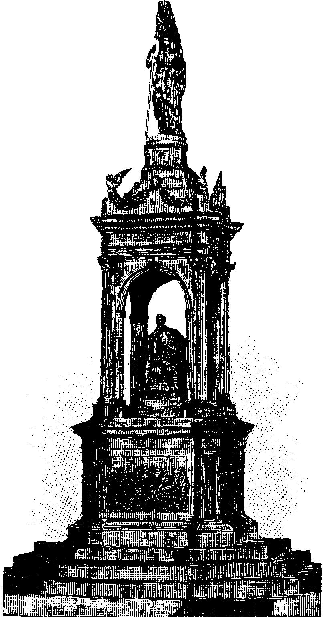
York, 1857). James Lick bequeathed the sum of 860,000 for a monument to Key,
to be placed in Golden Gate park, San Francisco, Cal., and it was executed by
William W. Story in Rome in 1885-'7. The height of this monument is fifty-one
feet. It consists of a double arch, under which a bronze figure of Key is
seated. It is surmounted by a bronze statue of America with an unfolded flag.
The material is travertine, a calcareous stone of a reddish yellow hue,
extremely porous, but of great durability.
On Sept. 14, 1814,
Francis Scott Key peered through clearing smoke to see an enormous flag flying
proudly after a 25-hour British bombardment of Baltimore's Fort McHenry. Key was
inspired to write a poem, which was later set to music. Even before "The
Star-Spangled Banner" became our national anthem, it helped transform the
garrison flag with the same name into a major national symbol of patriotism and
identity. The flag has had a colorful history, from its origins in a government
contract through its sojourn with several generations of a Baltimore family to
its eventual donation to the
Smithsonian
Institution.
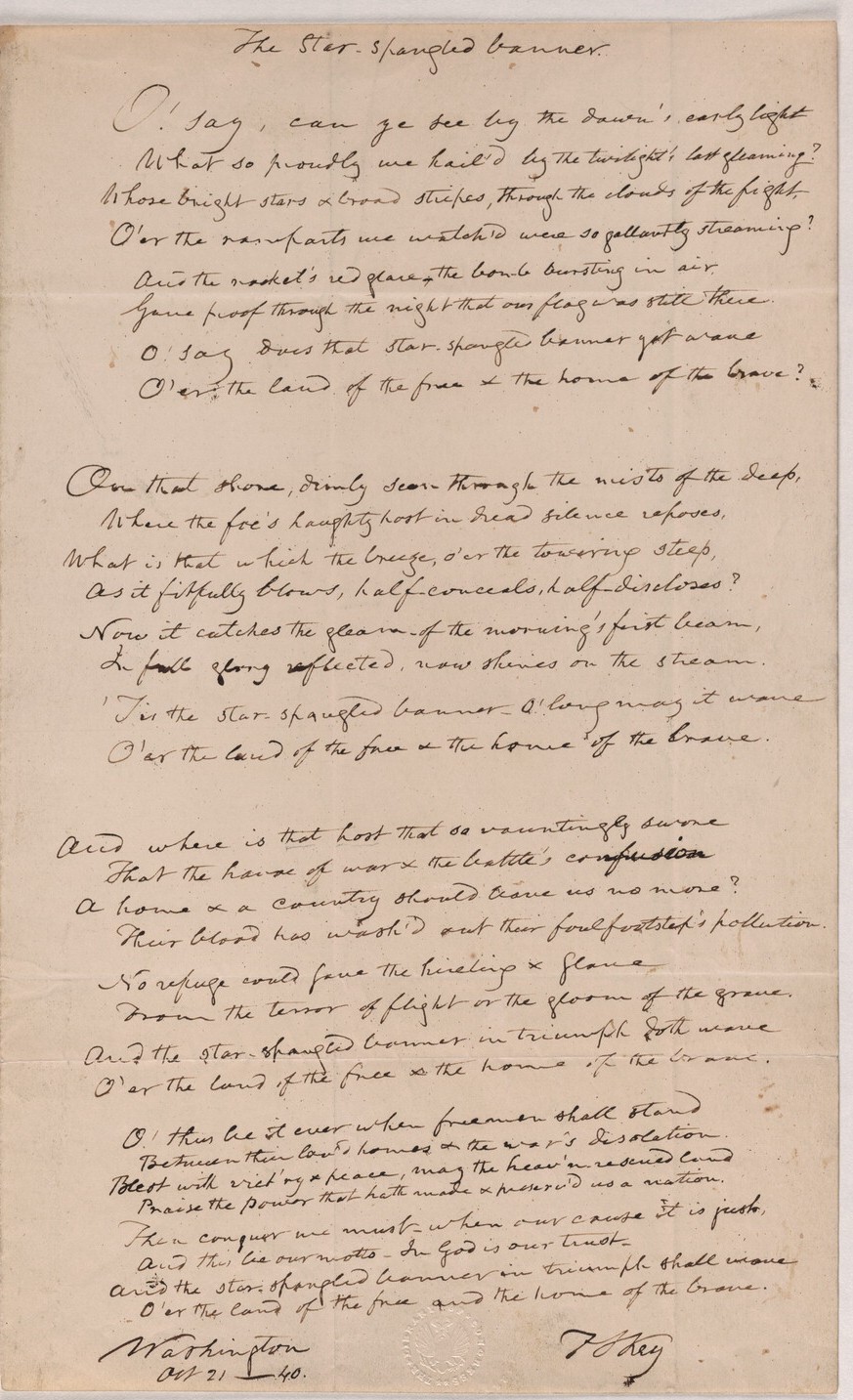
Oh, say can you see by the dawn's early light
What so proudly we hailed at the twilight's last gleaming?
Whose broad stripes and bright stars thru the perilous fight,
O'er the ramparts we watched were so gallantly streaming?
And the rocket's red glare, the bombs bursting in air,
Gave proof through the night that our flag was still there.
Oh, say does that star-spangled banner yet wave
O'er the land of the free and the home of the brave?


On the shore, dimly seen through the mists of the deep,
Where the foe's haughty host in dread silence reposes,
What is that which the breeze, o'er the towering steep,
As it fitfully blows, half conceals, half discloses?
Now it catches the gleam of the morning's first beam,
In full glory reflected now shines in the stream:
'Tis the star-spangled banner!  Oh long may it wave
O'er the land of the free and the home of the brave!


And where is that band who so vauntingly swore
That the havoc of war and the battle's confusion,
A home and a country should leave us no more!
Their blood has washed out their foul footsteps' pollution.
No refuge could save the hireling and slave
From the terror of flight, or the gloom of the grave:
And the star-spangled banner in triumph doth wave
O'er the land of the free and the home of the brave!


Oh! thus be it ever, when freemen shall stand
Between their loved home and the war's desolation!
Blest with victory and peace, may the heav'n rescued land
Praise the Power that hath made and preserved us a nation.
Then conquer we must, when our cause it is just,
And this be our motto:  "In God is our trust."
And the star-spangled banner in triumph shall wave
O'er the land of the free and the home of the brave!
Research Links
Francis Scott Key
Portrait
Reference: Whitecraft, Melissa. Francis Scott Key. 1994, Franklin Watts
Publisher,
New York, p 14. Image: North Wind Picture Archives, Alfred,ME, from the ...
FRANCIS SCOTT KEY & 1779-1843 Forum Frigate
FRANCIS SCOTT KEY Forum Frigate CLASSICAL POET'S POETRY FLEET If ye would like
to
moderate the FRANCIS SCOTT KEY Forum Frigate, please drop becket@jollyroger ...
Francis Scott Key
... FRANCIS SCOTT KEY. 1780-1843. Francis Scott Key was a respected young lawyer
living
in Georgetown just west of where the modern day Key Bridge crosses the ...
Francis Scott Key
... See The flag that Francis Scott Key saw now at the Smithsonian Francis Scott
Key
the story of the flag and the battle Fort McHenry national monument The Star ...
Francis Scott Key
Bridge
Francis Scott Key Bridge. Fourteen years in the making,
the final link in the Baltimore beltway ...
Francis Scott Key
... Francis Scott Key. 1779-1843. American poet, author of the STAR-SPANGLED
BANNER. Start your search on Francis Scott Key. ...
Francis Scott Key
Francis Scott Key (1779-1843) was a well known Washington lawyer and amateur
verse
writer. He became famous for writing the words of "The Star-Spangled Banner ...
Encyclopedia.com
- Results for Key, Francis Scott
Click here to visit our sponsor. ... Listing from Electric Library, a pay
service.
Francis Scott Key ; Archive Photos ; 01-01-1996; Size: 22K. ...
Description: (Encyclopedia.com)