Andrew Jackson (March 15, 1767 – June 8, 1845) was the seventh President
of the United States (1829–1837). He was military governor of Florida (1821),
commander of the American forces at the Battle of New Orleans (1815), and eponym
of the era of Jacksonian democracy. He was a polarizing figure who dominated
American politics in the 1820s and 1830s. His political ambition combined with
widening political participation, shaping the modern Democratic Party.[1]
Renowned for his toughness, he was nicknamed “Old Hickory.” As he based his
career in developing Tennessee, Jackson was the first president primarily
associated with the frontier..
Andrew Jackson
Continued
Click Here to go to
opening page The struggle over the
tariff was especially important as bringing out a clear expression of the
doctrine of nullification on the part of South Carolina. Practically, however,
nullification was first attempted by Georgia in the case of the disputes with
the Cherokee Indians. Under treaties with the Federal government these Indians
occupied lands that were coveted by the white people. Adams had made himself
very unpopular in Georgia by resolutely defending the treaty rights of these
Indians. Immediately upon Jackson's election, the state government assumed
jurisdiction over their lands, and proceeded to legislate for them, passing laws
that discriminated against them. Disputes at once arose, in the course of which
Georgia twice refused to obey the supreme court of the United States. At the
request of the governor of Georgia, Jackson withdrew the Federal troops from the
Cherokee country, and refused to enforce the rights that had been guaranteed to
the Indians by the United feelings toward Indians of a frontier fighter, and he
asked, with telling force, whether an eastern state, such as New York, would
endure the nuisance of an independent Indian state within her own boundaries. In
his sympathy with the people of Georgia on the particular question at issue, he
seemed to be conniving at the dangerous principle of nullification.
These events were carefully noted by the politicians of South Carolina. The
protectionist policy, which since the peace of 1815 had been growing in favor at
the north, had culminated in 1828 in the so-called "tariff of
abominations." This tariff, the result of a wild helter-skelter
scramble of rival interests, deserved its name on many accounts. It
discriminated, with especial unfairness, against the southern people, who were
very naturally and properly enraged by it. A new tariff, passed in 1832,
modified some of the most objectionable features of the old one, but still
failed of justice to the southerners. Jackson was opposed to the principle of
protective tariffs, and from his course with Georgia it might be argued that he
would not interfere with extreme measures on the part of the south. During the
whole of Jackson's first term there was more or less vague talk about
nullification. The subject had a way of obtruding itself upon all sorts of
discussions, as in the famous debates on Feet's resolutions, which lasted over
five months in 1830, and called forth Webster's immortal speech in reply to
Hayne. A few weeks after this speech, at a public dinner in commemoration of
Jefferson's birthday, after sundry regular toasts had seemed to indicate a drift
of sentiment in approval of nullification, Jackson suddenly arose with a
volunteer toast, "Our Federal Union: it must be preserved." Calhoun
was prompt to reply with a toast and a speech in behalf of "Liberty,
dearer than the Union," but the nullifiers were greatly disappointed
and chagrined. In spite of this warning, South Carolina held a convention, 19
November, 1832, and declared the tariffs of 1828 and 1832 to be null and void in
South Carolina; all state officers and jurors were required to take an oath of
obedience to this edict; appeals to the Federal supreme court were prohibited
under penalties; and the Federal government was warned that an attempt on its
part to enforce the revenue laws would immediately provoke South Carolina to
secede from the Union.
The ordinance of nullification was to take effect on 1 February, 1833, and
preparations for war were begun at once. On 16 December the president issued a
proclamation, in which he declared that he should enforce the laws in spite of
any and all resistance that might be made, and he showed that he was in earnest
by forthwith sending Lieutenant Farragut with a naval force to Charleston
harbor, and ordering General Scott to have troops ready to enter South Carolina
if necessary. In the proclamation, which was written by Livingston, the
president thus defined his position: "I consider the power to annul a
law of the United States, assumed by one state, incompatible with the existence
of the Union, contradicted expressly by the letter of the constitution,
unauthorized by its spirit, inconsistent with every principle on which it was
founded, and destructive of the great object for which it was formed."
Governor Hayne, of South Carolina, issued a counter-proclamation, and a few
days afterward Calhoun resigned the vice presidency, and was chosen to succeed
Hayne in the senate. Jackson's determined attitude was approved by public
opinion throughout the country. By the southern people generally the action of
South Carolina was regarded as precipitate and unconstitutional. Even in that
state a Union convention met at Columbia, and announced its intention of
supporting the president. In January, Calhoun declared in the senate that his
state was not hostile to the Union, and had not meditated an armed resistance; a
"peaceable secession," to be accomplished by threats, was
probably the ultimatum really contemplated. In spite of Jackson's warning, the
nullifiers were surprised by his unflinching attitude, and quite naturally
regarded it as inconsistent with his treatment of Georgia. When the 1st of
February came, the nullifiers deferred action. In the course of that month a
bill for enforcing the tariff passed both houses of congress, and at the same
time Clay's compromise tariff was adopted, providing for the gradual reduction
of the duties. until 1842, after which all duties were to be kept at 20 per
cent. This compromise enabled the nullifiers to claim a victory, and retreat
from their position with colors flying.
During the nullification controversy Jackson kept up the attacks upon the
United States bank which he had begun in his first annual message to congress in
1829. The charter of the bank would expire in 1836, and Jackson was opposed to
its renewal. The grounds of his opposition were partly sound, partly fanciful.
There was a wholesome opposition to paper currency, combined with great
ignorance of the natural principles of money and trade, as illustrated in a
willingness to tolerate the notes of local banks, according to the chaotic
system prevalent between Jackson's time and Lincoln's. There was something of
the demagogue's appeal to the prejudice that ignorant people are apt to cherish
against capitalists and corporations, though Jackson cannot be accused of
demagogy in this regard, because he shared the prejudice. Then there was good
reason for believing that the bank was in some respects mismanaged, and for
fearing that a great financial institution, so intimately related to the
government, might be made an engine of political corruption. Furthermore, the
correspondence between Sec. Ingham and Nicholas Biddle, president of the bank,
in the summer of 1829, shows that some of Jackson's friends wished to use the
bank for political purposes, and were enraged at Biddle's determination in
pursuing an independent course.
The occasion was duly improved by the "kitchen cabinet" to
fill Jackson's ears with stories tending to show that the influence of the bank
was secretly exerted in favor of the opposite party. Jackson's suggestions with
reference to the bank in his first message met with little favor, especially as
he coupled them with suggestions for the distribution of the surplus revenue
among the states. He returned to the attack in his two following messages, until
in 1832 the bank felt obliged in self-defense to apply, somewhat prematurely,
for a renewal of its charter on the expiration of its term. Charges brought
against the bank by Democratic representatives were investigated by a committee,
which returned a majority report in favor of the bank. A minority report
sustained the charges. After prolonged discussion, the bill to renew the charter
passed both houses, and on 10 July, 1832, was vetoed by the president. An
attempt to pass the bill over the veto failed of the requisite two-third
majority.
Circumstances had already given a flavor of personal contest to Jackson's
assaults upon the bank. There was no man whom he hated so fiercely as Clay, who
was at the same time his chief political rival. Clay made the mistake of forcing
the bank question into the foreground, in the belief that it was an issue upon
which he was likely to win in the coming presidential campaign. Clay's movement
was an invitation to the people to defeat Jackson in order to save the bank and
this naturally aroused all the combativeness in Jackson's nature. His determined
stand impressed upon the popular imagination the picture of a dauntless "tribune
of the people" fighting against the "monster monopoly." Clay unwisely attacked the veto power of the president, and thus gave Benton an opportunity to defend it by analogies drawn from the veto power of the ancient Roman tribune, which in point of fact it does not at all resemble. The discussion helped Jackson more than Clay. It was also a mistake on the part of the Whig leader to risk the permanence of such an institution as the U. S. bank upon the fortunes of a presidential canvass. It dragged the bank into politics in spite of itself, and, by thus affording justification for the fears to which Jackson had appealed, played directly into his hands. In this canvass all the candidates were for the first time nominated in national conventions.
There were three conventions--all held at Baltimore. In September, 1831, the Anti-Masons nominated William Wirt, of Virginia, in the hope of getting the national Republicans or Whigs to unite with
them but the latter, in December, nominated Clay. In the following March the Democrats nominated Jackson, with Van Buren for vice-president. During the year 1832 the action of congress and president with regard to the bank charter was virtually a part of the campaign. In the election South Carolina voted for candidates of her
own --John Floyd, of Virginia, and Henry Lee, of Massachusetts. There were 219 electoral votes for Jackson,
49 for Clay, 11 for Floyd, and 7 for Wirt. Jackson interpreted this overwhelming victory as a popular condemnation of the bank and approval of all his actions as president. The enthusiastic applause from all quarters which now greeted his rebuke of the nullifiers served still further to strengthen his belief in himself as a
"savior of society" and champion of "the people."
Men were getting into a state of mind in which questions of public policy were no longer argued upon their merits, but all discussion was drowned in cheers for Jackson. Such a state of things was not calculated to check his natural vehemence and disposition to override all obstacles in carrying his point. He now felt it to be his sacred duty to demolish the bank. In his next message to congress he created some alarm by expressing doubts as to the bank's solvency and recommending an investigation to see if the deposits of public money were safe. In some parts of the country there were indications of a run upon the branches of the bank. The committee of ways and means investigated the matter, and reported the bank as safe and sound, but a
minority report threw doubt upon these conclusions, so that the public uneasiness was not allayed. The conclusions of the members of the
committee, indeed, bore little reference to the evidence before them, and were determined purely by political partisanship.
Jackson made up his mind that the deposits must be removed from the bank. The act of 1816, which created that institution, provided that the public funds might be removed from it by order of the secretary of the treasury, who must, however, inform congress of his reasons for the removal. As congress resolved, by heavy majorities, that the deposits were safe in the bank, the spring of 1833 was hardly a time when a secretary of the treasury would feel himself warranted, in accordance with the provisions of the act, to order their removal. Sec.
McLane was accordingly unwilling to issue such an order. In what followed, Jackson had the zealous co-operation of Kendall and Blair. In May, McLane was transferred to the state department, and was succeeded in the treasury by William J. Duane, of Pennsylvania. The new secretary, however, was convinced that the removal was neither necessary nor wise, and, in spite of the president's utmost efforts, refused either to issue the order or to resign his office.
In September, accordingly, Duane was removed and Roger B. Taney was appointed in his place. Taney at
once ordered that after the 1st of October the public revenues should no longer be deposited with the national bank, but with sundry state banks, which soon came to be known as the
"pet banks." Jackson alleged, as one chief reason for this proceeding, that if the bank were to continue to receive
public revenues on deposit, it would unscrupulously use them in buying up all the members of congress and thus securing an indefinite renewal of its charter. This, he thought, would be a death-blow to free government in America. His action caused intense excitement and some commercial distress, and prepared the way for further disturbance. In the next session of the senate Clay introduced a resolution of censure, which was carried after a debate which lasted all winter. It contained a declaration that the president had assumed
" authority and power not conferred by the constitution and laws, but in derogation of both."
Jackson protested against the resolution, but the senate refused to receive his protest. Many of his appointments were rejected by the senate, especially those of the directors of the bank, and of Taney as secretary of
the treasury. An attempt was made to curtail the president's appointing power. On the other hand, many of the president's friends declaimed against the senate as an aristocratic institution, which ought to be abolished. Benton was Jackson's most powerful and steadfast ally in the senate. Benton was determined that the resolution of censure should be expunged from the records of the senate, and his motion continued to be the subject of acrimonious debate for two years. The contest was carried into the state elections, and some senators resigned in consequence of instructions received from their state legislatures. At length, on 16 Jan.,
1837 a few weeks before Jackson's retirement from office, Benton's persistency triumphed, and
the resolution of censure was expunged. Meanwhile the consequences of the violent method with which the finances had been handled were rapidly developing. Many state banks, including not a few of the
"wildcat" species, had been formed, to supply the paper currency that was supposed to be needed. The abundance of paper, together with the rapid westward movement of population, caused reckless speculation and an inflation of values. Extensive purchases of public lands were paid for in paper until tile treasury scented danger, and by the president's order, in July, 1836, the
"specie circular" was issued, directing that only gold or silver should be received for public lands. This caused a demand for coin, which none but the
" pet banks" could hope to succeed in meeting. But these banks were at the same time crippled by orders to surrender, on the following New-Year's day, one fourth of the surplus revenues deposited with them, as it was to be distributed as a loan among the states.
The "pet banks" had regarded the deposits as capital to be used in loans, and they were now suddenly obliged to call in these loans. These events led to
the great panic of 1837, which not only scattered thousands of private fortunes to the winds, but wrecked Van Buren's administration and prepared the way for the Whig victory of 1840.
In foreign affairs Jackson's administration won great credit through its enforcement of the French
spoliation claims. European nations which had claims for damages against France on account of spoliations committed by French cruisers during the Napoleonic wars had found no difficulty after the peace of 1815 in
obtaining payment; but the claims of the United States had been superciliously neglected. In 1831, after much fruitless negotiation, a treaty was made by which France agreed to pay the United States $5,000,000 in six annual
installments. The first payment was due on 2 Feb., 1833. A draft for the amount was presented to the French minister of finance, and payment was refused on the ground that no appropriation for that purpose had been made by the chambers. Louis Philippe brought the matter before the chambers, but no appropriation was made. Jackson was not tile man to be trifled with in this way. In his message of
December, 1834, he gravely recommended to congress that a law be passed authorizing the capture of French vessels enough to make up the amount due. The French government was enraged, and threatened war unless the president should apologize: not a hopeful sort of demand to make of Andrew Jackson. Here Great Britain interposed with good advice to France, which led to the payment of the claim without further delay. The effect of Jackson's attitude was not lost upon European governments, while at home the hurrahs for
"Old Hickory" were louder than ever. The days when foreign powers could safely insult us were evidently gone by.
The period of Jackson's presidency was one of the most remarkable in the history of the world, and nowhere more remarkable thin{ in the United States. It was signalized by the introduction and rapid development of railroads, of ocean navigation through Ericsson's invention of the screw-propeller, of agricultural machines, anthracite coal, and friction matches, of the modern type of daily newspaper, of the beginnings of such cities as Chicago, of the steady immigration from Europe, of the rise of the Abolitionists and other reformers, and of the blooming of American literature when to the names of Bryant, Cooper, and Irving were added those of Longfellow, Whittier, Prescott, Holmes. and
Hawthorne. Tile rapid expansion of the country and the extensive chances in ideas and modes of living brought to the surface much crudeness of thought and action. As the typical popular hero of such a period, Andrew Jackson must always remain one of the most picturesque and interesting figures in American history. His ignorance of the principles of statesmanship, the crudeness of his methods, and the evils that have followed from some of his measures, are obvious enough and have often been remarked upon. But in having a president of this type and at such a time we were fortunate in securing a man so sound in most of his impulses, of such absolute probity, truthfulness, and courage, and such unflinching loyalty to the Union. Jackson's death, in the year in which Texas was annexed to tile United States, marks in a certain sense the close of the political era in which he had played so great a part. From tile year 1845 the Calhoun element in the Democratic party became more and more dominant until 1860, while the elements more congenial with Jackson and variously represented by Benton, Blair, and Van Buren, went to form an important part of the force of Republicans and War Democrats that finally silenced the nullifiers and illustrated the maxim that the Union must be preserved.
Click Here for
Larger View
Copyright
© 2001 by Virtualology®.
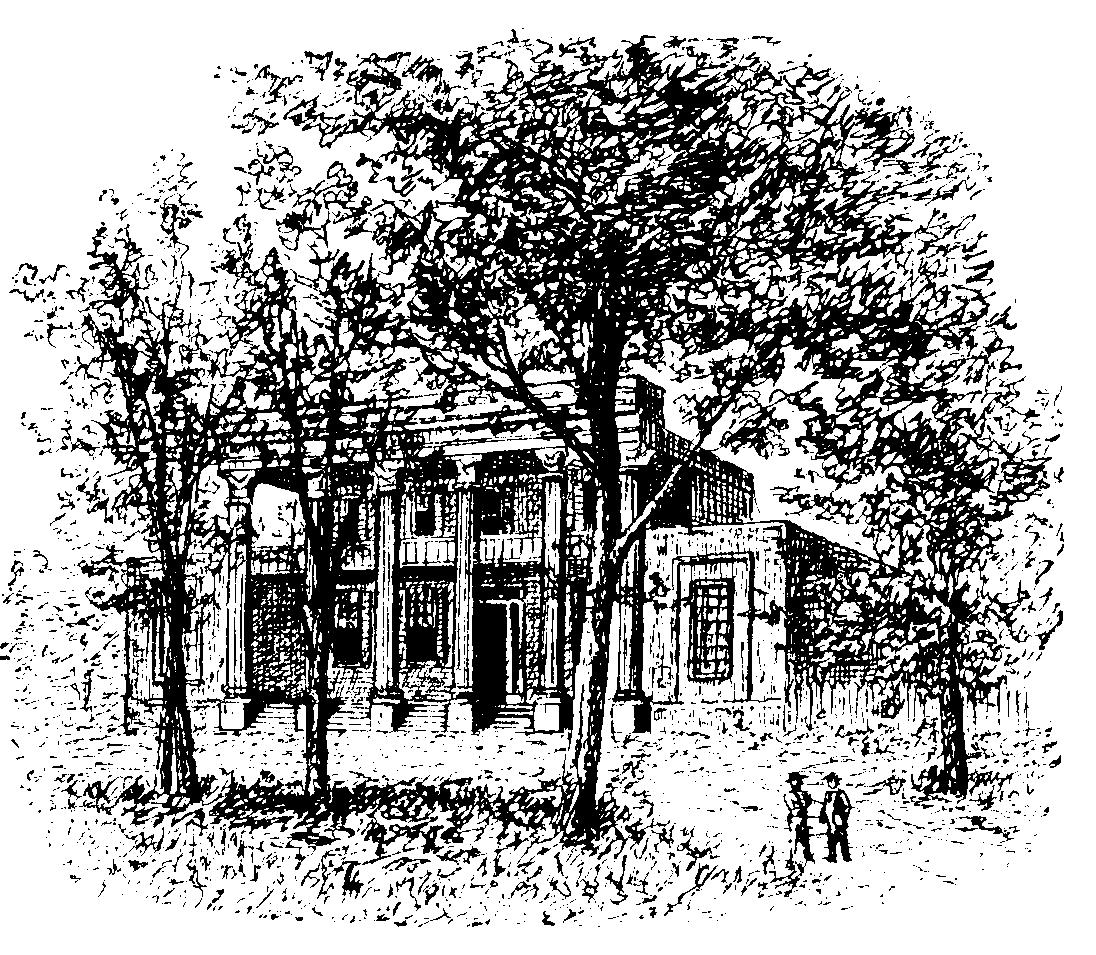
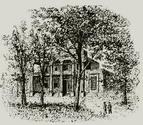
Jackson died at his home, "The Hermitage," near Nashville, a view of which is given
above. The principal biographies of him are by James Parton (3 vols., New York, 1861) and William G. Sumner (Boston, 1882). Other biographies are by John It. Eaton (Philadelphia, 1817); William Cobbett (New York, 1834); Amos Kendall (1843); P. A. Goodwin (Hartford, 1832). For accounts of his administration see, in general, Benton's
"Thirty Years' View," the memoirs of John Q. Adams, tile histories of the United States by Schouler and Von
Holst, and the biographies of Clay, Webster, Adams, Calhoun, Benton, and Edward Livingston. See, also, Mayo's
"Political Sketches of Eight Years in Washington" (Baltimore, 1839). The famous
"Letters of Major Jack Downing" (New York, 1834), a burlesque on Jackson's administration, were wonderfully popular in their day. The accompanying picture, taken from a miniature made much earlier in life than the steel portrait that appears with this article, was
painted by Valle, a French artist, and presented by Jackson to his friend Livingston, with the
following note, written at his headquarters, New Orleans. 1 May, 1815; Mr. E. Livingston is requested
to accept this picture as a mark of the sense entertain of his public services, and as a token of my
private friendship and esteem." The full Length portrait from a painting by Earl, prefixed to
Parton's third volume, is said to be the best representation of Jackson as he appeared upon the
street.
Click Here for
Larger View
Copyright
© 2001 by Virtualology®.
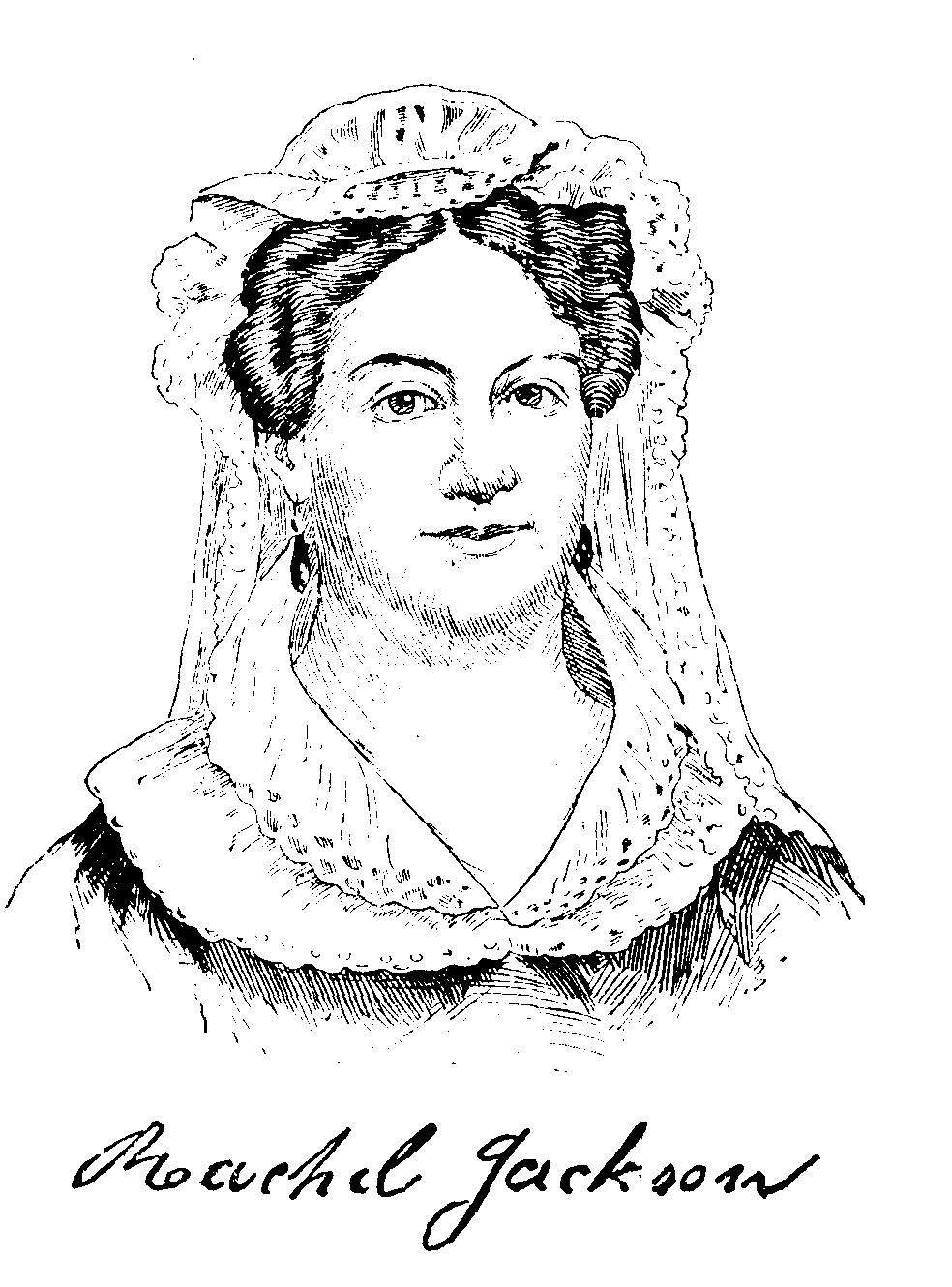
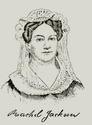
JACKSON, Rachel, born in 1767;
died at the Hermitage, Tenn., 22 Dec., 1828, was the daughter of Col. John
Donelson, a wealthy Virginia surveyor, who owned
extensive iron-works in Pittsylwmia county, Va., but sold t, hem in 1779 and settled in French Salt
Springs, where the city of Nashville now stands. He kept an account of his journey thither, entitled
"Journal of a Voyage, intended by God's Permission, in the Good Boat 'Adventure,' from Fort
Patrick Henry, on Holston River, to the French Salt Springs, on Cumberland River, kept by John
Donelson." Subsequently he removed to Kentucky, where he had several land-claims, and, after
his daughter's marriage to Capt. Lewis Robards, he returned to Tennessee, where he was murdered
by unknown persons in the autumn of 1785.
Mrs. Jackson went to New Orleans after the battle, and was presented by the ladies of that city with a set
of topaz jewelry. In her portrait at the Hermitage, painted by Earle, she wears
the dress in which she appeared at the ball that was leans in honor of her husband, and of which the
accompany illustration is a shown below. She went with General Jackson to Florida in 1821, to Washington
and Charleston in 1824, and to New Orleans in 1828. For many years she had suffered from an affection
of the heart, which was augmented by various reports that were in circulation regarding her previous career, and her death was hastened by overhearing a magnified account of her experiences. She was possessed of a kind and attractive manner, was deeply religious and charitable, and adverse to public life.
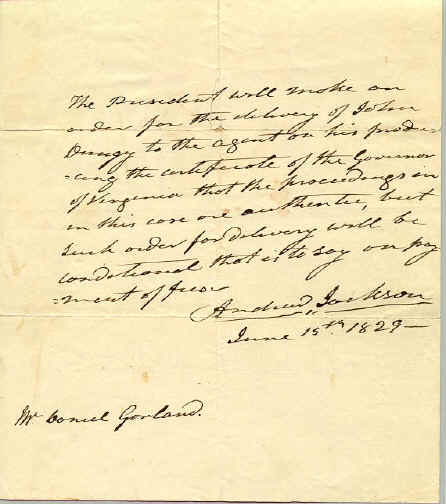
Andrew Jackson as President autograph letter signed, written in the third
person to Daniel Garland, promising an order to release a fugitive from the
Washington County jail; one page on watermarked wove; June 15, 1829.
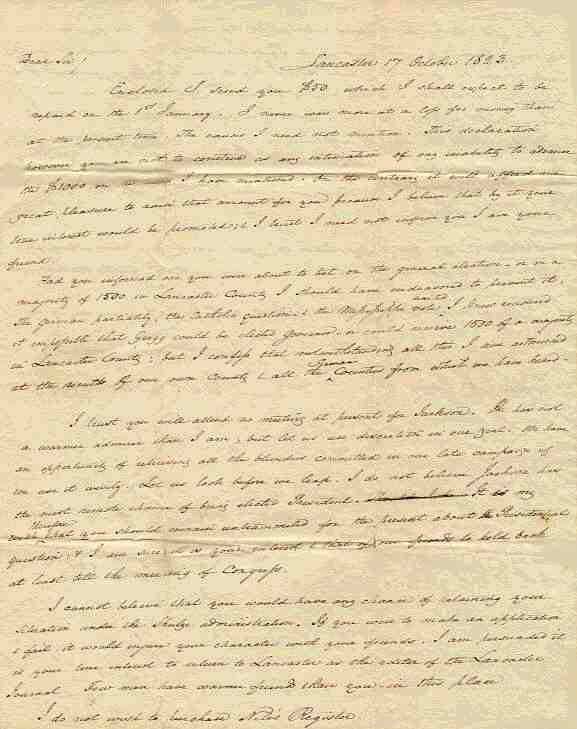
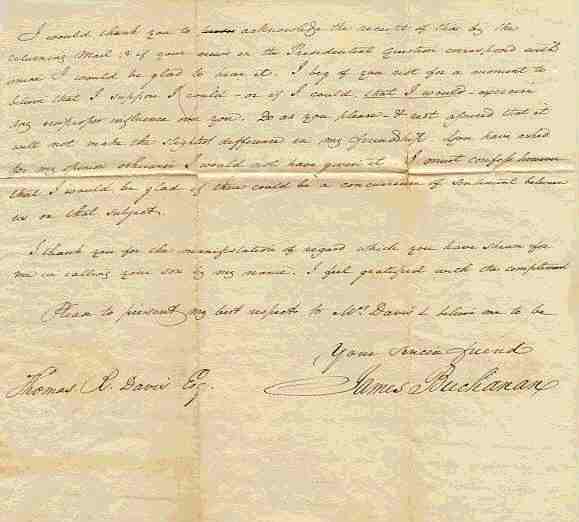
An exceptional rare early James Buchanan autograph letter signed, dated
October 17, 1823 commenting on Presidential candidate Andrew
Jackson: "I do not believe Jackson has the most remote
chance of being elected President." Page
1 and page 2.
Presidential
Libraries
Rutherford
B. Hayes Presidential Center
McKinley
Memorial Library
Herbert
Hoover Presidential Library and Museum - has research collections
containing papers of Herbert Hoover and other 20th century leaders.
Franklin
D. Roosevelt Library and Museum - Repository of the records of President
Franklin Roosevelt and his wife Eleanor Roosevelt, managed by the National
Archives and Records Administration.
Harry
S. Truman Library & Museum
Dwight
D. Eisenhower Presidential Library - preserves and makes available for
research the papers, audiovisual materials, and memorabilia of Dwight and Mamie
D. Eisenhower
John
Fitzgerald Kennedy Library
Lyndon
B. Johnson Library and Museum
Richard
Nixon Library and Birthplace Foundation
Gerald
R. Ford Library and Museum
Jimmy
Carter Library
Ronald Reagan Presidential Library
- 40th President: 1981-1989.
George
Bush Presidential Library
Andrew Jackson (March 15, 1767 – June 8, 1845) was the
seventh
President of the United States (1829–1837). He was
military governor of
Florida
(1821), commander of the American forces at the
Battle of New Orleans (1815), and
eponym of the
era of
Jacksonian democracy. He was a polarizing figure who dominated
American politics in the 1820s and 1830s. His political ambition combined
with widening political participation, shaping the modern
Democratic Party. [1]
Renowned for his toughness, he was nicknamed “Old Hickory.” As he based his
career in developing
Tennessee,
Jackson was the first president primarily associated with the
frontier.
--
From Wikipedia, the free encyclopedia |