series of postage stamps was issued to commemorate the three hundredth
anniversary of the settling of Walloons
Imperforate Stamps
In the early years, from 1840 to the 1850s, all stamps were imperforate,
and had to be cut from the sheet with scissors or knife. This was time-consuming
and error-prone (as mangled stamps of the era attest). Once reliable separation
equipment became available, nations switched rapidly. Imperforate stamps have
been issued occasionally since then, either because separation equipment was
temporarily unavailable (in newborn nations for instance), or to makers of
automatic stamp vending equipment (the United States did this in the 1900s and
1910s), as novelties for stamp collectors (particularly when stamps are issued
in souvenir sheets), or as errors.
In 1848, Henry Archer patented a "stroke process" for the perforation
of stamps, and in 1854 a "rotary process" was patented by William Bemrose and
Henry Howe Bemrose. The common aspect of the two processes was the use of rows
of small round pins ("combs") to punch out the holes. The processes have been
refined since then, but are basically still the ones in use in the 21st century.
The key decision for the perforator is the spacing of the holes; if too far
apart, the stamps will not separate easily, and the stamps will be likely to
tear and be ruined, but if too close, the stamps will tend to come apart in
normal handling, causing its own problems.
In a few cases the size of the holes has been a factor. In the case of
certain stamps produced by Australia for sale in rolls rather than sheets (coil
stamps) a pattern can be seen on the stamp's short side of two small, ten large
and two small holes.
The standard for describing perforation is the number of holes (or the
"teeth" or perfs of an individual stamp) in a 2-centimeter span. The
finest gauge ever used is 18 on stamps of the Malay States in the early 1950s,
and the coarsest is 2, seen on the 1891 stamps of Bhopal. Modern stamp
perforations tend to range from perf 11 to 13 or so.

Zigzag rouletting on an Epirus stamp of 1914
Stamps that are perforated on one pair of opposite sides and imperforate on
the other have most often been produced in coils instead of sheets, but they can
sometimes come from booklet panes. Booklet panes can be associated with any
combination of one, two or three imperforate sides. Sheet edges can produce any
one imperforate side or two adjacent imperforate sides when the stamp comes from
the corner of the sheet.
Variations include syncopated perforations which are uneven, either
skipping a hole or by making some holes larger. In the 1990s, Great Britain
began adding large elliptical holes to the perforations on each side, as an
anti-counterfeiting measure.
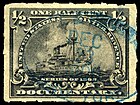
A rouletted revenue stamp, US 1898
Rouletting uses small cuts in the paper instead of holes. It was used
by a number of countries, but is rarely if ever seen on modern stamps. Varieties
include straight cuts, arc, sawtooth, and the serpentine roulettes used by the
early stamps of Finland.
A few types of stamps have combined rouletting and perforation, for instance
South Africa in 1942.