Who was
the First U.S. President? There were actually four first
Presidents
of the United Colonies and States of America Click Here
New Page 1
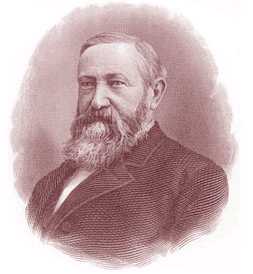
Benjamin Harrison 33rd President of the United States
23rd under the US Constitution
BENJAMIN HARRISON was born in his
grandfather’s home in North Bend, Hamilton County, Ohio on August 20, 1833.
His father, John Scott Harrison was the son of William Henry Harrison, the 9th
President of the United States and the grandson of Benjamin Harrison of
Virginia, who was one of the signers of the Declaration of Independence.
Harrison’s mother was Elizabeth Irwin of Mercersburg, Pennsylvania and the
couple settled on the family estate on the banks of the Ohio near the mouth of
the Big Miami River.
Young Harrison started school in a log schoolhouse and at the age of
fifteen he went to Cary’s Academy (which later became Farmer’s College) near
Cincinnati. In 1850, he entered Miami University of Ohio as a junior. At Miami
he renewed his acquaintance with Caroline Lavinia Scott, the daughter of John W.
Scott who had taught Harrison science at Cary’s Academy and was the president
of the Oxford Female Institute. Harrison graduated in 1852 with highest honors.
Although deeply religious, he finally decided to study law with Storer and
Gwynne a Cincinnati firm. He married Caroline on October 20, 1853 in the same
year he was admitted to the Ohio bar. The Harrisons had two children: Russell
Benjamin Harrison (1854 – 1936) and Mary Scott Harrison (1858 – 1930).
Harrison and his bride moved to Indianapolis, Indiana, which seemed to
him to be a promising location for a legal practice. He formed a partnership
with William Wallace, son of a former Indiana governor and the firm prospered,
as they were not specialized but took every case. Harrison achieved his training
as an all around lawyer and he had few rivals. His ability as a lawyer aided
well in his political career and in 1860, he was elected to the office of
Reporter of the Supreme Court of the State of Indiana.
In August 1862 at the request of Governor Oliver P. Morton, Harrison
entered the Union Army as a Colonel of the 70th Indiana Regiment and he was
honorably discharged in June 1865, after participating in many important
engagements during his three years of service.
Harrison returned to Indiana a war hero and he gained wide fame and some
fortune with his law practice, Porter, Harrison & Fishback. In 1881, he was
elected to the United States Senate by the Indiana Legislature and served until
1887, during which time he became one of the Senate’s strongest debaters. In
1888 he was presented to the Republican National Convention by the Indiana
delegation as a nominee for president. He won the nomination on the eighth
ballot and took a very active part in his campaign, making many speeches and
aided by his historic name. He was elected in November receiving 233 electoral
votes to Grover Cleveland’s 168.
On March 4, 1889, Harrison was inaugurated. He had received substantial
campaign contributions from American manufacturers who favored his protectionist
stance, but he displeased both party loyalists and reformers during his term in
office. He sponsored the first Pan-American Congress and supported the McKinley
Tariff Act, which increased import duties, and the Sherman Anti-Trust Act, which
regulated monopolies. While manufacturers benefited from the high tariffs under
Harrison, they did not pass the benefits on to labor. He was faced with mounting
resentment among industrial workers and a depressed farm economy.
Harrison was nominated again for president at the conclusion of his term
but was defeated by Grover Cleveland – the same man he had defeated four years
before.
Harrison’s wife Caroline had died two weeks before the election so as a
widower he returned to his law practice and his home in Indianapolis. He was
hired by Senator Stanford to deliver a course of lectures at the Leland Stanford
Jr., University in California on Constitutional law. He was prominent in the
Presbyterian councils and was a member of the Committee on Revision. In April
1896, Harrison married Mrs. Mary Scott Lord Dimmick, his first wife’s niece
and in 1897, their daughter, Elizabeth Harrison was born. In the same year, he
published This Country of Ours, his book explaining how the federal government
operates.
Harrison died in Indianapolis on March 13, 1901 of pneumonia. His Views of
an Ex-President, which was edited by his widow, was published posthumously. Mary
Scott Lord Dimmick Harrison survived him by nearly 47 years.
Center for Legislative Archives (NWL), National Archives
Building, 7th and Pennsylvania Avenue, NW, Washington, DC 20408 PHONE:
202-501-5350 FAX: 202-219-2176
Presidents
of the Continental Congress
United Colonies of The United States
Peyton
Randolph September 5, 1774 to October 22, 1774
and May 20 to May 24, 1775
Henry Middleton October 22, 1774 to October 26, 1774
The Vice President
Speaker of the House
President pro tempore of the Senate
Secretary of State
Secretary of the Treasury
Secretary of Defense
Attorney General
Secretary of the Interior
Secretary of Agriculture
Secretary of Commerce
Secretary of Labor
Secretary of Health and Human Services
Secretary of Housing and Urban Development
Secretary of Transportation
Secretary of Energy
Secretary of Education
Secretary of Veterans Affairs
Research
Links
Virtualology is
not affiliated with the authors of these links nor responsible for its content.
Franklin
D. Roosevelt Library and Museum - Repository of the records of President
Franklin Roosevelt and his wife Eleanor Roosevelt, managed by the National
Archives and Records Administration.
Dwight
D. Eisenhower Presidential Library - preserves and makes available for
research the papers, audiovisual materials, and memorabilia of Dwight and Mamie
D. Eisenhower
Center for Legislative Archives (NWL), National Archives
Building, 7th and Pennsylvania Avenue, NW, Washington, DC 20408 PHONE:
202-501-5350 FAX: 202-219-2176
Unauthorized Site:
This site and its contents are not affiliated, connected,
associated with or authorized by the individual, family,
friends, or trademarked entities utilizing any part or
the subject's entire name. Any official or affiliated
sites that are related to this subject will be hyper
linked below upon submission
and Evisum, Inc. review.
Please join us in our mission to incorporate The Congressional Evolution of the United States of America discovery-based curriculum into the classroom of every primary and secondary school in the United States of America by July 2, 2026, the nation’s 250th birthday. , the United States of America: We The
People. Click Here





 (larger access
file - 92903 bytes)
(larger access
file - 92903 bytes)



