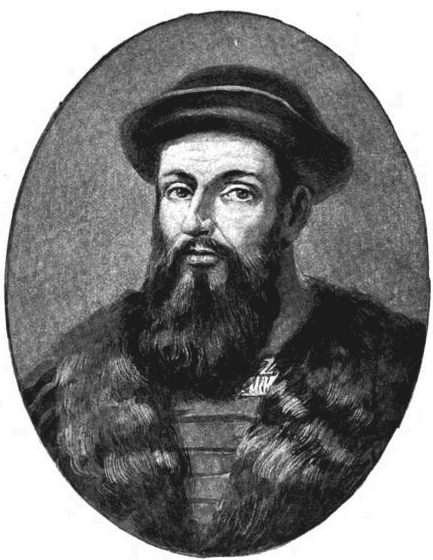
Ferdinand Magellan (Portuguese: Fernão de Magalhães, IPA: [fɨɾˈnɐ̃ũ dɨ
mɐgɐˈʎɐ̃ĩʃ] Spanish: Fernando de Magallanes) (Spring 1480 – April 27, 1521,
Mactan Island, Cebu, Philippines) was a Portuguese maritime explorer who, while
in the service of the Spanish Crown, tried to find a westward route to the Spice
Islands of Indonesia
Ferdinand Magellan
Explorer
Ferdinand Magellan was the leader of
the first expedition to circumnavigate the real world. He was the first European
to sail across the Pacific Ocean and discovered a route by which ships could
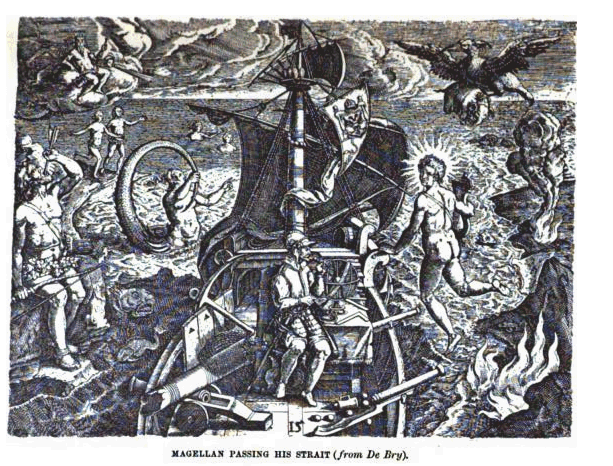
sail a complete circle around the world. The Straits of Magellan, located at the
Southern tip of South America are named for him. This strait proved to be the
connection between the Atlantic and the Pacific Oceans.
Magellan was born the son of Pedro
Ruy de Magalhaes and Alda de Mezquita in Sabrosa, Portugal in 1480. In
Portuguese his name was Fernao de Magalhaes. Of noble parentage, he became a
page at the Portuguese court where he learned astronomy and nautical science. At
a young age he was preoccupied by voyages of discovery. In 1505, sailing with
Francisco d’Almeida, Magellan took part in an expedition to India for the
purpose of establishing Portuguese royalty in India. By the year 1510 he had
been promoted to the rank of captain. In 1511, he took part in the Portuguese
conquest of Malacca, gaining control of the Strait of Malacca. Although it is
not absolutely documented, Magellan may have been part of the voyage that
reached the Spice Islands in 1511. Returning home in 1512, he took part in the
Portuguese expedition to Marocco and was severely wounded, leaving him lame for
life. Feeling he was not sufficiently rewarded for his services, Magellan left
the army without permission, leading to his disgrace with the king. He gave up
his nationality and offered his services to King Charles I (later Holy Roman
Emperor Charles V), ruler of Spain in 1517.
Portugal had claimed as theirs the
islands of the Far East as a result of the Treaty of Tordesillas of 1494.
Magellan claimed that many of them, including the rich Spice Islands, actually
lay in Spain’s territory, that Portuguese maps had been falsified to conceal
this fact. In 1513, Vasco de Balboa had found an ocean on the far side of the
New World discovered by Christopher Columbus. Magellan proposed to the Spanish
king an expedition to find a passage through the New World to this ocean and to
sail west to the Moluccas, thus proving that the Spice Islands lay on the
Spanish side of the line of demarcation. King Charles approved the plan.
Magellan took the oath of allegiance in the church of Santa Maria de la Victoria
de Triana in Seville, and received the imperial standard. He also gave a large
sum of money to the monks of the monastery in order that they might pray for the
success of the expedition. After a year of preparations the expedition left
Seville in September of 1519 in five small vessels.
Sailing across the Atlantic Ocean he
reached South America at the Bay of Rio de Janeiro by December 13th. They
arrived at the estuary of the Rio de la Plata by January 10, 1520 and probed for
the passage to the vast western ocean. By March 31st, Magellan decided to spend
the next six months there during winter storms. During this time, one ship, The
Santiago, was wrecked, a mutiny occurred and was quelled, and another ship was
lost to desertion headed back to Spain. The voyage was resumed on August 24,
1520. By October he had sighted what he assumed to be the sought after strait.
Ships went ahead and reported what they thought to be an ocean beyond. However,
this only proved to be another large bay. After deliberating with his
navigators, Magellan decided to proceed. Magellan had just sailed through the
strait that would later bear his name, the Strait of Magellan. Those straits
were originally called the Canal de Todos los Santos (All Saints’ Channel) by
Magellan himself. By late November (November 28) Magellan and the three
remaining ships finally reached the ocean which seven years earlier, Balboa had
discovered. Because of its apparent calmness, he named it Mar Pacifico, the
Pacific Ocean.
The voyage proceeded along the coast
of South America and on December 18th headed west into the Pacific. One month
into the voyage, hardships were encountered. Supplies were depleting, food and
drinking water were scarce. Many of the crew died of scurvy. Land was sighted
but no landfall was made until Magellan reached the Marianas (or Ladrone)
Islands by March of 1521. There he took on more provisions. Landing on the
island of Cebu on April 7th, he was received in a friendly manner by the chief
and ruler of the island. After eight days, Magellan was able to covert the ruler
to Christianity along with hundreds of natives. The ruler agreed to aid him in
an attack on the natives of neighboring island, Mactan. There, involved in
fighting with natives, Magellan was killed on April 27, 1521.
The two remaining ships were
refitted and spices purchased. Under Juan Sebastian del Cano they set sail for
the return voyage to Spain. Only one ship, the Victoria, with a crew of only
eighteen men and 4 East Indians reached Seville, Spain on September 8, 1522
after a voyage across the Indian Ocean, around the Cape of Good Hope and north
through the Atlantic. Completing a voyage of more than three years, they had
succeeded in circumnavigating the globe. The spices they brought them amply
repaid the expenses of the voyage.
Magellan himself had not succeeded
in his principal purpose, to circumnavigate the globe in one voyage. He had,
however, provided the skill and determination that made this achievement
possible.
There is no greater name than
Ferdinand Magellan in the history of discovery. He succeeded in crossing the
Pacific from east to west. His voyage laid the foundation for trade in the
Pacific between the New World and the East. -
By Charles George
Herbermann
Edited by Stanley L. Klos 2000
Published by Universal Knowledge
Foundation, 1913
Magellan, Ferdinand (Portuguese Fernäo Ma- gaUiäes),
the first circumnavigator of the world; b. about 1480 at Saborosa in Villa Real,
Province of Traz os Montes, Portugal; d. during his voyage of discovery on the
Island of Mactan in the Philippines, 27 April, 1521. He was the son of Pedro Ruy
de Magalhäes, mayor of the town, and of Alda de Mezquita. He was brought up at
the Court of Portugal and learned astronomy and the nautical sciences under good
teachers, among whom may have been Martin Behaim. These studies filled him at an
early age with enthusiasm for the great voyages of discovery which were being
made at that period. In 1505 he took part in the expedition of Francisco
d'Almeida, which was equipped to establish the Portuguese viceroyalty in India,
and in 1511 he performed important services in the Portuguese conquest of
Malacca. He returned home in 1512 and took part in the Portuguese expedition to
Marocco, where he was severely wounded. On account of a personal disagreement
with the commander-in-chief, he left the army without permission. This and an
unfavourable report that nad been made upon him by Almeida led to his disgrace
with the king. Condemned to inactivity and checked in his desire for personal
distinction, he once more devoted himself to studies and projects to which he
was mainly stimulated by the reports of the recently discovered Moluccas sent by
his friend Serrao. Serräo so greatly exaggerated the distance of the Moluccas to
the east of Malacca 'hat the islands appeared to lie within the half of the
world granted by the pope to Spain. Magellan therefore resolved to seek the
Moluccas by sailing to the west around South America. As he could not hope to
arouse interest for the carrying out of his plans in Portugal, and was himself,
moreover, misjudged and ignored, he renounced his nationality and offered his
services to Spain. He received much aid from Diego Barbosa, warden of the castle
of Seville, whose daughter he married, and from the influential Juan de Aranda,
agent of the Indian office, who at once desired to claim the Moluccas for Spain.
King Charles I of Spain (afterwards the Emperor Charles V) gave his consent as
early as 22 March, 1518, being largely influenced to do this by the advice of
Cardinal Juan Rodriguez de Fonseca. The king made an agreement with Magellan
which settled the different shares of ownership in the new discoveries, and the
rewards to be granted the discoverer, and appointed him commander of the fleet.
This fleet consisted of five vessels granted by the government; two of 130 tons
each, two of 90 tons each, and one of 60 tons. They were provisioned for 234
persons for two years. Magellan commanded the chief ship, the Trinidad; Juan de
Cartagena, the San Antonio; Gaspar de Qucsada, the Concepción ; Luis de Mendoza,
the Victoria; Juan Serrano, the Santiago. The expedition also included Duarte
Barbosa, Barbosa's nephew, the cosmographer Andres de San Martin, and the
Italian Antonio Pigafetta of Vicenza, to whom the account of the voyage is due.
Magellan took the oath of allegiance in the church of Santa Maria de la Victoria
de Triana in Seville, and received the imperial standard. He also gave a large
sum of money to the monks of the monastery in order that they might pray for the
success of the expedition. The fleet sailed 20 September, 1519, from San Lucar
de Barameda. They steered by way of the Cape Verde Islands to Cape St. Augustine
in Brazil, then along the coast to the Bay of Rio Janeiro (13 December), thence
to the mouth of the Plata (10 January, 1520). In both these bodies of water a
vain search was made for a passage to the western ocean. On 31 March Magellan
decided to spend the winter below 49° 15' south latitude, and remained nearly
five months in the harbour of San Julian. While in winter quarters here a mutiny
broke out, so that Magellan was forced to execute Qucsada and Mendoza, and to
put Cartagena ashore.
The voyage was resumed on 24 August, and on 21 October the fleet reached Cape
Vírgenes and, with it, the entrance to the long-sought straits. Those straits,
which are 373 miles long, now bear the name of the daring discoverer, though he
himself called them Canal de Todos los Santos (All Saints' Channel). The San
Antonio with the pilot Gomez on board secretly deserted and returned to Spain,
while Magellan went on with the other ships. He entered the straits on 21
November and at the end of three weeks reached the open sea on the other side.
As he found a very favourable wind, he gave the name of Mar Pacifico to the vast
ocean upon which he now sailed for more than three months, suffering great
privation during that time from lack of provisions. Keeping steadily to a
northwesterly course, he reached the equator 13 February, 1521, and the Ladrones
6 March.
On 16 March Magellan discovered the Archipelago of San Lázaro, afterwards called
the Philippines. He thought to stay here for a time, safe from the Portuguese,
and rest his men and repair his ships, so as to arrive in good condition at the
now not distant Moluccas. He was received in a friendly manner by the chief of
the island of Cebú, who, after eight days, was baptized along with several
hundred other natives. Magellan wished to subdue the neighbouring Island of
Mactan and was killed there, 27 April, by the poisoned arrows of the natives.
After both Duarte Barbosa and Serrano had also lost their lives on the island of
Cebú, the ships Trinidad and Victoria set sail under the guidance of Carvalho
and Gonzalo Vaz d'Espinosa and reached the Moluccas 8 November, 1521. Only the
Victoria, with Sebastian del Cano as captain, and a crew of eighteen men,
reached Spain (8 September, 1522). The ship brought back 533 hundredweight of
cloves, which amply repaid the expenses of the voyage.
Magellan himself did not reach his goal, the Spice Islands; yet he had
accomplished the most difficult part of his task. He had been the first to
undertake the circumnavigation of the world, had carried out his project almost
completely, and had thus achieved the most difficult nautical feat of all the
centuries. The voyage proved most fruitful for science. It gave the first
positive proof of the earth's rotundity and the first true idea of the
distribution of land and water.
Ferdinand Magellan -
From Wikipedia, the free encyclopedia
Magellan was the first European to enter the Pacific from the
eponymous
Strait of Magellan, which he discovered. He was also the first European to
reach the archipelago of what is now known as the Philippines, which was
unknown to the western world before his landing. Arab traders had established
commerce within the archipelago centuries earlier.
Of the 237 men who set out on five ships to circumnavigate the earth in
1519, only 18 completed the circumnavigation of the globe and managed to
return to Spain in 1522.[1][2]
They were led by the Basque navigator
Juan Sebastián Elcano, who took over command of the expedition after
Magellan's death. Seventeen other men arrived later in Spain, twelve men
captured by the Portuguese in
Cape
Verde some weeks earlier, and between 1525 and 1527 five survivors of the
Trinidad.
Origins and first voyage
Magellan, because of his family's heritage, became a page to Queen Leonor
at the royal court after the death of his parents during his tenth year. Very
little is known about Magellan's background. He was the son of Rui de
Magalhães (son of Pedro Afonso de Magalhães and wife Quinta de Sousa) and wife
Alda de Mesquita, and brother of Duarte de Sousa, Diogo de Sousa and Isabel de
Magalhães, but exactly how he is connected to the respective families it is
unknown. He was married to Beatriz Barbosa and had two children: Rodrigo de
Magalhães[3]
and Carlos de Magalhães, both of whom died at a young age.
Magellan made his first known expedition at sea at the age of 25 in 1505,
when he was sent to
India to install
Francisco de Almeida as the
Portuguese
viceroy. The voyage gave Magellan his first experience of battle when a
local king, who had paid tribute to
Vasco da Gama three years earlier, refused to pay tribute to Almeida,
which resulted in the
Battle of Diu in 1509. After taking leave without permission, Magellan
fell out of favour with Almeida and was also accused of trading illegally with
the Moors.
Several of the accusations were subsequently proved and there were no further
offers of employment after May 15, 1514. Later on in 1515, Magellan had an
employment offer as a crew member on a Portuguese ship, but rejected this
offer.
Spanish search of the Spice Islands
The aim of
Christopher Columbus' voyage to the West was to reach the coasts of the
Spice Islands (or the
Indies) and
to establish commercial relations between Spain and the several Asian
kingdoms. The Spanish soon realised after Columbus' voyages that the lands of
the Americas were not a part of Asia, but a new continent. Once
Vasco da Gama and the Portuguese arrived in India in 1498, it became
urgent for Spain to find a new commercial route to Asia. The
Treaty of Tordesillas reserved for Portugal the routes that went around
Africa. The Spanish Crown then decided to send out exploration voyages in
order to find a way to Asia by travelling westwards.
Vasco Núñez de Balboa sailed the Pacific Ocean in 1513, and
Juan Díaz de Solís died in
Río de la Plata some years later trying to find a passage in South
America.
When Magellan arrived at the Court of Spain, he presented
King Charles V with a plan that would give the ships of the
Crown of Castile full access to the lands of the Spice Islands, after that
plan failed to gain approval from the Portuguese king,
Manuel I.
On August 10, 1519, five ships under Magellan's command –
Trinidad, San Antonio, Concepción,
Victoria, and Santiago – left Seville and travelled from the
Guadalquivir River to Sanlúcar de Barrameda at the mouth of the river,
where they remained more than five weeks.
Spanish authorities were wary of Magellan, who was originally Portuguese.
They almost prevented the admiral from sailing, and switched his crew from
mostly Portuguese men to men of Spain. Nevertheless, Magellan set sail from
Sanlúcar de Barrameda with about 270 men on September 20.
King Manuel ordered a Portuguese naval detachment to pursue Magellan, but
Magellan avoided them. After stopping at the
Canary Islands, Magellan arrived at
Cape
Verde, where he set course for Cape St. Augustine in
Brazil. On
November 27, the expedition crossed the
equator; on
December 6, the crew sighted South America.
Magellan's ship Victoria
Since Brazil was Portuguese territory, Magellan avoided it, and on December
13 anchored near present-day
Rio de Janeiro. There the crew was resupplied, but bad conditions caused
them to delay. Afterwards, they continued to sail south along
South America's east coast, looking for the strait that Magellan believed
would lead to the Spice Islands. The fleet reached
Río de la Plata on January 10, 1520.
On March 30, the crew established a settlement they called
Puerto San Julian. On April 2, a mutiny involving two of the five ship
captains broke out, but it was unsuccessful because most of the crew remained
loyal. Juan Sebastián Elcano was one of those who were forgiven.
Antonio Pigafetta, an Italian from
Vicenza who
paid to be on the Magellan voyage, related that Gaspar Quesada, the captain of
Concepcion, was executed; Juan de Cartagena, the captain of San
Antonio, and a
priest named
Padre Sanchez de la Reina were instead
marooned
on the coast. Another account states that Luis de Mendoza, the captain of
Victoria, was executed along with Quesada.[4]
Reportedly those killed were
drawn and quartered and
impaled
on the coast; years later, their bones were found by Sir
Francis Drake.[5][6]
The journey resumed. The Santiago was sent down the coast on a
scouting expedition and was wrecked in a sudden storm. All of its crew
survived and made it safely to shore. Two of them returned overland to inform
Magellan of what had happened, and to bring rescue to their comrades. After
this experience, Magellan decided to wait for a few weeks more before again
resuming the voyage.
At 52°S latitude on October 21, the fleet reached
Cape Virgenes and concluded they had found the passage, because the waters
were brine and
deep inland. Four ships began an arduous trip through the 373-mile (600 km)
long passage that Magellan called the Estrecho (Canal) de Todos los Santos,
("All Saints' Channel"), because the fleet travelled through it on November 1,
or
All Saints' Day. The strait is now named the
Strait of Magellan. Magellan first assigned Concepcion and San
Antonio to explore the strait, but the latter, commanded by
Gómez, deserted and returned to Spain on November 20. On November 28, the
three remaining ships entered the
South Pacific.
Magellan named the waters the Mar Pacifico (Pacific Ocean) because of
its apparent stillness.[7]
Magellan was the first European to reach
Tierra del Fuego just east of the Pacific side of the strait.
Heading northwest, the crew reached the equator on February 13, 1521. On
March 6, they reached the
Marianas and Guam.
Magellan called Guam the "Island of Sails" because they saw a lot of
sailboats. They renamed it to "Ladrones Island" (Island of Thieves) because
many of Trinidad's small boats were stolen there. On March 16, Magellan
reached the island of
Homonhon
in the
Philippines, with 150 crew left, and became the first European to reach
the Philippines.
Magellan was able to communicate with the native peoples because his
Malay interpreter,
Enrique, could understand their language. Enrique was
indentured by Magellan in 1511 right after the sacking of
Malacca, and was at his side during the battles in Africa, during
Magellan's disgrace at the King's court in Portugal, and during Magellan's
successful raising of a fleet. They traded gifts with
Rajah Siaiu of
Mazaua[8]
who guided them to
Cebu on April 7.
Rajah Humabon of Cebu was friendly towards Magellan, and the Spaniards;
both he and his queen Juana were baptized as Christians. Afterward, Rajah
Humabon and his ally Datu Zula convinced Magellan to kill their enemy, Rajah
Lapu-Lapu,
on Mactan. Magellan had wished to convert Lapu-Lapu to Christianity, as he had
Rajah Humabon, a proposal to which Lapu-Lapu was dismissive. On the morning of
April 27, 1521, Magellan sailed to Mactan with an army of men. During the
resulting
Battle of Mactan against native forces led by Lapu-Lapu, Magellan was shot
by a poisonous arrow and later surrounded and finished off with spears and
other weapons.
Pigafetta and Ginés de Mafra provided the only extant eyewitness accounts
of the events culminating in Magellan's death:
"When morning came, forty-nine of us leaped into the water up to our
thighs, and walked through water for more than two cross-bow flights before we
could reach the shore. The boats could not approach nearer because of certain
rocks in the water. The other eleven men remained behind to guard the boats.
When we reached land, [the natives] had formed in three divisions to the
number of more than one thousand five hundred people. When they saw us, they
charged down upon us with exceeding loud cries... The musketeers and
crossbow-men shot from a distance for about a half-hour, but uselessly...
Recognizing the captain, so many turned upon him that they knocked his helmet
off his head twice... A native hurled a bamboo spear into the captain's face,
but the latter immediately killed him with his lance, which he left in the
native's body. Then, trying to lay hand on sword, he could draw it out but
halfway, because he had been wounded in the arm with a bamboo spear. When the
natives saw that, they all hurled themselves upon him. One of them wounded him
on the left leg with a large cutlass, which resembles a scimitar, only being
larger. That caused the captain to fall face downward, when immediately they
rushed upon him with iron and bamboo spears and with their cutlasses, until
they killed our mirror, our light, our comfort, and our true guide. When they
wounded him, he turned back many times to see whether we were all in the
boats. Thereupon, beholding him dead, we, wounded, retreated, as best we
could, to the boats, which were already pulling off."[9]
Magellan provided in his will that Enrique, his interpreter, was to be
freed upon his death. However, after Mactan, the remaining ships' masters
refused to free Enrique. Enrique escaped his indenture on May 1, with the aid
of Rajah Humabon, amid the deaths of almost 30 crewmen. Pigafetta had been
jotting down words in the Bisayan language, both Butuanon and Cebuano—which he
started at Mazaua on Friday, March 29 and grew to a total of 145 words—and was
apparently able to continue communications during the rest of the voyage. The
Spaniards offered the natives merchandise in exchange for Magellan's body, but
they were declined and his body was never recovered.[10]
The casualties suffered in the Philippines left the expedition with too few
men to sail all three of the remaining ships. Consequently, on May 2, they
abandoned Concepción and burned the ship. The fleet, reduced to
Trinidad and Victoria, fled westward to
Palawan.
They left that island on June 21, and were guided to
Brunei,
Borneo by
Moro pilots who could navigate the shallow seas. They anchored off the
Brunei breakwater for 35 days, where Pigafetta, an Italian from
Vicenza,
recorded the splendour of Rajah Siripada's court (gold,
two pearls the
size of hens' eggs, etc.). In addition, Brunei boasted tame
elephants
and armament of 62 cannons, more than 5 times the armament of Magellan's
ships, and Brunei disdained
cloves, which
were to prove more valuable than gold, upon the return to Spain. Pigafetta
mentions some of the technology of the court, such as
porcelain
and eyeglasses
(both of which were not available or only just becoming available in Europe).
After reaching the
Maluku Islands (the Spice Islands) on November 6, 115 crew were left. They
managed to trade with the Sultan of
Tidore, a
rival of the Sultan of
Ternate,
who was the ally of the Portuguese.
The two remaining ships, laden with valuable spices, attempted to return to
Spain by sailing westwards. However, as they left the Spice Islands, the
Trinidad began to take on water. The crew tried to discover and repair
the leak, but failed. They concluded that Trinidad would need to spend
considerable time being overhauled, but the small Victoria was not
large enough to accommodate all the surviving crew. As a result, Victoria
with some of the crew sailed west for Spain. Several weeks later, Trinidad
departed and attempted to return to Spain via the Pacific route. This attempt
failed. Trinidad was captured by the Portuguese, and was eventually
wrecked in a storm while at anchor under Portuguese control.
One of Magellan's ships circumnavigated the globe, finishing 16
months after the explorer's death.
Victoria set sail via the
Indian Ocean route home on December 21, commanded by
Juan Sebastián Elcano. By May 6, the Victoria rounded the
Cape of Good Hope, with only rice for rations. Twenty crewmen died of
starvation before
Elcano put into
Cape
Verde, a Portuguese holding, where he abandoned 13 more crew on July 9 in
fear of losing his cargo of 26
tons of spices
(cloves and
cinnamon).
On September 6, 1522, Elcano and the remaining crew of Magellan's voyage
arrived in Spain aboard the last ship in the fleet, Victoria, almost
exactly three years after they departed. Magellan had not intended to
circumnavigate the world, only to find a secure way through which the Spanish
ships could navigate to the Spice Islands; it was Elcano who, after Magellan's
death, decided to push westward, thereby completing the first voyage around
the entire Earth.
Maximilianus Transylvanus interviewed the surviving members of the
expedition when they presented themselves to the Spanish court at
Valladolid in the autumn of 1522, and wrote the first account of the
voyage, which was published in 1523. The account written by Pigafetta did not
appear until 1525, and was not wholly published until 1800. This was the
Italian transcription by
Carlo Amoretti of what we now call the Ambrosiana codex. The expedition
eked out a small profit, but the crew was not paid full wages.[11]
Four crewmen of the original 55 on Trinidad finally returned to
Spain in 1525; 51 of them had died in war or from disease. In total,
approximately 232 Spanish, Portuguese, Italian, French, English and German
sailors died on the expedition around the world with Magellan.[12]
Legacy
Magellan's expedition was the first to circumnavigate the globe and the
first to navigate the strait in South America connecting the Atlantic and
Pacific oceans. Magellan's crew observed several animals that were entirely
new to European science, including a "camel
without humps", which could have been a
llama,
guanaco,
vicuña, or
alpaca. A
black "goose"
that had to be skinned instead of plucked was a
penguin.
Two of the closest
galaxies, the
Magellanic Clouds, were discovered by crew members in the
southern hemisphere. The full extent of the Earth was also realized, since
their voyage was 14,460 leagues (69,800km or 43,400mi).
The need for an
International Date Line was established. Upon returning they found their
calendars were a day behind, even though they had faithfully maintained the
ship's log. However, they did not have clocks accurate enough to observe the
very slight lengthening of each day during which they were underway on the
journey (and since they traveled west, after circumnavigation they had rotated
about the earth's axis exactly one time less, hence experiencing one less
night, than if they had remained in Spain).[13]
This caused great excitement at the time and a special delegation was sent to
the Pope to explain the oddity to him.
When Victoria, the one surviving ship, returned to the harbor of
departure after completing the first circumnavigation of the Earth, only 18
men out of the original 237 men were on board.
Martino de Judicibus
Among the survivors there were only two Italians,
Antonio Pigafetta and Martino de Judicibus. Martino de Judicibus (Spanish:
Martín de Judicibus) was a
Genoese or
Savonese[14]
Chief Steward. He served with Ferdinand Magellan
on his historical voyage to find a westward route to the
Spice Islands of
Indonesia.[15]
His history is preserved in the nominative registers at the Archivo General
de Indias in
Seville,
Spain. The
family name is referred to with the exact Latin patronymic, "de Judicibus". He
was initially assigned to the caravel Concepción, one of five ships of
the small Spanish fleet of Magellan. Martino de Judicibus embarked on the
expedition with the rank of merino.
Forgotten Founders Historic Documents and Coins of Freedom - By Stanley
L. Klos - Last Exhbit at the 2008 GOP Convention:
http://www.pinellasrepublican.org/
Forgotten Founders Historic Documents and Coins of Freedom - By Stanley
L. Klos
Uncommon Sense: President Obama and
US China Trade 1784-2009
The United Colonies 1st
government began in a Philadelphia Tavern
and the United States 1st federal government ended in a
NYC Tavern!
The Founders convened the government in 11 different capitol buildings and
experienced 15 years of challenges that
included war,
hyper-inflation, a failed
constitution, judicial corruption, armed citizen and U.S. Army rebellions.
Unauthorized Site:
This site and its contents are not affiliated, connected,
associated with or authorized by the individual, family,
friends, or trademarked entities utilizing any part or
the subject's entire name. Any official or affiliated
sites that are related to this subject will be hyper
linked below upon submission
and Evisum, Inc. review.