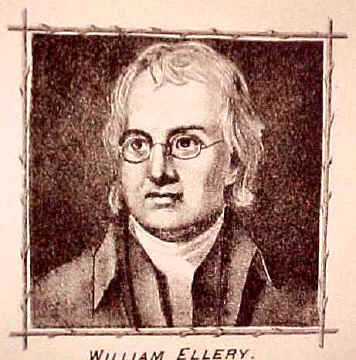
WILLIAM
ELLERY, was forty-eight years old when he presented
himself at the Second Congress on May 14, 1776.He was replacing Samuel Ward, a political ally who had died in
March.Ellery was born in
Newport, Rhode Island December 22, 1727, was a graduate of Harvard class
of 1747.His father was
deputy governor of Rhode Island.William,
however, showed no interest in politics, law or much of anything else
for that matter.He held a
number of odd jobs earning just enough to raise a large family.His first wife, Ann Remington of Cambridge, died after fourteen
years of marriage leaving six children; his second wife, Abigail Cary,
gave him five more children.Twenty
years would pass before he sought a career in law.He confided later, "if the year before I graduated I had
determined upon law, or physics, especially the latter, I am persuaded
that I should have led a more profitable and useful life.But no one advised me, and I made no choice.I entered into small commerce without a spirit of enterprise or
skill in trade; that would not do.I had married a wife, and could not submit to be an understrapper
to a physician.I became a
clerk of the court; where I copied writs and declarations, gained some
knowledge of practice, and stood forth a dabbler -- a quack lawyer."
William
Ellery stepped out of his quiet, unassuming character during the Stamp
Act crisis by leading a riotous march through Providence in opposition.At the opening of the Second Congress, he announced boldly:"You must exert yourself.To be ruled by Tories, when we may be ruled by Sons of Liberty
– how debasing.You must rouse up all that is Roman in Providence.There is liberty and fire enough; it only requires the
application of the bellows.Blow,
then, a blast that will shake this country."
William
Ellery signed the Declaration of Independence at the age of forty-eight.He was noted
for his ready wit, and he often amused himself by writing epigrams about
his colleagues while they were speaking.According to a well known story, Ellery, at the signing of the
Declaration, took a position where he could watch the faces of the
delegates as they put their names to this revolutionary document, and
reported afterward that every one of them showed ‘undaunted
resolution'.More than
one record indicates that at the time of the signing, Benjamin Harrison,
a heavily-built man said to the thin-framed Ellery, "I shall have a
great advantage over you, Mr. Ellery, when we are all hung for what we
are now doing.From the
size and weight of my body, I shall die in a few minutes, but from the
lightness of your body you will dance in the air for an hour or two
before you are dead."
On
January 1, 1790, President Washington appointed Ellery collector of customs
for the Newport district, and he retained this post, through all the
changes in administration, until his death thirty years later.Ellery died in 1820 at the age of ninety-two.With the exception of Charles Carroll of Carrollton, he was the
longest-lived of the Signers.
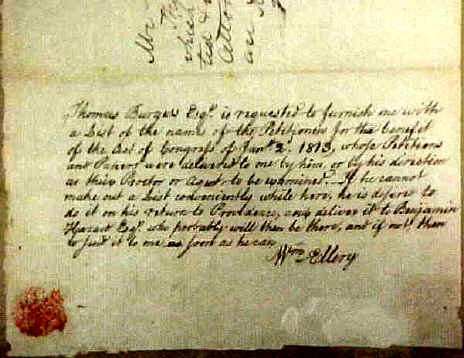
Autograph document signed "Wm. Ellery," written to
Thomas Burgess.Ellery is
requesting Burgess to furnish a list of"Petitioners for thebenefit of the Act of Congress of Jany. 2,
1813."Docketed by Thomas
Burgess perpendicular to Ellery's text.One page measuring 6 ½ x 8 ¼ inches.Seal of Ellery in lower left corner.
Image Copyright 2001 Virtualology, Inc
Image Copyright 2001 Virtualology, Inc.
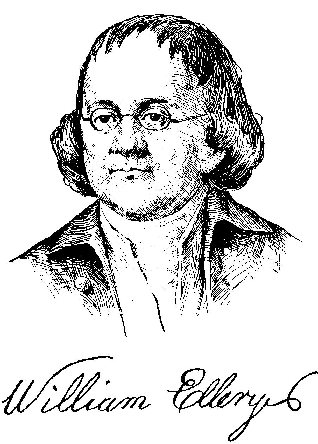
ELLERY,
William, signer of the Declaration of Independence, born in Newport, R.
I., 22 December 1727; died there, 15 February, 1820. His father, of the same
name, was graduated at Harvard in 1722, became a successful merchant in Newport,
served successively as judge, senator, and lieutenant governor of the colony,
and (lied in 1764. The younger William received his early education mostly from
his father, and was graduated at Harvard in 1747. He married in 1750, engaged in
business in Newport, and was for some time naval officer of Rhode Island he
began the practice of law in Newport in 1770, having served for two years
previous as clerk of one of the courts. He was an active patriot, and in May,
1776, was chosen the colleague of Stephen Hopkins, as delegate to the
Continental congress, and took his seat on the 14th of that month, He became an
influential member of that body, serving on the committee to consider the ways
and means of establishing expresses between the continental posts, on those on
the treasury and on marine affairs, and on the special committee for purchasing
clothing for the army. During this session he signed the Declaration of
Independence, and he was accustomed in later years to relate with great vivacity
the incidents connected with that event. "I was determined," he
said, "to see how they all looked as they signed what might be their
death warrant. I placed myself beside the secretary, Charles Thomson, and eyed
each closely as he affixed his name to the document. Undaunted resolution was
displayed in every countenance."
Mr.
Ellery continued a member of the congress till 1786, with the exception of the
years 1780 and 1782, and, overcoming his natural diffidence, became a ready
debater. He was a member of important committees, but did especially good
service on the board of admiralty, where he had much influence, and probably
originated the plan of fitting out fire ships at Newport. During the British
occupation of Rhode Island, Mr. Ellery's house was burned and much of his other
property injured.
In
1779 he was a member of a committee to arrange some diplomatic difficulties
among the American commissioners to Europe, and was chairman of a committee to
consider means of relieving the distress brought upon the Rhode Islanders by the
British occupation. In 1782 he presented to congress a plan for organizing a
department of foreign affairs. In 1785 he actively supported Rufus King in his
effort to abolish slavery throughout the country, seconding King's resolution to
that effect. He was appointed commissioner of the continental loan office for
Rhode Island in 1786, was for a short period chief justice of the Rhode Island
superior court, and from 1790 till his death was collector of Newport,
being" retained in the office in spite of frequent and frank avowals of
political differences with several administrations.
Channing,
William Ellery
Lycos Zone. Home. enter a word or phrase: get help Explore our Almanacs,
Dictionary,
and Encyclopedia! ... encyclopedia Encyclopedia Channing, William Ellery. ...
William
Ellery
... of Newport, ?-1820 Died: February 15, 1820 William Ellery was born at
Newport, Rhode
Island, in December of 1727. Under the tutelage of his Prominent father ...
William Ellery
... William Ellery signed the Declaration of Independence at the age of
forty-eight.
He was noted for his ready wit, and he often amused himself by writing
...
William
Ellery
... William Ellery 1727 1820 Representing Rhode Island at the Continental
Congress
Born: December 22, 1727 in: Newport, Rhode Island Education: Harvard College ...
William Ellery
... Newport, Rhode Island December 22, 1727, was a graduate of Harvard ... years
later.
Ellery died in 1820 at the age of ... Start your search on William Ellery. ...
Biography of
William Ellery
William Ellery. 1727-1820. William Ellery, the son
of a gentleman of the same name, was born at ...
Grave of William B.
Ellery
... 1727. d. February 15, 1820. Signer of The Declaration ... Epitaph: IN MEMORY
OF WILLIAM
ELLERY BORN DECEMBER 22 1727 GRADUATED HARVARD COLLEGE 1747 ...
Ellery,
William
... Ellery, William, 1727 1820 , political leader in the American Revolution,
signer
of the Declaration of Independence, b. Newport, RI While a member of the ...
Ellery,
William - A-to-Z History - DiscoverySchool.com
... Ellery, William (1727-1820), was one of the Rhode Island signers of the
Declaration
of Independence. He served in the Continental Congress from 1776 until 1781 ...
Abraham
Clark
William Ellery (1727-1820), Rhode Island. The mind of William Ellery kept pace
with the world. He was a lawyer who had graduated from Harvard and while in ...
Famous
ELLERYS
Ad Famous ELLERYS. William Ellery (1727-1820). Signer of the Declaration
of American Independance. Robert LJ Ellery (1827-1906). ...
Newport
Notables
William Ellery b. Newport, RI, December 22, 1727. d.
Newport, RI, February 15, 1820. Bibliography ...
Rl
Docs 2
... Home. Rhode Island Documents 2. WILLIAM ELLERY (1727-1820). Lawyer, Patriot
Activist,
Signer of the Declaration of Independence. Represented Rhode Island in the ...
Untitled
... County, RI. WILLIAM ELLERY. William Ellery 1727-1820.
The Price They Paid. CONNECTICUT. ROGER SHERMAN. Roger ...
We invite you to read a transcription
of the complete text of the Declaration as presented by the National Archives.
&
The article "The
Declaration of Independence: A History,"
which provides a detailed account of the Declaration, from its drafting through
its preservation today at the National Archives.
Virtualology welcomes
the addition of web pages with historical documents and/or scholarly papers on
this subject.To submit a web link
to this pageCLICK
HERE.Please be sure to
include the above name, your name, address, and any information you deem
appropriate with your submission.
Unauthorized Site:
This site and its contents are not affiliated, connected,
associated with or authorized by the individual, family,
friends, or trademarked entities utilizing any part or
the subject's entire name. Any official or affiliated
sites that are related to this subject will be hyper
linked below upon submission
and Evisum, Inc. review.
Please join us in our mission to incorporate The Congressional Evolution of the United States of America discovery-based curriculum into the classroom of every primary and secondary school in the United States of America by July 2, 2026, the nation’s 250th birthday. , the United States of America: We The
People. Click Here