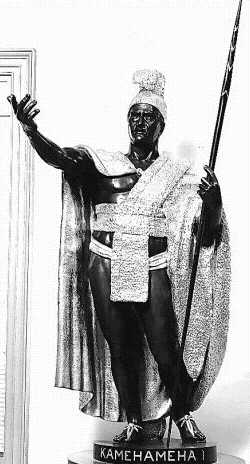
King Kamehameha I was born at Kokoiki in the Kohala district of the Island of
Hawai'i about 1758. He grew into a courageous warrior and was said to have
overturned the huge Naha Stone in Hilo. According to native belief, such a feat
indicated superhuman strength and foreshadowed the inevitable conquest of all of
Hawai'i.
Upon the death of his uncle, Chief Kalaniopu'u, Kamehameha received custody
of the war gods and the temples, while the late chief's son, Kiwala'o, inherited
the island. However, district chiefs became dissatisfied with Kiwala'o's methods
of redistricting the lands. A struggle ensued between Kiwala'o's forces and the
various chiefs under the leadership of Kamehameha. His cousin was killed, and
Kamehameha attained control of half the Island of Hawai'i. During the struggle,
Kamehameha's "divine right" was exemplified by a rare explosive eruption of
Kilauea Volcano, which wiped out parts of the opposing army.
In 1785 Kamehameha married Ka'ahumanu, the daughter of one of his most
trusted advisors. In 1790, after attaining control of the remainder of Hawai'i
Island, he successfully invaded the Islands of Maui, Lana'i, and Moloka'i. By
1810, he had unified all the inhabited islands of Hawai'i under his rule.
As king, Kamehameha placed capable followers in charge of large districts. He
encouraged trade and peaceful activities, and he presided over the opening of
Hawai'i to the rest of the world. On May 8, 1819, King Kamehameha I, also
referred to today as Kamehameha the Great, died at Kailua in the district of
Kona on his home Island of Hawai'i. His remains were hidden with such secrecy,
according to ancient custom, that "only the stars know his final resting place."
American sculptor Thomas R. Gould depicted Kamehameha in his regal garb,
including a helmet of rare feathers attached to woven plant fibers. The gilded
cloak is based on one that Kamehameha's subjects made for the king by weaving
yellow feathers of native birds into a fine mesh net. The sandals, although not
historically accurate, suggest the type of footwear that Kamehameha would have
worn. The spear in his left hand symbolizes the ability to defend oneself and
one's nation; it is also a reminder that Kamehameha ended the wars among the
Hawaiian people. His right hand is extended in a gesture of aloha, the
traditional spirit of friendly greeting.
Gould was commissioned to create a statue of Kamehameha by the legislature of
the Kingdom of Hawai'i and modeled the figure at his studio in Rome in 1879. It
was cast in bronze at a Paris foundry in 1880 but was lost in a shipwreck on its
way to Hawai'i. A second statue was cast from the same model and arrived safely;
it was unveiled by Hawai'i's last king, Kalakaua, in 1883 in front of the
Judiciary Building in Honolulu, where it still remains. The first statue was
subsequently recovered and brought to Hawai'i; in 1912 it was placed at Kohala
Court House in Kapa'au on the Island of Hawai'i, in Kamehameha's home district.
The statue in the Capitol was made from molds taken of the Honolulu statue.
It was dedicated along with a statue of Father Damien, Hawai'i's other gift to
the National Statuary Hall collection, at a ceremony held on April 15, 1969 in
the Capitol Rotunda. The statue was moved to National Statuary Hall in June of
that year. The great weight of the bronze statue and its solid granite base
(over 6 tons) make it one of the heaviest objects in the collection, so a major
factor in its location is the need to support it safely.
Every year on Kamehameha Day (June 11, a state holiday in Hawai'i), National
Statuary Hall is the scene of a ceremony in honor of the king. The statue is
draped with leis of flowers from Hawai'i and hula dancers per-form before
portrayers of Kamehameha and Ka'ahu-manu.
Unauthorized Site:
This site and its contents are not affiliated, connected,
associated with or authorized by the individual, family,
friends, or trademarked entities utilizing any part or
the subject's entire name. Any official or affiliated
sites that are related to this subject will be hyper
linked below upon submission
and Evisum, Inc. review.
Please join us in our mission to incorporate The Congressional Evolution of the United States of America discovery-based curriculum into the classroom of every primary and secondary school in the United States of America by July 2, 2026, the nation’s 250th birthday. , the United States of America: We The
People. Click Here