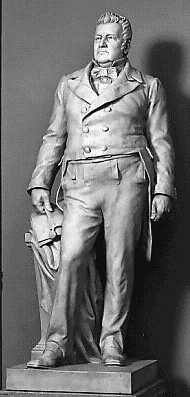
John Middleton Clayton
CLAYTON, John Middleton, jurist, born in Dags-borough, Sussex County, Del., 24 July, 1796; died in Dover, Del., 9 November, 1856. He was the eldest son of James Clayton (a descendant of Joshua of that name, who came to America with William Penn) and Sarah Middleton, of Virginian ancestry. The pecuniary disasters consequent upon the war of 1312 reduced his father from affluence to comparative poverty, and it was only by making the greatest sacrifices that he was able to send his son to College. He was graduated at Yale in 1815, studied law at the Litchfield law-school, began to practice in 1818, and soon attained eminence in his profession. In 1824 he was sent to the Delaware legislature, and was subsequently secretary of state. In 1829 he was sent to the United States senate, and in 1831 appointed a member of the convention to revise the constitution of Delaware. In 1835 he was again returned to the senate as a Whig, but resigned in 1837 to become chief justice of Delaware, an office which he held for three years. From 1845 till 1849 he was again United States senator, and at the latter date became secretary of state under President Taylor. He was elected a senator for the third time, and served in that capacity from March, 1851, until his death. He early distinguished himself in the senate by a speech during the debate on the Foote resolution, which, though merely relating to the survey of the public lands, introduced into the discussion the whole question of nullification. His argument in favor of paying the claims for French spoliations was also a fine instance of senatorial oratory. One of his most noted speeches delivered in the senate was that made in 1855 against the message of President Pierce vetoing the act ceding public lands for an insane asylum. While secretary of state he negotiated in 1850 the treaty with the British government, known as the Clayton-Bulwer treaty, which guaranteed the neutrality and encouragement of lines of interoceanic travel across the American isthmus. In 1851 he zealously defended that treaty in the senate and vindicated President Taylor's administration. From 1844 Mr. Clayton cultivated a tract of land near Newcastle, which in a few years he made one of the most fruitful estates in that fertile region. Mr. Clayton was always accessible, and was noted for his genial disposition and brilliant conversational powers.
Unauthorized Site:
This site and its contents are not affiliated, connected,
associated with or authorized by the individual, family,
friends, or trademarked entities utilizing any part or
the subject's entire name. Any official or affiliated
sites that are related to this subject will be hyper
linked below upon submission
and Evisum, Inc. review.
Please join us in our mission to incorporate The Congressional Evolution of the United States of America discovery-based curriculum into the classroom of every primary and secondary school in the United States of America by July 2, 2026, the nation’s 250th birthday. , the United States of America: We The
People. Click Here