Stanley L. Klos - Neighborhood Recovery Act - http://roi.us/nra.htm

Virtual Museum of Art | Virtual Museum of History | Virtual Public Library | Virtual Science Center | Virtual Museum of Natural History | Virtual War Museum
   You are in: Museum of History >> Hall of Explorers >> Daniel Boone


Daniel Boone - October 22,  1734 – September 26, 1820 was an American pioneer and hunter whose frontier exploits made him one of the first folk heroes of the United States.  A Stan Klos Website

Daniel Boone
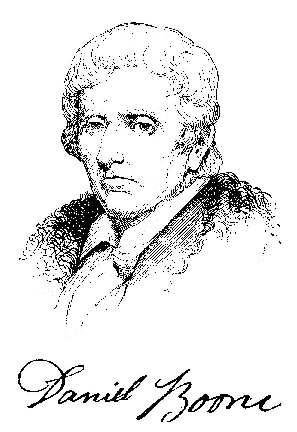

Image Copyright© 2001 by VirtualologyT

BOONE, Daniel, pioneer, born in Berks County, Pennsylvania, 22 October, 1734 (For more on Daniel Boone's birthplace please visit his Homestead); died in Missouri, 26 Sept., 1820. Among the immigrants that landed, 10 Oct., 1717, at Philadelphia was George Boone, of Exeter, England, who came with his wife and eleven children, bought land near Bristol, Bucks County, Pennsylvania, and joined the society of Friends. His son, Squire Boone, married Sarah Morgan, and Daniel was their son. Squire Boone, who was a farmer, moved, about 1748, to Holman's Ford, on the Yadkin, in North Carolina.

Daniel's education was very limited ; he could read and write, but beyond that all he knew related to the fields, the woods, the net, the rifle, and hunting. He was a hunter born, and loved the solitude of the forest. Strong, brave, lithe, inured to hardship and privation, he traced his steps through the pathless forest, sought out the hiding places of panther, bear, and wolf, and was the match of any Indian in the sagacity with which he detected the footsteps of the red man. About 1755 he married Rebecca Bryan and set up his own log cabin, but, displeased with the encroachments of civilization on his solitude, and incited by the glowing accounts brought by John Finley, who had penetrated into the unknown regions of Kentucky, formed a company of six kindred spirits, and, bidding adieu to his family and the comforts of home, on 1 May, 1769, set out on his perilous journey of exploration.


This is a Picture from the Wikimedia Commons

After numerous adventures with the Indians, having become intimately acquainted with the character of the country, established an enviable reputation for sagacity and integrity on important frontier service assigned to him by Lord Dunmore in the campaign against the Indians, usually called "Lord Dunmore's War," and constructed a strong fort on the left bank of Kentucky river, which he named "Boonesborough," he determined to bring his wife and family to the new home. Some of his neighbors joined him, and he conducted the party, numbering upward of thirty, safely to "Boonesborough" without having encountered any other difficulties than such as are common to this passage. On one occasion Boone, with an armed party of thirty men, had gone for a supply of salt to a place called " Salt Licks," nearly 100 miles north of Boonesborough, and was captured, with twenty-seven of his men, by a band of more than 100 Indian warriors led by two Frenchmen. They carried them first to Old Chillicothe, on the Miami, and then to Detroit, where they surrendered for a ransom all their prisoners except Boone ; him they took back to Old Chillicothe, where the great Blackfish, a renowned Shawanese chief, adopted him into his family under an imposing but painful ceremonial; all his hair, except a tuft three or four inches in diameter on the crown of the head, was plucked out; that tuft was allowed to grow to the length of the "warlock," dressed with feathers and ribbons; an ablution in the river was supposed to cleanse him from the taint of white blood; a coat of paint on his face, and a solemn charge from Blackfish, completed the rite.

After a prolonged and anxious residence among them, during which he was kindly treated, he discovered their intention of marching upon Boonesborough, and resolved, at the peril of certain death in the event of recapture, to attempt his escape and save his family and friends. Chased by 450 Indians, he performed that daring feat in the forty-third year of his age, and thus simply records it: "On the 16th [of June], before sunrise, I departed in the most secret manner, and arrived at Boonesborough on the 20th, after a journey of 160 miles, during which I had but one meal." At the fort he learned that his wife and children, despairing of ever seeing him again, had returned, and safely reached her father's home in North Carolina. The Indians assailed the fort, but were repelled with loss, and retreated. Boone then, in the autumn of 1778, rejoined his family on the Yadkin, and returned with them to Kentucky in 1780.
The country, though well settled, was still unsafe, and, soon after his return, Boone and his brother, Squire, were surprised by Indians ; Squire was killed and scalped, and Daniel had a narrow escape. A sanguinary engagement, called the "Battle of the Blue Licks," took place in 1782, in which Boone's two sons fought at his side. One of them was killed, and the other severely wounded. Boone was full of expedients, and on one occasion extricated himself from four armed Indians by blinding them with tobacco dust. Kentucky was admitted into the union, 4 Feb., 1791, and in the survey of the state the title to Boone's land was disputed. The case was decided against him, and, stung to the quick by the wrong, he had again to seek a new home, which he established at Point Pleasant, between the Ohio and the Great Kanawha; but in 1795 he removed to Missouri, then a Spanish possession, and received not only the appointment of commandant of the Femme Osage district, but a grant of 8,000 acres. The Spanish possessions passed into the hands of Napoleon, who sold them to the United States, and, in the survey that followed, the Spanish grant of Boone's lands was pronounced invalid. An appeal to the legislature of Kentucky, and another to congress, resulted in a grant by the latter of 850 acres. Boone was then seventy-five years of age, hale and strong. The charm of the hunter's life clung to him to the last, and in his eighty-second year he went on a hunting excursion to the mouth of Kansas river. He had made his own coffin and kept it under his bed, and after his death they laid him in it to rest by the side of his wife, who had passed away seven years before.

On 13 Sept., 1845, their remains were removed to the cemetery near Frankfort, Kentucky, a few miles from the fort of Boonesborough, by the concurrent action of the citizens of Frankfort and the legislature of Kentucky. His son, Enoch, born in Boonesborough, Kentucky, in 1777 ; d. 8 March, 1862, was the first white male child born in Kentucky. Daniel Boone's wife, with her daughters, went to live with her husband in his palisaded fort in June, 1776, and while there gave birth to this son; but after Boone's capture, on 7 Feb., 1778, his family returned to North Carolina. Edited Appleton's American Biography Copyright© 2001 by VirtualologyTM

Daniel Boone [October 22 (November 2 new style), 1734 – September 26, 1820] was an American pioneer and hunter whose frontier exploits made him one of the first folk heroes of the United States.


Daniel Boone

From Wikipedia, the free encyclopedia

Daniel Boone

 
This 1820 painting by Chester Harding is the only portrait of Daniel Boone made from life. Boone, 85 years old and just months away from death, had to be steadied by a friend while the artist worked.[1]
Born October 22, 1734(1734-10-22)
November 2, 1734(1734-11-02) N.S.
Daniel Boone Homestead, Oley Valley, Berks County, Pennsylvania
Died September 26, 1820 (aged 85)
Nathan Boone's home, Femme Osage Creek, Missouri, United States
Resting place Either Frankfort Cemetery, Kentucky
or Old Bryan Farm graveyard, Missouri

Daniel Boone [October 22 (November 2 new style), 1734 – September 26, 1820] was an American pioneer and hunter whose frontier exploits made him one of the first folk heroes of the United States. Boone is most famous for his exploration and settlement of what is now the U.S. state of Kentucky, which was then beyond the western borders of the Thirteen Colonies. Despite resistance from American Indians, for whom Kentucky was a traditional hunting ground, in 1775 Boone blazed the Wilderness Road through the Cumberland Gap and into Kentucky. There he founded Boonesborough, one of the first English-speaking settlements beyond the Appalachian Mountains. Before the end of the 18th century, more than 200,000 people entered Kentucky by following the route marked by Boone.[2]

Boone was a Militia officer during the American Revolutionary War (1775–1783), which in Kentucky was fought primarily between settlers and British-allied American Indians. Boone was captured by Shawnees in 1778 and adopted into the tribe, but he escaped and continued to help defend the Kentucky settlements. He was elected to the first of his three terms in the Virginia General Assembly during the war, and fought in the Battle of Blue Licks in 1782, one of the last battles of the American Revolution. Boone worked as a surveyor and merchant after the war, but he went deep into debt as a Kentucky land speculator. Frustrated with legal problems resulting from his land claims, in 1799 Boone resettled in Missouri, where he spent his final years.

Boone remains an iconic, if imperfectly remembered, figure in American history. He was a legend in his own lifetime, especially after an account of his adventures was published in 1784, making him famous in America and Europe. After his death, he was frequently the subject of tall tales and works of fiction. His adventures—real and legendary—were influential in creating the archetypal Western hero of American folklore. In American popular culture, he is remembered as one of the foremost early frontiersmen, even though the mythology often overshadows the historical details of his life.[3]


Youth

The Daniel Boone half dollar was a U.S. commemorative coin issued from 1934 to 1938 in honor of the bicentennial of Boone's birth.

Daniel Boone was born on October 22, 1734. Because the Gregorian calendar was adopted during Boone's lifetime, his birth date is sometimes given as November 2, 1734 (the "New Style" date), although Boone used the October date.[4] He was the sixth of eleven children in a family of Quakers. His father, Squire Boone, Sr. (1696–1765), had immigrated to Pennsylvania from the small town of Bradninch, Devon, England in 1713. Squire Boone's parents George and Mary Boone followed their son to Pennsylvania in 1717. In 1720, Squire, who worked primarily as a weaver and a blacksmith, married Sarah Morgan (1700–1777), whose family members were Quakers from Wales, and settled in Towamencin Township, Pennsylvania in 1708. In 1731, the Boones built a log cabin in the Oley Valley, now the Daniel Boone Homestead in Berks County, Pennsylvania, where Daniel was born.

Daniel Boone spent his early years on what was then the western edge of the Pennsylvania frontier. There were a number of American Indian villages nearby. The pacifist Pennsylvania Quakers generally had good relations with the Indians, but the steady growth of the white population compelled many Indians to relocate further west. Boone received his first rifle at age 12 and picked up hunting skills from local whites and Indians, beginning his lifelong love of hunting. Folk tales often emphasized Boone's skills as a hunter. In one story, the young Boone was hunting in the woods with some other boys. The scream of a panther scattered the boys, except for Boone, who calmly cocked his squirrel gun and shot the animal through the heart just as it leaped at him. As with so many tales about Boone, the story may or may not be true, but it was told so often that it became part of the popular image of the man.[5]

In Boone's youth, his family became a source of controversy in the local Quaker community. In 1742, Boone's parents were compelled to publicly apologize after their eldest child Sarah married John Wilcoxson, a "worldling" (non-Quaker), while she was visibly pregnant. When Boone's oldest brother Israel also married a "worldling" in 1747, Squire Boone stood by his son and was therefore expelled from the Quakers, although his wife continued to attend monthly meetings with her children. Perhaps as a result of this controversy, in 1750 Squire sold his land and moved the family to North Carolina. Daniel Boone did not attend church again, although he considered himself a Christian and had all of his children baptized. The Boones eventually settled on the Yadkin River, in what is now Davie County, North Carolina, about two miles (3 km) west of Mocksville.[6]

Because he spent so much time hunting in his youth, Boone received little formal education. According to one family tradition, a schoolteacher once expressed concern over Boone's education, but Boone's father was unconcerned, saying "let the girls do the spelling and Dan will do the shooting…." Boone received some tutoring from family members, though his spelling remained unorthodox. Historian John Mack Faragher cautions that the folk image of Boone as semiliterate is misleading, however, arguing that Boone "acquired a level of literacy that was the equal of most men of his times." Boone regularly took reading material with him on his hunting expeditions—the Bible and Gulliver's Travels were favorites—and he was often the only literate person in groups of frontiersmen. Boone would sometimes entertain his hunting companions by reading to them around the evening campfire.[7]


Hunter, husband, and soldier

As a young man, Boone served with the British military during the French and Indian War (1754–1763), a struggle for control of the land beyond the Appalachian Mountains. In 1755, he was a wagon driver in General Edward Braddock's attempt to drive the French out of the Ohio Country, which ended in disaster at the Battle of the Monongahela. Boone returned home after the defeat, and on August 14, 1756, he married Rebecca Bryan, a neighbor in the Yadkin Valley. The couple initially lived in a cabin on his father's farm. They would eventually have ten children.

In 1759, a conflict erupted between British colonists and Cherokee Indians, their former allies in the French and Indian War. After the Yadkin Valley was raided by Cherokees, many families, including the Boones, fled to Culpeper County, Virginia. Boone served in the North Carolina militia during this "Cherokee Uprising", and his hunting expeditions deep into Cherokee territory beyond the Blue Ridge Mountains separated him from his wife for about two years. According to one story, Boone was gone for so long that Rebecca assumed he was dead, and began a relationship with his brother Edward ("Ned"), giving birth to daughter Jemima in 1762. Upon his return, the story goes, his wife reproved him saying, "You'd had better have stayed home and got it yourself." Boone was understanding and did not blame Rebecca. Whatever the truth of the tale, Boone raised Jemima as his own and favorite child. Boone's early biographers knew this story, but did not publish it.[8]


I can't say as ever I was lost,
but I was bewildered once for three days.

—Daniel Boone[9]

Boone's chosen profession also made for long absences from home. He supported his growing family in these years as a market hunter. Almost every autumn, Boone would go on "long hunts", which were extended expeditions into the wilderness lasting weeks or months. Boone would go on long hunts alone or with a small group of men, accumulating hundreds of deer skins in the autumn, and then trapping beaver and otter over the winter. The long hunters would return in the spring and sell their take to commercial fur traders. In this business, buckskins came to be known as "bucks", which is the origin of the American slang term for "dollar."[10]

Frontiersmen often carved messages on trees or wrote their names on cave walls, and Boone's name or initials have been found in many places. One of the best-known inscriptions was carved into a tree in present Washington County, Tennessee which reads "D. Boon Cilled a. Bar [killed a bear] on [this] tree in the year 1760". A similar carving is preserved in the museum of the Filson Historical Society in Louisville, Kentucky, which reads "D. Boon Kilt a Bar, 1803." However, because Boone spelled his name with the final "e", and the inconsistency of an 1803 date east of the Mississippi after Boone moved to Missouri in 1799, these particular inscriptions may be forgeries, part of a long tradition of phony Boone relics.[11]

In 1762 Boone and his wife and four children moved back to the Yadkin Valley from Culpeper. By mid-1760s, with peace made with the Cherokees, immigration into the area increased, and Boone began to look for a new place to settle, as competition decreased the amount of game available for hunting. This meant that Boone had difficulty making ends meet; he was often taken to court for nonpayment of debts, and he sold what land he owned to pay off creditors. After his father's death in 1765, Boone traveled with his brother Squire and a group of men to Florida, which had become British territory after the end of the war, to look into the possibility of settling there. According to a family story, Boone purchased land in Pensacola, but Rebecca refused to move so far away from friends and family. The Boones instead moved to a more remote area of the Yadkin Valley, and Boone began to hunt westward into the Blue Ridge Mountains.[12]


Kentucky

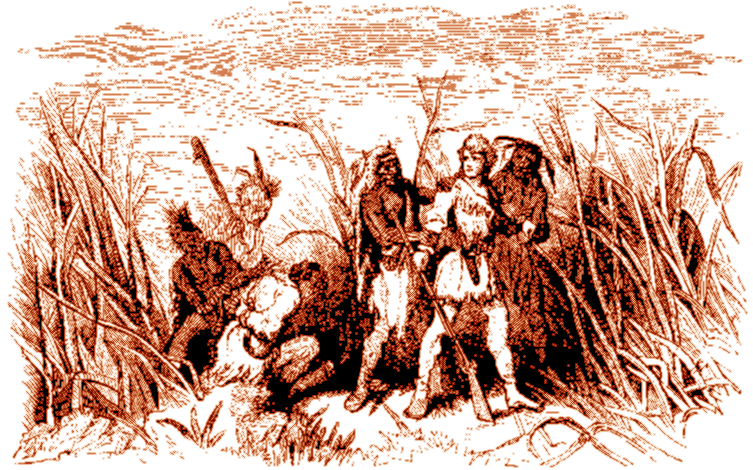
"Capture of Boone and Stuart" from Life & Times of Col. Daniel Boone by Cecil B. Hartley (1859)

Boone first reached Kentucky in the fall of 1767 when on a long hunt with his brother Squire Boone, Jr. While on the Braddock expedition years earlier, Boone had heard about the fertile land and abundant game of Kentucky from fellow wagoner John Findley, who had visited Kentucky to trade with American Indians. Boone and Findley happened to meet again, and Findley encouraged Boone with more tales of Kentucky. At the same time, news had arrived about the Treaty of Fort Stanwix, in which the Iroquois had ceded their claim to Kentucky to the British. This, as well as the unrest in North Carolina due to the Regulator movement, likely prompted Boone to extend his exploration.[13]

On May 1, 1769, Boone began a two-year hunting expedition in Kentucky. On December 22, 1769, he and a fellow hunter were captured by a party of Shawnees, who confiscated all of their skins and told them to leave and never return. The Shawnees had not signed the Stanwix treaty, and since they regarded Kentucky as their hunting ground, they considered white hunters there to be poachers. Boone, however, continued hunting and exploring Kentucky until his return to North Carolina in 1771, and returned to hunt there again in the autumn of 1772.

On September 25, 1773, Boone packed up his family and, with a group of about 50 emigrants, began the first attempt by British colonists to establish a settlement in Kentucky. Boone was still an obscure hunter and trapper at the time; the most prominent member of the expedition was William Russell, a well-known Virginian and future brother-in-law of Patrick Henry. On October 9, Boone's eldest son James and a small group of men and boys who had left the main party to retrieve supplies were attacked by a band of Delawares, Shawnees, and Cherokees. Following the Treaty of Fort Stanwix, American Indians in the region had been debating what to do about the influx of settlers. This group had decided, in the words of historian John Mack Faragher, "to send a message of their opposition to settlement…." James Boone and William Russell's son Henry were captured and gruesomely tortured to death. The brutality of the killings sent shock waves along the frontier, and Boone's party abandoned its expedition.[14]

George Caleb Bingham's Daniel Boone Escorting Settlers through the Cumberland Gap (1851–52) is a famous depiction of Boone.

The massacre was one of the first events in what became known as Dunmore's War, a struggle between Virginia and primarily Shawnees of the Ohio Country for control of what is now West Virginia and Kentucky. In the summer of 1774, Boone volunteered to travel with a companion to Kentucky to notify surveyors there about the outbreak of war. The two men journeyed more than 800 miles (1,300 km) in two months in order to warn those who had not already fled the region. Upon his return to Virginia, Boone helped defend colonial settlements along the Clinch River, earning a promotion to captain in the militia as well as acclaim from fellow citizens. After the brief war, which ended soon after Virginia's victory in the Battle of Point Pleasant in October 1774, Shawnees relinquished their claims to Kentucky.[15]

Following Dunmore's War, Richard Henderson, a prominent judge from North Carolina, hired Boone to travel to the Cherokee towns in present North Carolina and Tennessee and inform them of an upcoming meeting. In the 1775 treaty, Henderson purchased the Cherokee claim to Kentucky in order to establish a colony called Transylvania. Afterwards, Henderson hired Boone to blaze what became known as the Wilderness Road, which went through the Cumberland Gap and into central Kentucky. Along with a party of about thirty workers, Boone marked a path to the Kentucky River, where he established Boonesborough. Other settlements, notably Harrodsburg, were also established at this time. Despite occasional Indian attacks, Boone returned to the Clinch Valley and brought his family and other settlers to Boonesborough on September 8, 1775.[16]


American Revolution

Violence in Kentucky increased with the outbreak of the American Revolutionary War (1775–1783). Native Americans who were unhappy about the loss of Kentucky in treaties saw the war as a chance to drive out the colonists. Isolated settlers and hunters became the frequent target of attacks, convincing many to abandon Kentucky. By late spring of 1776, fewer than 200 colonists remained in Kentucky, primarily at the fortified settlements of Boonesborough, Harrodsburg, and Logan's Station.[17]

This 1877 illustration, entitled The rescue of Jemima Boone and Betsey and Fanny Callaway, kidnapped by Indians in July 1776, is one of many depictions of the famous event.

On July 14, 1776, Boone's daughter Jemima and two other teenage girls were captured outside Boonesborough by an Indian war party, who carried the girls north towards the Shawnee towns in the Ohio country. Boone and a group of men from Boonesborough followed in pursuit, finally catching up with them two days later. Boone and his men ambushed the Indians while they were stopped for a meal, rescuing the girls and driving off their captors. The incident became the most celebrated event of Boone's life. James Fenimore Cooper created a fictionalized version of the episode in his classic book The Last of the Mohicans (1826).[18]

In 1777, Henry Hamilton, a British Lieutenant Governor of Canada, began to recruit American Indian war parties to raid the Kentucky settlements. On April 24, Shawnees led by Chief Blackfish attacked Boonesborough. A bullet struck Boone's ankle, smashing the bone, but he was carried back inside the fort amid a flurry of bullets by Simon Kenton, a recent arrival at Boonesborough. Kenton became Boone's close friend as well as a legendary frontiersman in his own right.

While Boone recovered, Shawnees kept up their attacks outside Boonesborough, destroying the surrounding cattle and crops. With the food supply running low, the settlers needed salt to preserve what meat they had, and so in January 1778 Boone led a party of thirty men to the salt springs on the Licking River. On February 7, 1778, when Boone was hunting meat for the expedition, he was surprised and captured by warriors led by Blackfish. Because Boone's party was greatly outnumbered, he convinced his men to surrender rather than put up a fight.

Blackfish wanted to continue to Boonesborough and capture it, since it was now poorly defended, but Boone convinced him that the women and children were not hardy enough to survive a winter trek. Instead, Boone promised that Boonesborough would surrender willingly to the Shawnees the following spring. Boone did not have an opportunity to tell his men that he was bluffing in order to prevent an immediate attack on Boonesborough, however. Boone pursued this strategy so convincingly that many of his men concluded that he had switched his loyalty to the British.

Illustration of Boone's ritual adoption by the Shawnees, from Life & Times of Col. Daniel Boone, by Cecil B. Hartley (1859)

Boone and his men were taken to Blackfish's town of Chillicothe where they were made to run the gauntlet. As was their custom, the Shawnees adopted some of the prisoners into the tribe to replace fallen warriors; the remainder were taken to Hamilton in Detroit. Boone was adopted into a Shawnee family at Chillicothe, perhaps into the family of Chief Blackfish himself, and given the name Sheltowee ("Big Turtle"). On June 16, 1778, when he learned that Blackfish was about to return to Boonesborough with a large force, Boone eluded his captors and raced home, covering the 160 miles (260 km) to Boonesborough in five days on horseback and, after his horse gave out, on foot.[19]

During Boone's absence, his wife and children (except for Jemima) had returned to North Carolina, fearing that he was dead. Upon his return to Boonesborough, some of the men expressed doubts about Boone's loyalty, since after surrendering the salt making party he had apparently lived quite happily among the Shawnees for months. Boone responded by leading a preemptive raid against the Shawnees across the Ohio River, and then by helping to successfully defend Boonesborough against a 10-day siege led by Blackfish, which began on September 7, 1778.

After the siege, Captain Benjamin Logan and Colonel Richard Callaway—both of whom had nephews who were still captives surrendered by Boone—brought charges against Boone for his recent activities. In the court-martial that followed, Boone was found "not guilty" and was even promoted after the court heard his testimony. Despite this vindication, Boone was humiliated by the court-martial, and he rarely spoke of it.[20]

After the trial, Boone returned to North Carolina in order to bring his family back to Kentucky. In the autumn of 1779, a large party of emigrants came with him, including (according to tradition) the family of Abraham Lincoln's grandfather.[21] Rather than remain in Boonesborough, Boone founded the nearby settlement of Boone's Station. Boone began earning money at this time by locating good land for other settlers. Transylvania land claims had been invalidated after Virginia created Kentucky County, and so settlers needed to file new land claims with Virginia. In 1780, Boone collected about $20,000 in cash from various settlers and traveled to Williamsburg to purchase their land warrants. While he was sleeping in a tavern during the trip, the cash was stolen from his room. Some of the settlers forgave Boone the loss; others insisted that he repay the stolen money, which took him several years to do.

A popular image of Boone which emerged in later years is that of the backwoodsman who had little affinity for "civilized" society, moving away from places like Boonesborough when they became "too crowded". In reality, however, Boone was a leading citizen of Kentucky at this time. When Kentucky was divided into three Virginia counties in November 1780, Boone was promoted to lieutenant colonel in the Fayette County militia. In April 1781, Boone was elected as a representative to the Virginia General Assembly, which was held in Richmond. In 1782, he was elected sheriff of Fayette County.[22]

Meanwhile, the American Revolutionary War continued. Boone joined General George Rogers Clark's invasion of the Ohio country in 1780, fighting in the Battle of Piqua on August 7. In October, when Boone was hunting with his brother Ned, Shawnees shot and killed Ned. Apparently thinking that they had killed Daniel Boone, the Shawnees beheaded Ned and took the head home as a trophy. In 1781, Boone traveled to Richmond to take his seat in the legislature, but British dragoons under Banastre Tarleton captured Boone and several other legislators near Charlottesville. The British released Boone on parole several days later. During Boone's term, Cornwallis surrendered at Yorktown in October 1781, but the fighting continued in Kentucky unabated. Boone returned to Kentucky and in August 1782 fought in the Battle of Blue Licks, in which his son Israel was killed. In November 1782, Boone took part in another Clark expedition into Ohio, the last major campaign of the war.


Businessman on the Ohio

After the Revolution, Boone resettled in Limestone (renamed Maysville, Kentucky in 1786), then a booming Ohio River port. In 1787, he was elected to the Virginia state assembly as a representative from Bourbon County. In Maysville, he kept a tavern and worked as a surveyor, horse trader, and land speculator. He was initially prosperous, owning seven slaves by 1787, a relatively large number for Kentucky at the time, which was dominated by small farms rather than large plantations. Boone became something of a celebrity while living in Maysville: in 1784, on Boone's 50th birthday, historian John Filson published The Discovery, Settlement And present State of Kentucke, a book which included a chronicle of Boone's adventures.[23]

Although the Revolutionary War had ended, the border war with American Indians north of the Ohio River soon resumed. In September 1786, Boone took part in a military expedition into the Ohio Country led by Benjamin Logan. Back in Limestone, Boone housed and fed Shawnees who were captured during the raid and helped to negotiate a truce and prisoner exchange. Although the Northwest Indian War escalated and would not end until the American victory at the Battle of Fallen Timbers in 1794, the 1786 expedition was the last time Boone saw military action.[24]

This engraving by Alonzo Chappel (c. 1861) depicts an elderly Boone hunting in Missouri.

Boone began to have financial troubles while living in Maysville. According to the later folk image, Boone the trailblazer was too unsophisticated for the civilization which followed him and which eventually defrauded him of his land. Boone was not the simple frontiersman of legend, however: he engaged in land speculation on a large scale, buying and selling claims to tens of thousands of acres. The land market in frontier Kentucky was chaotic, and Boone's ventures ultimately failed because his investment strategy was faulty and because his sense of honor made him reluctant to profit at someone else's expense. According to Faragher, "Boone lacked the ruthless instincts that speculation demanded."[25]

Frustrated with the legal hassles that went with land speculation, in 1788 Boone moved upriver to Point Pleasant, Virginia (now West Virginia). There he operated a trading post and occasionally worked as a surveyor's assistant. When Virginia created Kanawha County in 1789, Boone was appointed lieutenant colonel of the county militia. In 1791, he was elected to the Virginia legislature for the third time. He contracted to provide supplies for the Kanawha militia, but his debts prevented him from buying goods on credit, and so he closed his store and returned to hunting and trapping.

In 1795, he and Rebecca moved back to Kentucky, living in present Nicholas County on land owned by their son Daniel Morgan Boone. The next year, Boone applied to Isaac Shelby, the first governor of the new state of Kentucky, for a contract to widen the Wilderness Road into a wagon route, but the governor did not respond and the contract was awarded to someone else. Meanwhile, lawsuits over conflicting land claims continued to make their way through the Kentucky courts. Boone's remaining land claims were sold off to pay legal fees and taxes, but he no longer paid attention to the process. In 1798, a warrant was issued for Boone's arrest after he ignored a summons to testify in a court case, although the sheriff never found him. That same year Kentucky named Boone County in his honor.


Missouri

In 1799, Boone moved out of the United States to Missouri, which was then part of Spanish Louisiana. The Spanish, eager to promote settlement in the sparsely populated region, did not enforce the legal requirement that all immigrants had to be Catholics. Boone, looking to make a fresh start, emigrated with much of his extended family to what is now St. Charles County. The Spanish governor appointed Boone "syndic" (judge and jury) and commandant (military leader) of the Femme Osage district. The many anecdotes of Boone's tenure as syndic suggest that he sought to render fair judgments rather than to strictly observe the letter of the law.

Boone served as syndic and commandant until 1804, when Missouri became part of the United States following the Louisiana Purchase. Because Boone's land grants from the Spanish government had been largely based on verbal agreements, he once again lost his land claims. In 1809, he petitioned Congress to restore his Spanish land claims, which was finally done in 1814. Boone sold most of this land to repay old Kentucky debts. When the War of 1812 came to Missouri, Boone's sons Daniel Morgan Boone and Nathan Boone took part, but by that time Boone was too old for militia duty.

A portrait of Boone by John James Audubon

Boone spent his final years in Missouri, often in the company of children and grandchildren. He hunted and trapped as often as his failing health allowed. According to one story, in 1810 or later Boone went with a group on a long hunt as far west as the Yellowstone River, a remarkable journey at his age, if true. Other stories of Boone around this time have him making one last visit to Kentucky in order to pay off his creditors, although some or all of these tales may be folklore. American painter John James Audubon claimed to have gone hunting with Boone in the woods of Kentucky around 1810. Years later, Audubon painted a portrait of Boone, supposedly from memory, although skeptics have noted the similarity of this painting to the well-known portraits by Chester Harding. Boone's family insisted that he never returned to Kentucky after 1799, although some historians believe that Boone visited his brother Squire near Kentucky in 1810 and have therefore reported Audubon's story as factual.[26]

Boone's gravesite in Frankfort, Kentucky

Boone died on September 26, 1820, at Nathan Boone's home on Femme Osage Creek. His last words were, "I'm going now. My time has come." He was buried next to Rebecca, who had died on March 18, 1813. The graves, which were unmarked until the mid-1830s, were near Jemima (Boone) Callaway's home on Tuque Creek, about two miles (3 km) from present day Marthasville, Missouri. In 1845, the Boones' remains were disinterred and reburied in a new cemetery in

Start your search on Daniel Boone.


Forgotten Founders Historic Documents and Coins of Freedom - By Stanley L. Klos - Last Exhbit at the 2008 GOP Convention: http://www.pinellasrepublican.org/

Forgotten Founders Historic Documents and Coins of Freedom - By Stanley L. Klos


Uncommon Sense: President Obama and
US China Trade 1784-2009

The United Colonies 1st government began in a Philadelphia Tavern
and the United States 1st federal government ended in a NYC Tavern!
The Founders convened the government in 11 different capitol buildings and
experienced 15 years of challenges that included war, hyper-inflation, a failed
constitution, judicial corruption, armed citizen and U.S. Army rebellions.


Unauthorized Site: This site and its contents are not affiliated, connected, associated with or authorized by the individual, family, friends, or trademarked entities utilizing any part or the subject's entire name. Any official or affiliated sites that are related to this subject will be hyper linked below upon submission and Evisum, Inc. review.

Research Links

  • Mariner Museum
  • Lewis & Clark National Historic Trail

    Copyright© 2000 by Evisum Inc.TM. All rights reserved.
    Evisum Inc.TM Privacy Policy

  • Search:

    About Us

    e-mail us


    Historic Holiday Gifts Form Men Who Know Almost Everything

    Commentary


    Books For Sale
    Click Here


    Virtual Museum of Art | Virtual Museum of History | Virtual Public Library | Virtual Science Center | Virtual Museum of Natural History | Virtual War Museum


    Estoric.com - A Stan Klos Company
