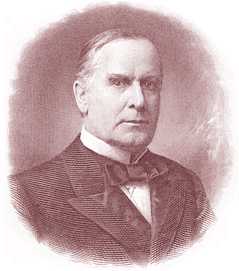
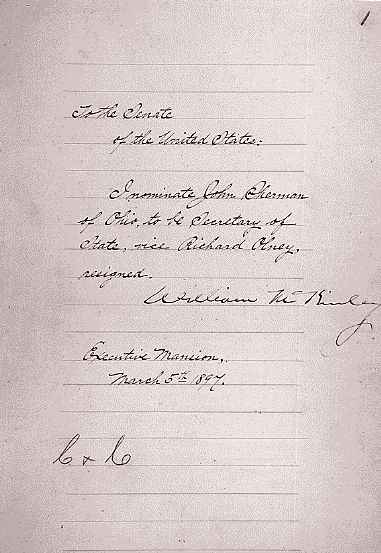
WILLIAM McKinley, Jr. was born in
Niles, Ohio on January 29, 1843. He was the seventh of the nine children of
William and Nancy Allison McKinley. Both of his grandfathers had fought in the
Revolutionary War and his father’s father had opened a small iron foundry and
settled in Niles, Ohio. His mother was a strong woman and a leader in their
small village. When William was nine, she moved her family to nearby Poland,
Ohio in order that they could pursue a better education, leaving their father
behind for a few years to manage the family foundry.
McKinley was enrolled at Poland Seminary, which was a private school, and
he studied there for eight years. He showed great skills in oratory and became
president of the Everett Literary and Debating Society. His mother held a great
influence over young McKinley and he was greatly attached to her. She had hopes
that he would enter the Methodist ministry and he accepted without question her
strict moral standards.
When he was seventeen, McKinley went to Allegheny College in Meadville,
Pennsylvania. However, his studies there were cut short by an illness. He
returned home in 1861 and taught school briefly. That same year as the Civil War
broke out, McKinley enlisted in the 23rd Ohio Volunteers. His superior officer
was Major Rutherford B. Hayes, the future president of the United States.
McKinley’s bravery under fire impressed Hayes and he was promoted and
eventually made an aide on Hayes’s staff. McKinley left the army in 1865 with
the rank of major.
After the war, McKinley began the study of law in the office of county
judge Charles E. Glidden of Youngstown. In 1866 he attended law school in
Albany, New York and the following year was admitted to the Ohio bar. He settled
in Canton, Ohio to practice law and participate in politics. He was moderately
successful as a lawyer, but became one of Canton’s most popular citizens. He
worked successfully on the campaign of Hayes, his former commanding officer. In
1869, Republican McKinley was elected the prosecuting attorney for Democratic
Stark County. He also had met his future wife, Ida Saxton, daughter of a wealthy
Canton businessman and banker. Two yea.rs later, on January 25, 1871, they were
married. The couple had two daughters, Katherine McKinley, born in 1871 and Ida
McKinley, who died after five months. After Ida’s death in 1873, Mrs. McKinley
suffered a mental breakdown and when Katherine died from typhoid fever in 1873,
it became more than she could bear. She suffered seizures and bouts of mental
depression for the rest of her life
In 1876, McKinley at the age of 33 was elected to represent the
northeastern Ohio district in Congress. He held that seat for 14 years with the
exception of one term. He was noted for his honesty, and as a powerful speaker
– a hardworking, conservative politician.
In 1889, McKinley was elected chairman of the House Ways and Means
Committee, which developed financial legislation and he became a prominent
national figure. In 1890, he wrote the McKinley Tariff Act that imposed the
highest tariffs that the United States had ever placed on imports. It was
devised to protect all American manufacturers but it was very unpopular because
it made it hard for Americans to purchase cheap foreign goods.
McKinley attracted the attention of Cleveland industrialist, Marcus A.
Hanna who was eager to be the maker of a president and to be the man who
exercised power behind the scenes. McKinley was a champion of protective tariffs
and an extremely popular politician and with Hanna’s help, he was elected
Governor of Ohio in 1891. Governor McKinley supported tax reform including
higher rates for corporations and even though he had called out the National
Guard on a coal miner strike that had turned violent, he retained the support of
the workingman.
In 1893, McKinley’s political career was almost ruined when a friend
went bankrupt and left McKinley responsible for debt of $130,000 through bank
notes he had endorsed. Hanna and his wealthy friends who repaid the debt saved
McKinley.
In 1896, with the aid of Hanna, who had left his private business to
devote full time to his candidacy, McKinley was nominated for the presidency.
His opponent was William Jennings Bryan, the Democratic nominee. The campaign
was unusual. Bryan toured the country delivering his famous “cross of gold”
speech and McKinley waged a “front porch” campaign from his home in Canton.
Hanna urged big businesses to rally in support of McKinley and they contributed
an unprecedented sum of $3.5 million to the Republican campaign. The country was
flooded with McKinley pamphlets and posters and factory managers warned their
workers that a victory for Bryan would mean depression and loss of their jobs.
Sweeping all the large industrial states, McKinley won the election by 271
electoral votes to Bryan’s 176. The Republicans also won control of both
houses of Congress. During the next four years McKinley was able to fulfill
party pledges and for the next 14 years, there was unbroken Republican control
of the Presidency, the Senate and the House.
At 54 years of age, McKinley was a handsome vigorous man at his
inauguration. Despite Ida’s poor health, she accompanied her husband and took
part in many of the social activities of the White House. McKinley never allowed
formal duties to interfere with his care for her. His attentiveness to her and
his concern for domestic harmony was mirrored in his efforts to seek harmony in
society at large.
In the friendly atmosphere of the McKinley Administration, industrial
combinations developed at an unprecedented pace. Prosperity returned and took
the demands for economic reform out of the picture. McKinley openly represented
large business interests; he sponsored no reform legislation and ignored
existing laws that were designed to regulate big business. But foreign policy
dominated the McKinley Administration, as many businesses began to favor
expanded foreign trade to obtain new markets for their products.
On February 15, 1898, the American battleship Maine exploded in the
Havana, Cuba harbor and 266 men died. On April 25th, Congress enacted a
resolution declaring war on Spain and in the 100-day war; the United States
destroyed the Spanish fleet outside Santiago harbor in Cuba, seized Manila in
the Philippines and occupied Puerto Rico. Successful conclusion of the war with
Spain brought peace to Cuba and economic concessions to American business.
McKinley also supported the annexation of Hawaii in 1898. In 1893,
American businessmen had overthrown Hawaiian Queen Liliuokalani with help from
American troops. President Grover Cleveland had found the rebellion dishonorable
and refused to annex the islands. McKinley saw the issue differently stating the
country needed Hawaii just as much and more that we did California.
In 1900, McKinley again campaigned against Bryan. Although McKinley did
not personally campaign, he received the largest popular majority ever given a
presidential candidate up to that time. He led in electoral votes 292 to 155.
On March 4, 1901, McKinley was inaugurated for a second time. His term
began auspiciously, but came to a tragic end in September. He appeared at the
Pan American Exposition in Buffalo, New York to make an important speech on
America’s world role. On September 6th, while greeting visitors in the Temple
of Music at the fair, twice Leon Czolgosz, a deranged anarchist, shot McKinley.
One bullet grazed his ribs and a second bullet penetrated his abdomen. The crowd
pounced upon Czolgosz and only McKinley’s order “Don’t let them hurt
him” saved Czolgosz from a fatal beating. Despite early hopes for his
recovery, McKinley died eight days later on September 14, 1901 in Buffalo.
Czolgosz was executed in October in Auburn, New York.
Presidents
of the Continental Congress
United Colonies of The United States
Peyton
Randolph September 5, 1774 to October 22, 1774
and May 20 to May 24, 1775
Henry Middleton October 22, 1774 to October 26, 1774
The Vice President
Speaker of the House
President pro tempore of the Senate
Secretary of State
Secretary of the Treasury
Secretary of Defense
Attorney General
Secretary of the Interior
Secretary of Agriculture
Secretary of Commerce
Secretary of Labor
Secretary of Health and Human Services
Secretary of Housing and Urban Development
Secretary of Transportation
Secretary of Energy
Secretary of Education
Secretary of Veterans Affairs
Research
Links
Virtualology is
not affiliated with the authors of these links nor responsible for its content.
Franklin
D. Roosevelt Library and Museum - Repository of the records of President
Franklin Roosevelt and his wife Eleanor Roosevelt, managed by the National
Archives and Records Administration.
Dwight
D. Eisenhower Presidential Library - preserves and makes available for
research the papers, audiovisual materials, and memorabilia of Dwight and Mamie
D. Eisenhower
Unauthorized Site:
This site and its contents are not affiliated, connected,
associated with or authorized by the individual, family,
friends, or trademarked entities utilizing any part or
the subject's entire name. Any official or affiliated
sites that are related to this subject will be hyper
linked below upon submission
and Evisum, Inc. review.
Please join us in our mission to incorporate The Congressional Evolution of the United States of America discovery-based curriculum into the classroom of every primary and secondary school in the United States of America by July 2, 2026, the nation’s 250th birthday. , the United States of America: We The
People. Click Here