Who was
the First U.S. President? There were actually four first
Presidents
of the United Colonies and States of America Click Here
New Page 1
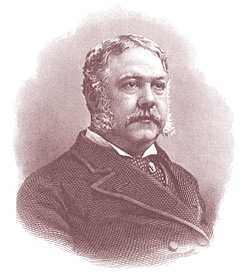
Chester A. Arthur 31st President of the United States
21st under the US Constitution
Chester Alan Arthur was born
on October 5, 1829 in Fairfield, Vermont. His father, William Arthur, was an
Irish-born Baptist minister and schoolteacher, and his mother, Malvina Stone
Arthur, was born in New Hampshire. The Arthur’s had five daughters and two
sons, of whom Chester was the eldest son.
William Arthur was an eloquent preacher and moved constantly from one town
to another. The family lived in several towns in Vermont and northern New York
before they moved to Saratoga County, New York, in 1839. Chester attended an
academy at Union Village (now Greenwich), New York. In 1844, the Arthur’s
moved to Schenectady and Chester was admitted to Union College. Chester’s
father had taught him Latin and Greek and even though he was only 15, he was
admitted to the college as a sophomore. Chester began to teach during the long
winter vacations, because his father could not help him financially. After
graduating near the top of his class at 18, he continued to teach at North
Pownal, Vermont and in 1852 he became the principal of the academy at Cohoes,
New York while studying law at home. He joined the law office of Culver and
Parker in New York City to continue his training and was admitted to the bar in
1854. He gained a reputation as a supporter of civil rights for blacks, and in
1855 won a case guaranteeing the rights of blacks to ride streetcars in New York
City.
In 1856, he formed his own law firm in the Wall Street district. To build
up his practice, he joined clubs to make acquaintances. He became an active
member in the ranks of the newborn Republican Party and soon had friends in
prominent literary and political circles. He could speak well on literature,
politics or fishing which happened to be his only sport. The young Arthur was a
striking figure, tall, with black eyes and brown hair. He went to the best
tailors, wore the latest fashions and was considered well informed and amusing.
He fell in love with Ellen Lewis Herndon, of Fredericksburg, Virginia, who was
living in New York City with her mother. Her father, Captain William Lewis
Herndon, was an explorer of the Amazon who had died a heroic death in the
Caribbean after saving many lives. Ellen and her mother belonged to a prominent
social group. The couple was married on October 25, 1859 and they had three
children: William Lewis Herndon Arthur (1860-1863); Chester Alan Arthur
(1864-1937); and Ellen Herndon Arthur (1871-1915).
In 1860 Arthur campaigned in New York City for presidential candidate
Abraham Lincoln. He also worked for the reelection of Edwin D. Morgan as
Governor of New York, and when Morgan won, he appointed Arthur engineer in chief
of his military staff, which was an honorary post. At the outbreak of the Civil
War in 1861, Morgan asked Arthur to take over the duties of quartermaster
general in New York City. The post involved supplying barracks, food, uniforms,
and equipment to thousands of troops who passed through the city. He supervised
the equipping of more than 220,000 volunteers before 1863, when he resigned
after a Democrat was elected governor.
After his return to private life, Arthur resumed his law practice and
remained active in the Republican Party of New York, making himself
indispensable to the political machine run by U. S. Senator Roscoe Conkling. The
political machine organized voters for the support of a candidate and dedicated
loyal workers were rewarded with government jobs in return for their services to
the “machine”. In 1871, Conkling persuaded President Ulysses S. Grant to
appoint Arthur as collector of customs for the Port of New York. This was a
great political appointment for Arthur, and he became the undisputed political
leader of New York City. In 1877, President Hayes who had pledged civil service
reform ordered an investigation of the customhouse. Arthur and two aids were
asked to resign and they refused. However, in the summer of 1878, Hayes fired
Arthur, giving the customs job to someone else that the Senate had later
approved. Arthur once again returned to New York City and to his law practice.
In 1880, the Republican Party was split into two factions, the Stalwarts,
strong believers in party loyalty above all else, and the Half-Breeds, who
believed in minor political reforms. At the Republican National Convention, both
factions were so evenly matched that a candidate could not gain the necessary
majority for nomination. The deadlock in the convention lasted until the 36th
ballot, when James A. Garfield was unexpectedly nominated. To make sure of the
Stalwarts aid in the election, the convention nominated Arthur for vice
president. Garfield won the election and Arthur took the Senate chair, but he
did not lose his interest in New York politics.
After the election, the split in the Republican Party widened. Garfield
made appointments, ignoring Conkling’s political machine. Conkling and New
York’s other Senator, Thomas C. Platt, resigned from the Senate in protest to
Garfield’s appointments. Arthur supported the New York Senators and
accompanied them to Albany to convince the state legislature to give them a vote
of confidence by reappointing them to the Senate. Despite their pleas, the
legislature did not reappoint the two men. Conkling and Plat never again held
public office.
In the middle of this political conflict, Charles J. Guiteau, a crazed
office seeker, shot President Garfield on July 2, 1881. Garfield died eleven
weeks later, on September 19, 1881. During the weeks were Garfield lingered
between life and death, Arthur remained in seclusion as popular indignation
against the Stalwarts ran high.
On September 20, 1881, the morning following Garfield’s death, Arthur
took the oath of office at his home in New York City. His record of party
loyalty greatly handicapped him when he became president. Many Americans
regarded him as little more than Conkling’s puppet. His simple and sincere
inaugural address helped to reassure the people. He came out strong in support
of civil service reform in his first address to congress. In 1883 he signed the
country’s first civil service law, the Pendleton Act, setting up the civil
service commission to conduct examinations for office holders. His
qualifications for the presidency were excellent. He was an experienced
administrator and he had tact and common sense. As a lawyer, he was well versed
in constitutional law.
Perhaps because of the influence of his heroic father-in-law, Arthur has
been called the Father of the American Navy. He took a personal interest in
modernizing and expanding it. The Navy had declined steadily after the Civil War
and in 1882, Congress appropriated money for the nation’s first all-steel
vessels. This was a modest first step in making the United States a major force
in naval power.
Although he was secretly suffering from Bright’s disease, an incurable
kidney ailment, Arthur hoped to be nominated for a second term as president.
Unfortunately, that did not happen and the convention of 1884 nominated Blain.
In the general election, Blaine lost to Grover Cleveland, the Democratic
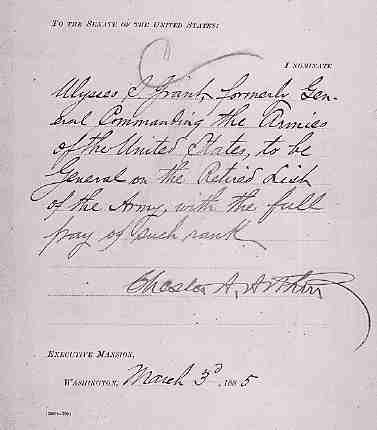
candidate. After turning over the White House to Cleveland on March 4, 1885,
Arthur again resumed his law practice in New York City. Shortly afterward he
became ill and died in 1886.
The Vice President
Speaker of the House
President pro tempore of the Senate
Secretary of State
Secretary of the Treasury
Secretary of Defense
Attorney General
Secretary of the Interior
Secretary of Agriculture
Secretary of Commerce
Secretary of Labor
Secretary of Health and Human Services
Secretary of Housing and Urban Development
Secretary of Transportation
Secretary of Energy
Secretary of Education
Secretary of Veterans Affairs
Research
Links
Virtualology is
not affiliated with the authors of these links nor responsible for its content.
Franklin
D. Roosevelt Library and Museum - Repository of the records of President
Franklin Roosevelt and his wife Eleanor Roosevelt, managed by the National
Archives and Records Administration.
Dwight
D. Eisenhower Presidential Library - preserves and makes available for
research the papers, audiovisual materials, and memorabilia of Dwight and Mamie
D. Eisenhower
Unauthorized Site:
This site and its contents are not affiliated, connected,
associated with or authorized by the individual, family,
friends, or trademarked entities utilizing any part or
the subject's entire name. Any official or affiliated
sites that are related to this subject will be hyper
linked below upon submission
and Evisum, Inc. review.
Please join us in our mission to incorporate The Congressional Evolution of the United States of America discovery-based curriculum into the classroom of every primary and secondary school in the United States of America by July 2, 2026, the nation’s 250th birthday. , the United States of America: We The
People. Click Here