Who was
the First U.S. President? There were actually four first
Presidents
of the United Colonies and States of America Click Here
New Page 1
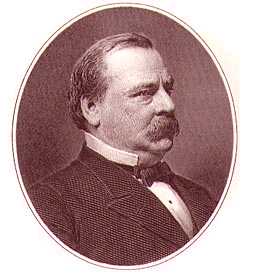
Grover Cleveland 32nd and 34th President of the United States
22nd and 24th under the US Constitution
STEPHEN GROVER CLEVELAND was
born March 18, 1837, the fifth of nine children to Richard Falley Cleveland and
Ann Neal Cleveland. He was named after Stephen Grover, the previous minister of
the church where his father was now pastor. In 1842, the family moved to
Fayetteville, New York, a small farming community on the Erie Canal, where his
father became pastor of the Presbyterian church. Young Cleveland attended the
local school and at 13 attended the Clinton Liberal Institute in nearby Clinton,
New York. His father died suddenly on October 1, 1853 and at 16 young Cleveland
lost any hopes for college. His older brother William was a teacher at the New
York Institute for the Blind and Cleveland was hired on as a teacher. In 1855,
Cleveland left his teaching post. He decided to look for work in Cleveland Ohio
as he wanted to be a lawyer and the west had always intrigued him. On his way,
he stopped to visit his uncle, Lewis Allen a wealthy and nationally famous
cattle breeder in Buffalo, New York. Allen convinced Cleveland to remain in
Buffalo, gave him a job and by 1859 after studying law with friends of his
uncle’s, Cleveland was admitted to the New York bar. He immediately offered a
job with Rodgers, Bowen and Rodgers, which was where he had studied law, and he
accepted. As the Civil War broke out, Cleveland was ever mindful of the support
he provided for his mother and sisters. When he was drafted he borrowed money to
hire a substitute to serve in his place, which was a common practice permitted
under the law.
In 1862, Cleveland was elected Democratic Supervisor of his Buffalo ward
and in 1863, he was appointed assistant district attorney of Erie County. He
crusaded against crime and corruption and made a name for himself. In 1870,
Cleveland ran for Sheriff of Buffalo, and won the election and as Sheriff he
continued his crusade against corruption. His term ended in 1873, and he
returned to practicing law. He becomes one of Buffalo’s most successful
attorneys, owing more to hard work than brilliant talent.
In 1881Cleveland was asked him to run for mayor of Buffalo by the
Democratic Party because of his work against corruption and he accepted. At
forty-four, he was single and moderately wealthy and easily won the election and
took office in 1882. Mayor Cleveland fought the city aldermen who were a corrupt
circle of politicians from both parties. He vetoed bills in an attempt to cut
the political graft that was rampant. He became know as the “veto mayor”.
The party leaders of New York needed a new face in order to reconcile a
deadlock for the nomination of a new Governor. Cleveland was chosen, and running
on his reputation for being an honest politician, he won the election without
making a single campaign speech. As Governor, Cleveland continued his campaign
against corruption and he also continued to liberally apply his veto power.
In 1884, the Republicans nominated James G. Blain, who had been accused of
accepting bribes, for president. In July 1884, the Democrats nominated Cleveland
for president, deciding that with his irrefutable public record, he would win
the votes of both the democrats and the Republicans who were unhappy with their
party’s choice for candidate. The campaign inspired many personal attacks,
with Blain being accused of aiding the railroads at public expense and Cleveland
being accused of fathering a illegitimate child, which Cleveland courageously
acknowledged. Ten years before Cleveland's presidency, store clerk Maria Halpin
named him as the father of her illegitimate son. Cleveland won the election by a
slim margin over Blaine. The electoral votes were Cleveland 219 to Blaine’s
182.
Cleveland was inaugurated March 4, 1885 and continued his independent and
conscientious but conservative course. He continued to fill government posts
with qualified people, not party loyalists and he persuaded Congress to repeal
an act that kept incompetent officeholders in office because of the length of
their service. He found himself continually at odds with the Republican
controlled Senate.
On June 2, 1886, 49-year-old Cleveland became the first and only president
to be married in the White House. Cleveland's bride was his ward, Frances
Folsom, the 22-year-old daughter of his late law partner and friend, Oscar
Folsom. For years, Cleveland acted as executor of Folsom's estate, but no one
suspected his interest in Frances until he proposed marriage after her
graduation from Wells College. The wedding ceremony took place in the Blue Room
with fewer than 40 people present. The couple had five children: Ruth Cleveland
(1891-1904); Ester Cleveland (1893-1980); Marion Cleveland (1895-1977); Richard
Folsom Cleveland (1897-1974) and Francis Grover Cleveland (1903-1995).
In the election of 1888, Cleveland was running against Benjamin Harrison
of Indiana. Although Cleveland received 100,000 more popular votes than
Harrison, he lost the election in electoral votes receiving 168 against
Harrison’s 233.
Cleveland returned to New York City and resumed his law practice in 1889.
However, three years later the Democrats once again nominated him. His
Republican opponent was again Benjamin Harrison. Despite arguments within his
own party, Cleveland decisively defeated President Harrison 277 electoral votes
to 145. Cleveland became the only President to be reelected after defeat.
On March 4, 1893, Cleveland once more took the presidential oath. The
Depression of 1893 struck his administration hard. Some Democrats saw salvation
in free coinage of silver, but Cleveland was able to persuade Congress to repeal
the Sherman Silver Purchase Act in an effort to improve the economic situation.
However, by focusing on monetary policy rather than on direct assistance to the
needy, Cleveland lost the support of his party.
The Democratic party was split by the end of Cleveland’s second term.
They had nominated both William Jennings Bryan and a rival candidate for
president. Cleveland removed himself from the campaign and the Republican
candidate, William McKinley easily defeated both Democratic nominees.
On March 4, 1897, Cleveland turned the presidency over to McKinley and
retired to a home he had purchased in Princeton, New Jersey. He remained a
public figure, lecturing and writing and engaging in business affairs, most
notably as a Trustee of the Equitable Life Assurance Society and as President of
the Association of Life Insurance Presidents. He died in Princeton on June 24,
1908.
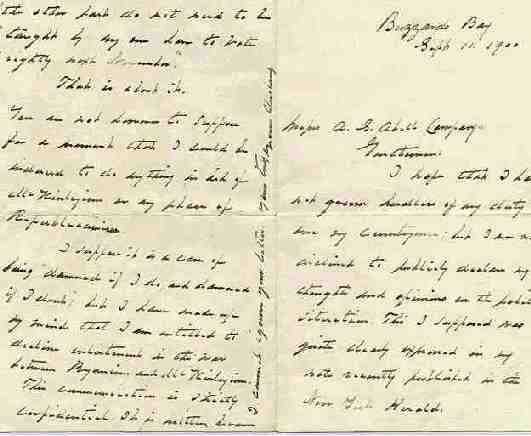
Grover
Cleveland-- Autograph letter signed to A.S. Abell Company, signed “Grover
Cleveland”.Four pages small 8vo
- Pages 1 and 4 and Pages
2 & 3.
Transcript:
Buzzards Bay
Sept. 11, 1900
Msrs. A.S. Abell
Company
Gentlemen:
I hope that I have not grown heedless of any duty I owe my countrymen;
but I am not inclined to publicly declare my strengths and opinions in the
political situation.This I
supposed was quite clearly expressed in my note recently published in the New
York Herald.
For a number of years, I have been abused and ridiculed by professed
democrats, because I have not hesitated to declare that Bryanism is not
Democracy.I have had the
consolation of seeing those who professed to share my belief run to cover, and
of noting a more headlong rush after anti-democratic vagaries.
My opinions have not changed.Why
then should I speak when bedlam is at its height?Perhaps I am too strong in my opinions.At any rate I should say (?) things; and all to no purpose except to add
to the volume of abuse which, undefended, I have so long borne.
I received this morning a clipping from a German newspaper, containing my
note to the Herald with this comment: “That was wise.That part of the American people who most need instruction at this time,
would not listen to Grover Cleveland; but the only thanks they would give him
for his well meant (?) would be to open upon him a new bombardment of poison and
dish; the other part do not seem to be taught by any one (?) to vote right next
November.”
Think about it.You are not
however to suppose for a moment that I could be induced to do anything in aid of
McKinleyism or any phase of Republicanism.
I suppose it is a case of being “damned if I do, and damned if I
don’t”; but I have made up my mind that I am entitled to decline enlistment
in the war between Bryanism and McKinleyism.
This communication is strictly confidential.It is written because I cannot ignore your letter.
Yours truly
Grover Cleveland
Presidents
of the Continental Congress
United Colonies of The United States
Peyton
Randolph September 5, 1774 to October 22, 1774
and May 20 to May 24, 1775
Henry Middleton October 22, 1774 to October 26, 1774
The Vice President
Speaker of the House
President pro tempore of the Senate
Secretary of State
Secretary of the Treasury
Secretary of Defense
Attorney General
Secretary of the Interior
Secretary of Agriculture
Secretary of Commerce
Secretary of Labor
Secretary of Health and Human Services
Secretary of Housing and Urban Development
Secretary of Transportation
Secretary of Energy
Secretary of Education
Secretary of Veterans Affairs
Research
Links
Virtualology is
not affiliated with the authors of these links nor responsible for its content.
Franklin
D. Roosevelt Library and Museum - Repository of the records of President
Franklin Roosevelt and his wife Eleanor Roosevelt, managed by the National
Archives and Records Administration.
Dwight
D. Eisenhower Presidential Library - preserves and makes available for
research the papers, audiovisual materials, and memorabilia of Dwight and Mamie
D. Eisenhower
Unauthorized Site:
This site and its contents are not affiliated, connected,
associated with or authorized by the individual, family,
friends, or trademarked entities utilizing any part or
the subject's entire name. Any official or affiliated
sites that are related to this subject will be hyper
linked below upon submission
and Evisum, Inc. review.