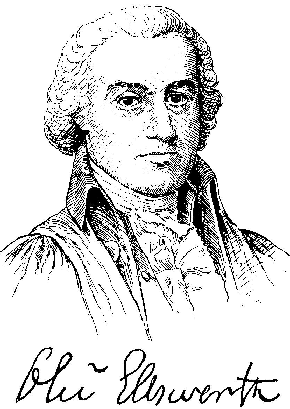
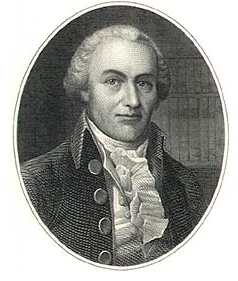
ELLSWORTH,
Oliver, jurist, born in Windsor, Colin., 29 April 1745; died
there, 26 November 1807. He entered Yale in 1762, but afterward went to
Princeton, where he was graduated in 1766. with high rank as a scholar. After a
year's study of theology he abandoned it for the law, and was admitted to the
bar of Hartford County in 1771. He married in the following year, and for three
years divided his attention between farming and practice. Becoming states'
attorney in 1775, he sold his farm, removed to Hartford, and soon acquired a
larger and more remunerative practice than any other member of the Connecticut
bar. As a Whig he was chosen, at the outbreak of the Revolution, to represent
Windsor in the general assembly, was one of the committee of four, called
"the Paytable," that managed all the military finances of the colony,
and in October, 1778, took his seat as a delegate to the Continental congress,
where he served on the marine committee (acting as a board of admiralty) and the
committee of appeals. By yearly election, from 1780 till 1784, he was a member
of the governor's council, in which he held unrivalled influence, and in June
1783, left his seat in congress and, although reelected, declined to serve.
In
1784 he declined the appointment of commissioner of the treasury, tendered by
congress, but accepted a legislative assignment as judge of the Connecticut
superior court, which he held until made a member of the Federal convention at
Philadelphia in May 1787. Here he was conspicuous in advocacy of the rights of
the individual states, and it was on his motion that the words "National
government" were expunged from the constitution and the words "Government
of the United States" substituted. His name was not affixed to that
document, because pressing domestic considerations compelled his return home as
soon as all of the provisions of the constitution had been completed; but his
force and energy were successful the next year in securing its ratification,
against much opposition, in the Connecticut state convention.
When
the new government was organized at New York in 1789, he was one of the senators
from Connecticut, and was chairman of the committee for organizing the U. S.
judiciary, the original bill, in his own handwriting, passing with but slight
alterations, and its provisions being still in force. His watchfulness over the
public expenditures earned for him the title of "the Cerberus of the
Treasury," and his abilities were strenuously exercised in building up
the financial credit of the government, and for the encouragement and protection
of manufactures. John Adams spoke of him as "the finest pillar of
Washington's whole administration," and he was, by common consent, the
Federalist leader in the senate.
He
suggested the mission of John Jay to England in 1794, and by his influence Jay's
treaty, though strenuously opposed in the House of Representatives, was defended
and approved by the senate. In March 1796, he was appointed chief justice of the
U. S. Supreme Court, and served with distinguished ability till 1799, when
President Adams, on the recommendation of the senate, appointed him, with
Patrick Henry and Governor William R. Davie, an extraordinary commission to
negotiate with France, the relations between which nation and the United States
were then severely strained. On reaching Paris, 2 March 1800, they found
Napoleon Bonaparte at the head of the new republic, and soon concluded a
satisfactory adjustment of all disputes.
The
negotiations and discussions were conducted almost exclusively by Judge
Ellsworth, and secured all the points most essential to the securing of peace,
including a recognition from France of the rights of neutral vessels, and an
indemnity for depredations on American commerce. Ill health preventing his
immediate return, Mr. Ellsworth sent home his resignation as chief justice and
visited England, where, while trying the mineral springs at Bath and elsewhere,
he became the recipient of marked attention from the court and from leading
public men, as well as from the English bench and bar. After his return to his
home in April 1801, his impaired health decided him to remain free from the
cares of public life, but in 1802 he was again elected a member of the
governor's council, which acted as a Supreme Court of errors, being the final
court of appeals in Connecticut from all inferior courts of state jurisdiction.
Born April 29, 1745, in Windsor, CT
Died November 26, 1807, in Windsor, CT
Federal Judicial Service:
Supreme Court of the United States, Chief Justice
Nominated by George Washington on March 3, 1796, to a seat vacated by John
Jay; Confirmed by the Senate on March 4, 1796, and received commission on
March 4, 1796. Service terminated on September 30, 1800, due to resignation.
Education:
Princeton University, B.A., 1766
Read law, 1771
Professional Career:
Private practice, Windsor, Connecticut, 1771-1775
Member, Connecticut General Assembly, 1773-1775
Private practice, Hartford, Connecticut, 1775-1784
State's attorney, Hartford, Connecticut, 1777-1785
Delegate, Continental Congress, 1778-1783
Member, Connecticut Council of Safety, 1779
Member, Connecticut Governor's Council, 1784-1785
Judge, Connecticut Superior Court, 1784-1789
Delegate, United States Constitutional Convention, 1787
U.S. Senator from Connecticut, 1789-1796
U.S. Minister Plenipotentiary to France, 1799-1800
Member, Connecticut Governor's Council, 1801-1807
Virtualology is not
affiliated with the authors of these links nor responsible for each Link's
content
Ellsworth, Oliver
... Ellsworth, Oliver, 1745 1807 , American political leader, third Chief
Justice of
the United States (1796 1800), b. Windsor, Conn. A Hartford lawyer, he was ...
USA:
Oliver Ellsworth
A Biography of Oliver Ellsworth (1745-1807). quote
Oliver Ellsworth was born on April 29, 1745 ...
Ellsworth,
Oliver
... Ellsworth, Oliver (1745-1807), one of the nation's founding fathers and
third Chief
Justice of the United States, received half of his undergraduate education ...
Ellsworth,
Oliver
Ellsworth, Oliver (1745 1807), US statesman and jurist, born in Windsor, Conn.;
US senator from Connecticut 1789 96; drafted bill organizing federal courts ...
ELLSWORTH,
Oliver
... 1799. ELLSWORTH, Oliver (1745-1807), American statesman,
third chief justice of the US (1796-99). ...
Oliver Ellsworth
Writings and Biography
Oliver Ellsworth Writings and Biography. Ellsworth, Oliver; 1745-1807; lawyer,
statesman,
judge; member of Continental Congress 1777-1783; member of Governor's ...
Oliver Ellsworth
Oliver Ellsworth. 1745-1807. Connecticut. Connecticut Legislature; Continental
Congress,
1778-83; Governor's Council and State judge; Deputy to United States ...
Oliver
Ellsworth
... Oliver Ellsworth lived from 1745 to 1807. He was an American political
leader and
the third Chief Justice of the United States from 1796 to 1800. Ellsworth was
...
Judges of the United
States Courts
... Topics | Courthouses | Publications | Links | Contact ] Ellsworth, Oliver
Born April
29, 1745, in Windsor, CT Died November 26, 1807, in Windsor, CT Federal ...
National
Historic Landmarks Database
... 1989): From 1782 to 1807, Elmwood was the Connecticut home of Oliver
Ellsworth (1745-1807),
a framer of the United States Constitution, author of the Judiciary ...
Geo
Washington letter to Oliver Ellsworth
... Oliver Ellsworth's lineage* goes as follows: Oliver Ellsworth, April 29,
1745, in
Windsor, CT, d. November 26, 1807 s/o David Ellsworth, 17 Jul 1709-5 Mar 1782
...
Delegates
to the Constitutional Convention: Connecticut
... born on April 29, 1745, in Windsor, CT ... the Pay Table, Oliver Ellsworth
was one ... in early
1801, Ellsworth retired from public ... on November 26, 1807, and was buried ...
Oliver
Ellsworth Homestead
... Born in 1745, Oliver Ellsworth was one of the ... Ellsworth and his wife,
Abigail Wolcott ... they
remained until his death in 1807. While living at the Homestead ...
Anti-Federalist
Society
... Chapel Cemetery, Millwood, Va. (See also his congressional biography.)
Ellsworth,
Oliver (1745-1807) Father of William Wolcott Ellsworth. Born in Windsor, Conn
...
Sectionalism
... , Oliver Ellsworth (1745-1807) Connecticut Senator, jurist Oliver Ellsworth
and Rufus King corner John Taylor of Caroline County, Virginia in a Senate ...
Unauthorized Site:
This site and its contents are not affiliated, connected,
associated with or authorized by the individual, family,
friends, or trademarked entities utilizing any part or
the subject's entire name. Any official or affiliated
sites that are related to this subject will be hyper
linked below upon submission
and Evisum, Inc. review.
Please join us in our mission to incorporate The Congressional Evolution of the United States of America discovery-based curriculum into the classroom of every primary and secondary school in the United States of America by July 2, 2026, the nation’s 250th birthday. , the United States of America: We The
People. Click Here