The War
of 1812 was a 32-month military conflict in which the United States took on the
greatest naval power in the world, Great Britain, in a conflict that would have
an immense impact on the young country's future.The war resulted in no
territorial change between the British Empire and the USA, but a resolution of
many issues which remained from the 1783 Treaty of Paris.
CAUSES WHICH LED
TO THE WAR (1)
The war which began in the year 1812 between Great
Britain and the United States of America, although it originated in an imperial
quarrel, and was carried on mainly by British money and largely by British
troops, was essentially a Canadian contest. Canada was the scene of most of the
battles of the war; it was for the purpose of separating Canada from the British
crown that the war was undertaken; and it was owing to the loyalty, constancy
and courage of the Canadian people that this object was foiled. Every Canadian
can, therefore, look back with feelings of just pride to this war so honourable
to his ancestors, and so worthy of being remembered for the example which it
affords of the difficulty of subduing a resolute and free people with arms in
their hands and with the courage to use them.
At the close of the War of the Revolution there was much bitterness felt towards
Great Britain by the people who had won their independence from her by the
sword. This independence had been gained by the assistance of France, and
although that country was then a monarchy, beyond all comparison more illiberal
than the government of Great Britain, it was perhaps but natural that the new
nation should turn to France and cultivate her friendship. The tremendous
revolution which broke out in that country a few years later, at first only
served to cement the ties of sympathy between France and the United States; and
although its subsequent excesses estranged Washington and many other eminent
men, there still remained a large and extremely violent party, headed by
Jefferson, which was ready to condone all the faults of the French republic, and
which felt an undying enmity to Great Britain. It was at this period that
parties began to form themselves, and that the terms " Federalist," and "
Democrat," were heard for the first time. The Democrats, of whom Jefferson was
the head, showed an extreme hostility to Great Britain, while the Federalists,
although not deficient in patriotism, held much more moderate views and were
disposed to cultivate her friendship.
The war which broke out in 1792 between France and Great Britain, and which
continued with but a short interval for more than twenty years, drew still more
sharply the lines between these two parties. The French government sent out
"Citizen" Genet as minister to the United States, and he forthwith proceeded,
with the the active cooperation of the anti-British party, to make that country
a base for the prosecution of war against the commerce of Great Britain.
Washington, who was then president, issued a proclamation of neutrality, warning
citizens of the United States not to take part in the contest, but so strong was
the feeling in favour of France, that the proclamation and its author were
assailed in such terms as a citizen of the United States of the present day must
blush to read. It was styled a "royal edict," "a daring and unwarrantable
assumption of executive power," and Washington was denounced as a "Monarchist,"
and a friend of England. Many of these attacks on the president appeared in the
National Gazette, but it was not until Freneau, its editor, was nearing the dark
valley of death that it was disclosed that these violent articles against
Washington were written or dictated by Thomas Jefferson, who figures as the
author of the Declaration of Independence, and who, at the very time these
attacks were made, was secretary of state in Washington's Cabinet.
The French minister, Genet, in defiance of Washington's proclamation, proceeded
to fit out privateers in Philadelphia to prey upon British commerce, these
privateers being manned by citizens of the United States. When the president
released some British prizes which had been taken by them and carried into
Philadelphia to be condemned, Genet stormed and raved and announced his
intention of appealing from the president to the people. This was virtually a
threat to excite an insurrection for the purpose of overthrowing the authority
of a chief magistrate elected by the people; yet so mentally debauched had
Jefferson become that his newspaper actually sustained Genet in this course. The
organ of this model secretary of state expressed the hope that the friends of
France would act with firmness and spirit, saying, "The people are his friends,
or the friends of France, and he will have nothing to apprehend." It turned out,
however, that "Citizen" Genet had something to apprehend,—the indignation of
Washington, who requested the French government to recall its minister.
In the meantime the death struggle between Great Britain and France was
producing a series of retaliatory measures which proved ruinous to the neutral
trader. In June, 1793, an order-in-council was issued by the British government
declaring that all vessels laden with breadstuff's bound to any port of France,
or places occupied by French armies, should be carried to England, and their
cargoes either disposed of there, or security given that they would be sold only
in a country which was friendly towards Great Britain. This was followed in
November of the same year by another orderin-council which directed British war
vessels and privateers to detain all ships carrying the produce of any colony
belonging to France, or conveying provisions or other supplies for the use of
such colonies, and to bring the same with their cargoes to legal adjudication in
the British courts of admiralty.
These orders-in-council fell with heavy effect on the commerce of the United
States, and produced a corresponding degree of indignation. This was increased
by another measure adopted about the same time by the British government— the
impressment of British seamen found on board of American vessels. This measure
was based on the doctrine, then recognized by all European nations, that a
subject could not renounce his allegiance, and that the government under whose
flag he was born had a right to his services wherever he might be found. This
involved the right of search both of war vessels and commercial ships—a claim
most obnoxious in every way, but more especially as the exercise of this right
was liable to great abuse. It is singular that in 1861, long after the right of
search had been abandoned by Great Britain, it was revived by Commodore Wilkes
of the United States navy, when he boarded the British mail steamer Trent, and
took from her Messrs. Mason and Slidell, the Confederate commissioners then on
their way to England. It is still more singular that this act, so universally
condemned in Great Britain, was almost as universally approved by public opinion
in the United States; so true is it that nations are generally guided in their
views of public questions by motives of expediency and self-interest. Congress,
in 1812, regarded the exercise of the right of search by Great Britain as a
"crying enormity," and declared war against her for that cause, yet Congress in
1861 passed a vote of thanks to Commodore Wilkes for his exercise of the right
of search in an extremely aggravated form. In neither case was Congress
fortunate in its expression of opinion, for in 1815 the government of the United
States was forced to conclude a treaty of peace with Great Britain in which the
right of search, the ostensible cause of the war, was not so much as mentioned,
while in 1861, a few days after the vote of thanks was passed, the same
government was obliged to give up Messrs. Mason and Slidell, on the demand of
the British government, and acknowledge itself in the wrong.
For the purpose of endeavouring to effect a settlement of the difficulties which
had arisen out of the enforcement of the orders-in-council and the right of
search, Washington sent John Jay, chief justice of the United States, as envoy
extraordinary to the court of Great Britain. The result of this mission was what
is known as the Jay Treaty, which, after providing for the disposal of most of
the unsettled questions between the two countries, contained a number of
commercial provisions which proved of great advantage to the United States.
Under it American vessels were allowed to enter British ports in Europe and the
East Indies on equal terms with British vessels, while participation in the East
Indian coasting trade, and trade between European and British East Indian ports
was left to the contingency of British permission. American vessels not
exceeding seventy tons were allowed to trade with the British West Indies on
condition that they should not, during the continuance of the treaty, transport
from America to Europe any of the principal colonial products. British vessels
were to be admitted into American ports on the same terms as those of the most
favoured nation. There were provisions for the protection of neutral property on
the high seas; these provided that a vessel entering a blockaded port should not
be liable to capture unless previously notified of the blockade. There were also
arrangements to prevent the arming of the privateers of any nation at war with
the two contracting parties, and the capture of goods in the bays and harbours
of either nation. In the event of war between the two countries, the citizens or
subjects of either were not to be molested, if peaceable; and fugitives from
justice charged with high crimes were to be mutually given up. The commercial
arrangements of the treaty were limited in their operation to two years after
the termination of the war in which Great Britain was then engaged. The treaty
was ratified by the Senate and signed by the president in the summer of 1795.
It might have been supposed that this treaty, which was extremely favourable to
the commerce of the United States, would have been received with satisfaction by
the people of that country, but it was far otherwise. The Democrats had resolved
to oppose it no matter what its provisions might be, especially if it should
remove all pretext for a war with Great Britain. They had already disclosed the
spirit which influenced them by their violent opposition to Jay's appointment,
and when the treaty was before the Senate efforts were made to intimidate the
members of that body so that they might refuse to ratify it. Democratic
newspapers told their readers that they should blush to think, "America should
degrade herself so much as to enter into any kind of a treaty with a power now
tottering on the brink of ruin." France, according to these newspapers, was the
natural ally of the United States, and the nation on whom their political
existence depended. "The nation on whom our political existence depends," said
one of these publications, "we have treated with indifference bordering on
contempt. Let us unite with France and stand or fall together." These words so
truthfully stated the result of the War of 1312 that they may be regarded as
almost prophetic. The United States did virtually unite with France, and
together they fell.
When the treaty was ratified and signed, Mr. Jay, the senators, and the
president became the objects of a storm of vituperation from the entire
Democratic party. Jay was denounced as a traitor who had been purchased by
British gold and was threatened with the guillotine. Hamilton and other speakers
who attempted to defend the treaty at a public meeting in New York were stoned
by the friends of Jefferson who sat at the same council table with him. In
Virginia secession was threatened, while in Charleston the British flag was
trailed in the dust and burned at the door of the British consul. The people of
the South, who held their fellow-men of another colour in bondage, and dealt in
them as chattels, were greatly enraged because the treaty did not provide that
they should be paid for such of their negroes as were carried away during the
Revolutionary War. Others felt a sense of wrong and outrage because the treaty
provided for the payment of honest debts contracted before the war, such a
stipulation being in their opinion wholly inconsistent with those principles of
liberty which impelled the patriots of the Revolution to plunder their loyal
neighbours, and confiscate their property.
The conduct of the Democratic party in 1795 sufficiently showed the violence of
the animosity against Great Britain which existed in the minds of a large body
of the people of the United States twelve years after the War of the Revolution
had been brought to a close. But when the treaty went into operation it was
found to be highly advantageous to the merchants and shipowners of the United
States. The French Directory, however, was greatly enraged, and issued a secret
order authorizing French ships of war to treat neutral vessels in the same
manner as they had suffered themselves to be treated by the English. Under this
order many American vessels were seized in the West Indies by French cruisers,
and their crews treated with great indignity and cruelty. Indeed, at this period
the French government showed a strong disposition to take entire charge of the
politics of the United States, and Commodore Joshua Barney, an American in the
naval service of France, who came to Philadelphia in 1796 with two frigates
which he commanded, told the citizens of that place that if Jefferson were not
elected president, war would be declared by France against the United States
within three months. So true was this, that the election of John Adams, a
Federalist, who was chosen instead of Jefferson, resulted in the issuing of a
decree by the French Directory which was equivalent to a declaration of war. It
not only authorized the capture of American vessels under certain conditions,
but declared that any American found on board of a hostile ship, although placed
there by impressment, should be hanged as a pirate. The American minister was
ordered to leave France and three envoys extraordinary who were sent in his
place to arrange all matters in dispute were treated with contempt and refused
an audience. All these circumstances produced great indignation in the United
States, and in the spring of 1798, although no actual declaration of war had
been issued, war with France was commenced on the ocean. The fall of the
Directory and the assumption of authority by Bonaparte as first consul, however,
speedily put an end to hostilities.
This brief summary of the progress of events after the Revolution will serve to
show more clearly the character of the questions which arose from time to time
between the two nations, and which finally resulted in the War of 1812. The
United States throughout the long war between Great Britain and France stood in
the unfortunate position of a neutral power whose commerce was certain to suffer
from the several orders-in-council and decrees which the belligerents launched
against each other. The accession of Bonaparte to supreme power, although it
brought the war between France and the United States to a close, instead of
improving their condition as neutrals, made it much worse. In May, 1806, the
British government declared the whole coast of Europe from the Elbe to Brest,
the territory occupied by the French armies, to be in a state of blockade. In
November of the same year Bonaparte issued the famous Berlin decree proclaiming
the British Isles to be in a state of blockade, forbidding all correspondence or
trade with England, and declaring all articles of English produce or manufacture
contrabrand, and the property of all British subjects to be lawful prize of war.
As the French fleets had been wholly destroyed, and the French government had
scarcely a vessel at sea, this was simply a "paper blockade." The same term has
been applied by American writers to the British blockade of the eight hundred
miles of coast from Brest to the Elbe, on the alleged ground that Great Britain
had not sufficient ships to enforce it. Yet in 1806 the British navy numbered
more than eight hundred vessels, manned by one hundred and forty thousand men.
Some of the objectors to this so called "paper blockade" lived to see President
Lincoln proclaim three thousand miles of the coast of the southern states to be
blockaded, although the Federal navy of that period numbered only ninety
vessels, of which less than half were in commission.
The British answer to the Berlin decree was an order-incouncil of November,
1807, by which all neutral trade with France or her allies was prohibited unless
through Great Britain. In December of the same year Bonaparte issued his Milan
decree which was a sort of supplement to that of Berlin. It declared every
vessel which submitted to be searched by British cruisers, or paid any tax, duty
or license money to the British government, or was found on the high seas or
elsewhere bound to or from any British port, to be denationalized and forfeited.
Spain and Holland, at the dictation of France, immediately issued similar
decrees, and thus was established the famous continental system of Napoleon
which crushed the neutral trader. It was a system which grew out of Bonaparte's
determination to destroy Great Britain and break up the British empire, a
resolve which was warmly approved by a large number of the people of the United
States. In their insane hatred of England they were ready to aid in the
destruction of the only constitutional government then existing in Europe, and
in the establishment of the grinding military despotism of Bonaparte over the
greater portion of the civilized world.
While the British orders-in-council and Bonaparte's decrees were agitating
commercial circles in the United States, the impressment of British seamen found
on board of American vessels had become a source of great ill-feeling towards
England. In 1800 the British minister had proposed a reciprocal surrender of all
deserters, but this was declined by the United States because the proposal was
so worded as to sanction impressment on private vessels. They contended that the
neutral flag was the safeguard of those sailing under it, a doctrine, the
application of which was greatly in favour of the United States, as it enabled
them to recruit their navy with deserters from British ships. As a measure of
retaliation, in March, 1806, the United States Congress passed a Non-Importation
Act, prohibiting the importation of nearly every article of British manufacture.
The Act was to be in abeyance until the following November, and in the meantime
negotiations were again opened for a treaty which should put an end to the
difficulties between the two nations. William Pinkney of Maryland was sent as
envoy extraordinary to London to join with Monroe, the resident minister, in
this work. Negotiations commenced in August, and after some delay a treaty was
arranged in most respects more favourable than the Jay Treaty. The British
government declined to relinquish the right of impressment by formal treaty, but
the British commissioners put into writing a statement that it was the intention
of the government not to allow impressments from American vessels on the high
seas except under extraordinary circumstances, such as having on board known
deserters from the British navy. The new treaty placed the trade between the
United States and the European possessions of Great Britain on a footing of
perfect reciprocity. It was also stipulated that no American vessels could be
visited or seized by British cruisers within five miles of the coast of the
United States. But the time spent in the negotiation of this treaty was wasted,
for Jefferson, who was then president, had resolved upon a step which would
effectually prevent it from going into operation. Instead of laying it before
the Senate for ratification or rejection, as it was his duty to do, he usurped
the authority which the constitution had vested in that body, and entirely
suppressed this important treaty, which would undoubtedly have been the means of
insuring a lasting peace between the two countries. This action proved that
Jefferson and his advisers did not desire any accommodation of existing
grievances, but only war.
At this juncture a very unfortunate affair took place which produced much
ill-feeling. While a British squadron was near Cape Henry, Virginia, three of
the crew of the frigate Mclampus deserted. These men were enlisted on board the
United States frigate Chesapeake, and a demand made by the British minister for
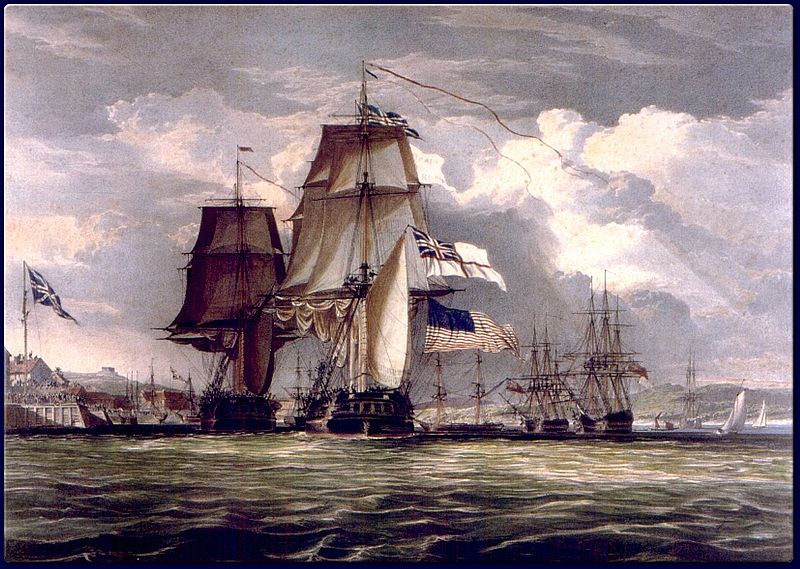
their restoration was refused. The Chesapeake some time afterwards put to sea
and was by the orders of Vice-Admiral Berkeley, overhauled by the British 50-gun
ship Leopard. Captain Humphreys, of that ship, demanded the delivery of the
deserters on board the Chesapeake, and on this being refused poured several
broadsides into the latter, killing three men and wounding eighteen, and
compelling the American vessel to strike her flag.
This act was immediately disavowed by the British government and the admiral
recalled. In the United States the affair produced the liveliest indignation,
which was not mitigated in the least by the earnest efforts of Great Britain to
settle the matter amicably. A proclamation was issued by the president
forbidding all persons to have any intercourse with or to sell any supplies to
British war vessels in the waters of the United States, and warlike preparations
were made on an extensive scale. Messrs. Monroe and Pinkney were sent to England
in the armed schooner Revenge to make a number of demands on the British
government, including the abandonment of the right of search. Great Britain was
quite ready to make reparation in the Chesapeake affair, but declined to treat
on the other matters, Mr. Canning telling the envoys plainly, that, while he was
ready to listen to any suggestions with a view to the removal of existing
difficulties, he would not negotiate anew on the basis of a treaty concluded and
signed and already rejected by one of the parties.
The envoys returned home, and then was passed the famous Embargo Act which
prohibited all vessels in the ports of the United States, except foreign ships
in ballast, or with cargoes taken on board before the notification of the Act,
from sailing for any foreign port. Coastwise vessels were required to give heavy
bonds to land their cargoes in the United States. This Act, which is the most
remarkable example on record of a nation destroying its own foreign trade in the
hope of thereby injuring another nation with which it had large dealings,
utterly failed to effect the object for which it was passed. It became law in
December, 1807, and, after being made more stringent by several amending and
enforcing Acts, was finally repealed in March, 1809, it having been found only
injurious to the nation that enacted it. In a single year under its operation
the imports of the United States fell from $138,500,000 to $56,990,000 and the
exports from $108,343,000 to $22,430,000. In lieu of the Embargo Act a
NonIntercourse Act was passed by which the commerce of the United States was
opened to all the world except England and France. As the latter country had
little or no commerce with the United States, it was quite evident, that, as
before, England was the only nation aimed at by this measure. The relations
between Great Britain and the United States continued to grow more strained, and
they were not improved when, in 1809, the latter government requested the recall
of Mr. Jackson, the British minister at Washington. The English government did
not take the trouble to send another minister to replace him until 1811.
In the meantime the government of the United States, which had every year been
growing more friendly to France, was endeavouring to make terms with that
country for a relaxation of the continental system. As a result of this, in
August, 1810, the French minister of foreign affairs, in a. despatch to the
American minister at Paris, stated that the Berlin and Milan decrees were
revoked, and that their operation would cease from the first of November
following, "It be ing understood that in consequence of this declaration, the
English shall revoke their orders-in-council, and renounce the new principles of
blockade which they have wished to establish, or that the United States,
conformably to their law, will cause their rights to be respected by the
English." The meaning of the last clause of this communication might be somewhat
obscure were it not from our knowledge of the fact that Minister Armstrong had
been instructed to offer, in addition to the repeal of the Embargo Act, a
declaration of war against Great Britain should that government refuse to recall
the orders-in-council after the emperor had withdrawn his Berlin and Milan
decrees. This offer was made in April, 1808, but Bonaparte did not value an
American alliance so highly as the men who offered it. His business was war, and
he did not believe that an American alliance could, be of much service to him.
This is why two years were suffered to elapse before any notice was taken of the
American minister's offer. Although the French response was merely a contingent
reThis brief summary of the progress of events after the Revolution will serve
to show more clearly the character of the questions which arose from time to
time between the two nations, and which finally resulted in the War of 1812. The
United States throughout the long war between Great Britain and France stood in
the unfortunate position of a neutral power whose commerce was certain to suffer
from the several orders-in-council and decrees which the belligerents launched
against each other. The accession of Bonaparte to supreme power, although it
brought the war between France and the United States to a close, instead of
improving their condition as neutrals, made it much worse. In May, 1806, the
British government declared the whole coast of Europe from the Elbe to Brest,
the territory occupied by the French armies, to be in a state of blockade. In
November of the same year Bonaparte issued the famous Berlin decree proclaiming
the British Isles to be in a state of blockade, forbidding all correspondence or
trade with England, and declaring all articles of English produce or manufacture
contraband, and the property of all British subjects to be lawful prize of war.
As the French fleets had been wholly destroyed, and the French government had
scarcely a vessel at sea, this was simply a "paper blockade." The same term has
been applied by American writers to the British blockade of the eight hundred
miles of coast from Brest to the Elbe, on the alleged ground that Great Britain
had not sufficient ships to enforce it. Yet in 1806 the British navy numbered
more than eight hundred vessels, manned by one hundred and forty thousand men.
Some of the objectors to this so called "paper blockade" lived to see President
Lincoln proclaim three thousand miles of the coast of the southern states to be
blockaded, although the Federal navy of that period numbered only ninety
vessels, of which less than half were in commission.
The British answer to the Berlin decree was an order-in council of November,
1807, by which all neutral trade with France or her allies was prohibited unless
through Great Britain. In December of the same year Bonaparte issued his Milan
decree which was a sort of supplement to that of Berlin. It declared every
vessel which submitted to be searched by British cruisers, or paid any tax, duty
or license money to the British government, or was found on the high seas or
elsewhere bound to or from any British port, to be denationalized and forfeited.
Spain and Holland, at the dictation of France, immediately issued similar
decrees, and thus was established the famous continental system of Napoleon
which crushed the neutral trader. It was a system which grew out of Bonaparte's
determination to destroy Great Britain and break up the British empire, a
resolve which was warmly approved by a large number of the people of the United
States. In their insane hatred of England they were ready to aid in the
destruction of the only constitutional government then existing in Europe, and
in the establishment of the grinding military despotism of Bonaparte OA'er the
greater portion of the civilized world.
While the British orders-in-council and Bonaparte's decrees were agitating
commercial circles in the United States, the impressment of British seamen found
on board of American vessels had become a source of great ill-feeling towards
England. In 1800 the British minister had proposed a reciprocal surrender of all
deserters, but this was declined by the United States because the proposal was
so worded as to sanction impressment on private vessels. They contended that the
neutral flag was the safeguard of those sailing under it, a doctrine, the
application of which was greatly in favour of the United States, as it enabled
them to recruit their navy with deserters from British ships. As a measure of
retaliation, in March, 1806, the United States Congress passed a Non-Importation
Act, prohibiting the importation of nearly every article of British manufacture.
The Act was to be in abeyance until the following November, and in the meantime
negotiations were again opened for a treaty which should put an end to the
difficulties between the two nations. William Pinkney of Maryland was sent as
envoy extraordinary to London to join with Monroe, the resident minister, in
this work. Negotiations commenced in August, and after some delay a treaty was
arranged in most respects more favourable than the Jay Treaty. The British
government declined to relinquish the right of impressment by formal treaty, but
the British commissioners put into writing a statement that it was the intention
of the government not to allow impressments from American vessels on the high
seas except under extraordinary circumstances, such as having on board known
deserters from the British navy. The new treaty placed the trade between the
United States and the European possessions of Great Britain on a footing of
perfect reciprocity. It was also stipulated that no American vessels could be
visited or seized by British cruisers within five miles of the coast of the
United States. But the time spent in the negotiation of this treaty was wasted,
for Jefferson, who was then president, had resolved upon a step which would
effectually prevent it from going into operation. Instead of laying it before
the Senate for ratification or rejection, as it was his duty to do, he usurped
the authority which the constitution had vested in that body, and entirely
suppressed this important treaty, which would undoubtedly have been the means of
insuring a lasting peace between the two countries. This action proved that
Jefferson and his advisers did not desire any accommodation of existing
grievances, but only war.
At this juncture a very unfortunate affair took place which produced much
ill-feeling. While a British squadron was near Cape Henry, Virginia, three of
the crew of the frigate Mclampus deserted. These men were enlisted on board the
United States frigate Chesapeake, and a demand made by the British minister for
their restoration was refused. The Chesapeake some time afterwards put to sea
and was by the orders of Vice-Adniiral Berkeley, overhauled by the British
50-gun ship Leopard. Captain Humphreys, of that ship, demanded the delivery of
the deserters on board the Chesapeake, and on this being refused poured several
broadsides into the latter, killing three men and wounding eighteen, and
compelling the American vessel to strike her flag.
This act was immediately disavowed by the British government and the admiral
recalled. In the United States the affair produced the liveliest indignation,
which was not mitigated in the least by the earnest efforts of Great Britain to
settle the matter amicably. A proclamation was issued by the president
forbidding all persons to have any intercourse with or to sell any supplies to
British war vessels in the waters of the United States, and warlike preparations
were made on an extensive scale. Messrs. Monroe and Pinkney were sent to England
in the armed schooner Revenge to make a number of demands on the British
government, including the abandonment of the right of search. Great Britain was
quite ready to make reparation in the Chesapeake affair, but declined to treat
on the other matters, Mr. Canning telling the envoys plainly, that, while he was
ready to listen to any suggestions with a view to the removal of existing
difficulties, he would not negotiate anew on the basis of a treaty concluded and
signed and already rejected by one of the parties.
The envoys returned home, and then was passed the famous Embargo Act which
prohibited all vessels in the ports of the United States, except foreign ships
in ballast, or with cargoes taken on board before the notification of the Act,
from sailing for any foreign port. Coastwise vessels were required to give heavy
bonds to land their cargoes in the United States. This Act, which is the most
remarkable example on record of a nation destroying its own foreign trade in the
hope of thereby injuring another nation with which it had large dealings,
utterly failed to effect the object for which it was passed. It became law in
December, 1807, and, after being made more stringent by several amending and
enforcing Acts, was finally repealed in March, 1809, it having been found only
injurious to the nation that enacted it. In a single year under its operation
the imports of the United States fell from $138,500,000 to $56,990,000 and the
exports from $108,343,000 to $22,430,000. In lieu of the Embargo Act a
NonIntercourse Act was passed by which the commerce of the United States was
opened to all the world except England and France. As the latter country had
little or no commerce with the United States, it was quite evident, that, as
before, England was the only nation aimed at by this measure. The relations
between Great Britain and the United States continued to grow more strained, and
they were not improved when, in 1809, the latter government requested the recall
of Mr. Jackson, the British minister at Washington. The English government did
not take the trouble to send another minister to replace him until 1811.
In the meantime the government of the United States, which had every year been
growing more friendly to France, was endeavouring to make terms with that
country for a relaxation of the continental system. As a result of this, in
August, 1810, the French minister of foreign affairs, in a. despatch to the
American minister at Paris, stated that the Berlin and Milan decrees were
revoked, and that their operation would cease from the first of November
following, "It be ing understood that in consequence of this declaration, the
English shall revoke their orders-in-council, and renounce the new principles of
blockade which they have wished to establish, or that the United States,
conformably to their law, will cause their rights to be respected by the
English." The meaning of the last clause of this communication might be somewhat
obscure were it not from our knowledge of the fact that Minister Armstrong had
been instructed to offer, in addition to the repeal of the Embargo Act, a
declaration of war against Great Britain should that government refuse to recall
the orders-in-council after the emperor had withdrawn his Berlin and Milan
decrees. This offer was made in April, 1808, but Bonaparte did not value an
American alliance so highly as the men who offered it. His business was war, and
he did not believe that an American alliance could, be of much service to him.
This is why two years were suffered to elapse before any notice was taken of the
American minister's offer. Although the French response was merely a contingent
repeal of the decrees, depending on the repeal of the orclers-incouncil, the
government of the United States at once treated it as absolute, and, while
strictly enforcing the Non-Importation Act against British ships, permitted
French men-of-war and merchantmen to enter its harbours freely; it also required
the British government to revoke the orders-in-council. That government demanded
the production of the instrument by which the Berlin and Milan decrees were
revoked, but it was not until May 21st, 1812, that such a document was produced
and then it was found to bear date of April 28th, 1811, or nearly eight months
after the time when it was first announced that the decrees were revoked. This
instrument expressly declared that these French decrees were repealed in
consequence of the American Congress having by an Act of March 1st, 1811,
provided that British ships and merchandise should be excluded from the ports of
the United States. This was a clear proof that an understanding which was
hostile to British interests existed between that country and France. Still when
this French document was produced, the British government, to quote the language
of the manifesto issued by the Prince Regent, "desirous of reverting if possible
to the ancient and accustomed principles of Maritime War, determined on
revoking, conditionally, the orders-in-council." It was not until May 21st,
1812, that the British government was furnished by the American minister in
London with a copy of the document, and, on the twenty-third of June, a
declaration from the Prince Regent in council was published absolutely revoking
all orders so far as they applied to the United States. Had the government of
that country been animated by a sincere desire for peace this action would have
brought the War of 1812 to a sudden end.
In May, 1811, an encounter took place on the high seas between a British war
vessel and an American frigate which showed the belligerent disposition which
animated the navy of the United States. The United States frigate President, 44
guns, carrying the broad pennant of Commodore Rodgers, while cruising off Cape
Henry sighted the British corvette Little Belt, 20 guns, Captain A. B. Bingham,
which was cruising northwards in search of the frigate Guerriere. The President
discovered the British vessel about noon, and immediately gave chase, but it was
dark before the American frigate drew alongside. Captain Bingham hailed the
President asking, "What ship is that?" but the only reply he received was a
repetition of his own question. The President then fired a broadside which the
Little Belt immediately returned. An action ensued which lasted about forty-five
minutes, when the big American ship sheered off. At dawn the President bore down
again and Rodgers sent an officer on board the Little Belt with profuse
apologies and offers of assistance which were declined. As the United States
government was at that time at peace with the whole world, it is clear that
Rodgers' attack on the Little Belt was merely the act of a sea bully who wished
to stand well with his countrymen at a cheap rate by attacking a ship of less
than one-fourth his / own strength. The Little Belt bore away for Halifax, while
Rodgers returned to New York to receive the congratulations of his friends.
When Congress met in November, 1811, its tone was warlike. The president, Mr.
Madison, sounded the keynote by a belligerent message, and the committee on
foreign relations presented a report which was a comprehensive indictment of
Great Britain for almost every kind of political crime. A tremendous amount of
fervid eloquence was employed to fire the national heart to the point of going
to war, Henry Clay and John C. Calhoun being among the loudest and most violent
in their advocacy of extreme measures. John Randolph of Virginia, Josiah Quincy
of Massachusetts and all the leaders of the Federal party were against a war
with England, and opposed all proposals to that end, but they were entirely
outnumbered in Congress, and measures looking towards a declaration of war were
rapidly passed. Additional regulars to the number of twenty-five thousand men
were ordered to be enlisted, the calling out of one hundred thousand militia was
authorized, and appropriations were made for large purchases of arms and
ammunition. The president was authorized to call upon the governors of the
several states, requiring each state to furnish its quota of this militia force.
Provision was also made for the enlistment of a large body of volunteers. These
bills were passed in January, 1812, and it was expected that at least seventy
thousand men would be ready to take the field in the spring and invade Canada.
The Federal government was encouraged in its truculent course by some of the
state legislatures—those of New Jersey, Pennsylvania, Virginia, Georgia,
Kentucky and Ohio having passed resolutions in favour of war with Great Britain.
The Massachusetts House of Representatives, in its reply to the annual message
of the governor, denounced Great Britain as "a piratical state." Patriotism was
a very plentiful commodity in the United States at that time, if the report of
the committee on foreign relations is to be believed. It stated that the
patriotic fire of the Revolution still lived in the American breast "with a holy
and inextinguishable flame." This "holy flame" developed itself mainly in an
intense desire to possess Canada, and it was stimulated by the thought that a
favourable time had arrived to strike a deadly blow against Great Britain. It
was known that Napoleon was preparing to invade Russia with an immense army and
no one in the United States doubted his success. An alliance with so powerful a
ruler appeared to these American patriots to be very desirable, and they fully
believed that Canada was ready to rise and throw off its allegiance to the
British crown as soon as an American army appeared on its frontier. Dr. Eustis,
the United States secretary of war, in one of his speeches gave expression to
this sentiment when he said: "We can take the Canadas without soldiers; we have
only to send officers into the provinces and the people, disaffected towards
their own government, will rally round our standard."
The Honourable Henry Clay, who had always been most violent in his animosity
against Great Britain, said on the floors of Congress: "It is absurd to suppose
that we will not succeed in our enterprise against the enemy's provinces. We
have the Canadas as much under our command as Great Britain has the ocean, and
the way to conquer her on the ocean is to drive her from the land. I am not for
stopping at Quebec or anywhere else, but I would take the whole continent from
them, and ask them no favours. Her fleets cannot then rendezvous at Halifax as
now; and, having no place of resort in the north, cannot infest our coast as
they have lately done. It is as easy to conquer them on the land as their whole
navy would conquer ours on the ocean. We must take the continent from them. I
wish never to see peace till we do. God has given us the power and the means; we
are to blame if we do not use them."
It was with such aspirations and hopes as these that the government and people
of the United States entered upon the War of 1812.
(1) James Hannay,,History of the War of 1812 between Great Britain and the
United States, Morang & Company, Toronto: 1905
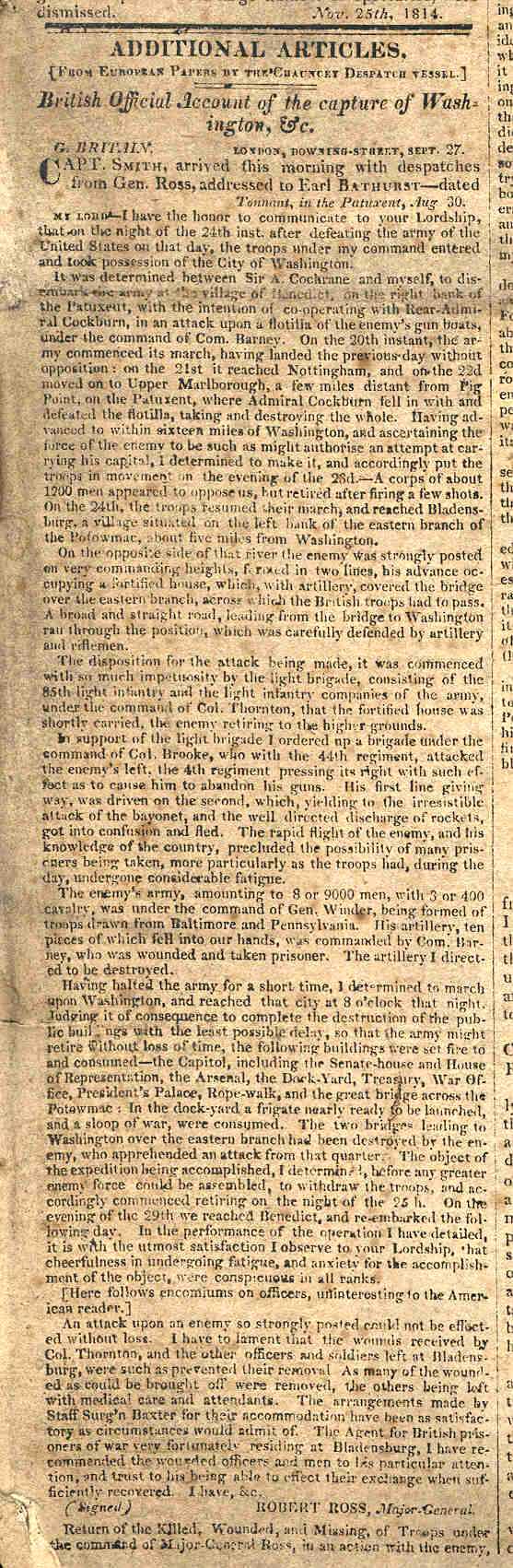
Official British Account
of the
Capture of Washington D.C.
As reported in The Columbian Centinel December 7, 1814
I
have the honor to communicate to your Lordship, that on the night of the 24
th inst. After defeating the army of the United States that day, the
troops under my command entered and took possession of the city of Washington.
It was determined between Sir A. Cochrane and myself, to disembark the army at
the village of Nenedict, on the right bank of the Patuxeut, with the intention
of Co-operating with Rear-admiral Cockburn, in an attack upon a flotilla of the
enemy?s gun boats, under of the command of Com. Barney. On the 20th instant,
the ar-my command its march, having landing the previous day without opposition:
on the 21st it reached Nottingham, and on the 22nd moved on to Upper
Marlborough, a few miles distant from Pig Point on the Patuxent, where Admiral
Cockburn fell in with and defeated the flotilla taking and destroying the whole.
Having advanced to within 16 miles of Washington, and ascertaining the force of
the enemy to be such as might authorize an attempt at carrying his capital, I
determined to make it, and accordingly put the 1200 men appeared to oppose us
but retired after firing a few shots.
On
the 24 th the troops resumed their march, and reached Bladensburg, a
village situated on the left bank of the eastern branch of the Pofowmac, about
five miles from Washington. On the opposite side of that river the enemy was
strongly posted on very commanding heights formed in two lines, his advance
occupying a fortified house, which, with artillery, covered the bridge over the
eastern branch, across which the British troops had pass. A broad and straight
road, leading from the bridge to Washington ran through the position, which was
carefully defended by artillery and riflemen. The disposition for the attack
being made, it was commenced with so much impetuosity by the list brigade,
consisting at the 85th light infantry and the army, under the command
of Col. Thornton, that the fortifired house was shortly carried, the enemy
retiring to the higher grounds. In support of the light brigade I ordered up a
brigade under the command of Col. Brooke, who with the 44th regiment,
attacked the enemy?s left, the 4th regiment pressing its right with
such effect as to cause him to abandon his guns. His first line giving way, was
driven on the second, which, yielding to the irresistible attack of the bayonet,
and the well directed discharge of rockets, got into confusion and fled. The
rapid flight of the enemy, and his knowledge of the country, precluded the
possibility of many prisoners being taken, more particularly as the troops had,
during the day, undergone considerable fatigue.
The
enemy?s army amounting to 8 or 9000 men, with 3 or 400 cavalry, was under the
command of Gen. Winder, being formed of troops drawn from Baltimore and
Pennsylvania. His artillery, ten pieces of which fell into are hands, was
commanded by Com. Barney, who was wounded and taken prisoner. The artillery I
directed to be destroyed. Having halted the army for a short time, I determined
to march upon Washington, and reached that city at 8 o?clock that night. Judging
it of consequences to complete the destruction of the public buildings with the
least possible delay, so that the army might retire without loss of time, the
following buildings were set fire to and consumed- the capitol, including the
Senate house and House of representation, the Arsenal, the Dock-Yard, Treasury,
War office, President?s Palace, Rope-Walk, and the great bridge across the
Potewmac: In the dock-yard a frigate nearly ready to be launched, and a slope of
war, were consumed. The two bridges leading to Washington over the eastern
branch, had the enemy been destroyed by the enemy who apprehended an attack from
that quarter.
The
object of the expedition being accomplished, I determined, before any greater
enemy force could be assembled, to withdraw the troops, and accordingly
commenced retiring on the night of the 25th. On the evening if the 29th
we reached Benedict, and re-embarked the following day. In the performance of
the operation I have detailed, it is with the utmost satisfaction I observe to
your Lordship that cheerfulness in undergoing fatigue, and anxiety for the
accomplishment of the object, were conspicuous in all ranks
An
attack upon an enemy so strongly posted could not be effected without loss. I
have to lament that the wounds received by Col. Thornton, and the others
officers and soldiers left at Bladensburg, were such as prevented their removal
As many of the wounded as could be brought off were removed, the others being
left with medical care and attendants. The arrangements made by Staff Sueg?n
Baxter for their accommodation have been as satisfactory as circumstances would
admit of. The Agent for British prisoners of war very fortunately residing at
Bladensburg, I have recommended the wounded officers and men to his particular
attention, and trust to his being able to effect their exchange when
sufficiently recovered. -- Robert
Ross, Major General