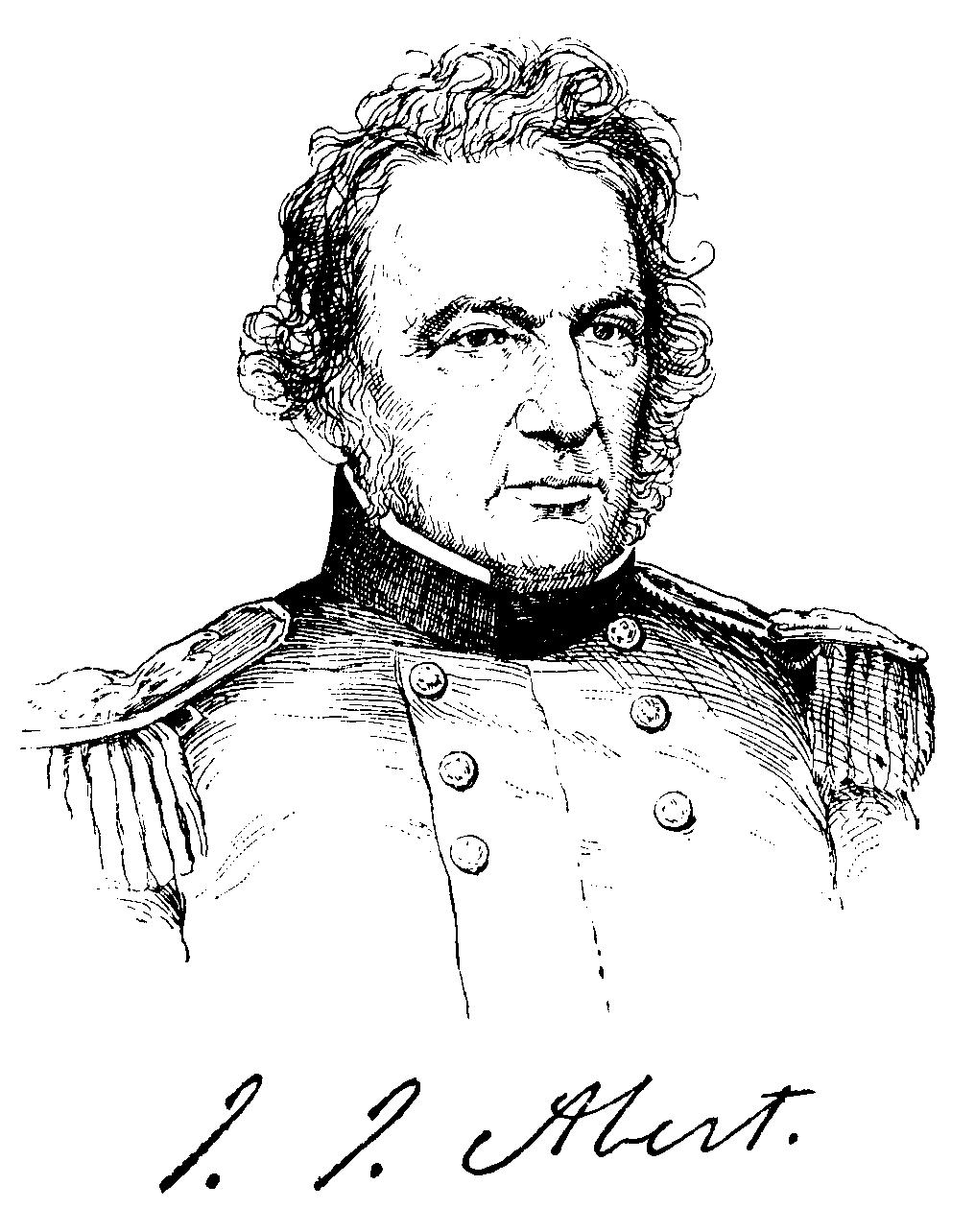
Appleton's Cyclopedia of American Biography, edited by James
Grant Wilson, John Fiske and Stanley L. Klos. Six volumes, New York: D. Appleton
and Company, 1887-1889 and 1999. Virtualology.com warns that these 19th Century
biographies contain errors and bias. We rely on volunteers to edit the historic
biographies on a continual basis. If you would like to edit this biographyplease
submit a rewritten biography in text form.
If acceptable, the new biography will be published above the 19th Century
Appleton's Cyclopedia Biography citing the volunteer editor
Virtual American Biographies
Over 30,000 personalities
with thousands of 19th Century illustrations, signatures, and exceptional life
stories. Virtualology.com
welcomes editing and additions to the
biographies. To become this site's editor or a contributor
Click Here
or e-mail Virtualology here.
ABERT, John James, soldier, born in Shepherdstown, Virginia, 17 September 1788; died in Washington. District of Columbia, 27 September 1863. He was the son of John Abert, who came to this country with Rochambeau in 1780. Young Abert was graduated at West Point in 1811, but at once resigned, and was then employed in the war office. Meanwhile he studied law, and was admitted to the bar in the District of Columbia in 1813. in the war of 1812 he volunteered as a private soldier for the defense of the capital. He was reappointed to the army in 1814 as topographical engineer, with the rank of major, in 1829 he succeeded to the charge of the topographical bureau at Washington, and in 1838 became colonel in command of that branch of the engineers. He was retired in 1861 after "long and faithful service." Col. Abert was associated in the supervision of many of the earlier national works of engineering, and his reports prepared for the government are standards of authority. He was a member of several scientific societies, and was one of the organizers of the national institute of science, which was subsequently merged into the Smithsonian institute. His sons served with distinction in the United States army during the civil war.
James William Abert, soldier, born in Mount Holly, New Jersey, 18 November, 1820, was graduated at West Point in 1842. After service in the infantry he was transferred to the topographical engineers, and was engaged on the survey of the northern lakes in 1843-'44. He then served on the expedition to New Mexico, and published a report (Senate doe., 1848). From 1843 to 1850 he was assistant in drawing at West Point, and from 1851 to 1860 he was engaged in the improvement of western rivers, except during the Seminole war in 1856-'58, when he was in Florida. During the civil war he served on the staffs of General Patterson and General Banks in the Virginia campaign of 1861-'62. He was severely injured at Frederick, Maryland, in 1862, and subsequently served on General Gillmore's staff, having attained the rank of major in 1863. He resigned on 25 June, 1864. For a short time he was an examiner of patents in Washington, and later he became professor of mathematics and drawing in the University of Missouri, at Rolla. He is a contributor to current literature in science, art, and history. --Silvanus Thayer, civil engineer, born in Philadelphia, Pennsylvania, 22 July, 1828. He was educated at Princeton, and in 1848 began his engineering career in the government service on the construction of the James River and Kanawha canal. For eleven years he was actively engaged on government work at various localities. In 1859 he was appointed engineer in charge of all the works of construction at the Pensacola navy yard. During the civil war he served at first on the staff of General Banks in his Virginia campaign, and later under General Meade with the Army of the Potomac. From 1865 to 1866 he was engaged on the surveys of the Magdalena River for the Colombian government. On his return he again joined the engineering corps, and has been occupied on numerous government surveys. Since 1873 he has been in charge of the geographical division extending from Washington, District of Columbia, to Wilmington, North Carolina Col. Abert is the author of numerous valuable reports on his work, and has also published "Notes, Historical and Statistical, upon the Projected Route for an Interoceanic Ship Canal between the Atlantic and Pacific Oceans" (Cincinnati, 1872).--William Stretch, soldier, born in Washington, District of Columbia, 1 February, 1836 ; died in Galveston, Tex., 25 August, 1867. He was appointed lieutenant in the artillery in 1855, and at the outbreak of the civil war in 1861 was stationed at Fort Monroe, Virginia He was appointed captain in the cavalry in 1861, and fought in the battles of Williamsburg and Hanover Court House. Later he joined General McClellan's staff, and was at Antietam. From November 1862, to October, 1864, he was assistant inspector-general at New Orleans under General Banks, after which he served in the defenses of Washington as colonel of the 3d Massachusetts artillery. Subsequent to the war he was with his regiment in Texas, and became assistant inspector-general of the district of Texas. In ,June, 1867, he was advanced to the rank of major in the 7th United States cavalry. He received several brevets, the highest of which was that of lieutenant colonel.
Unauthorized Site:
This site and its contents are not affiliated, connected,
associated with or authorized by the individual, family,
friends, or trademarked entities utilizing any part or
the subject's entire name. Any official or affiliated
sites that are related to this subject will be hyper
linked below upon submission
and Evisum, Inc. review.
Please join us in our mission to incorporate The Congressional Evolution of the United States of America discovery-based curriculum into the classroom of every primary and secondary school in the United States of America by July 2, 2026, the nation’s 250th birthday. , the United States of America: We The
People. Click Here