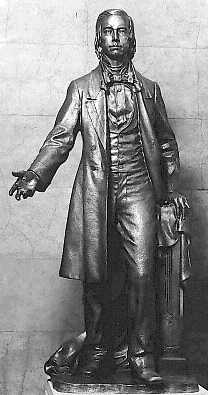
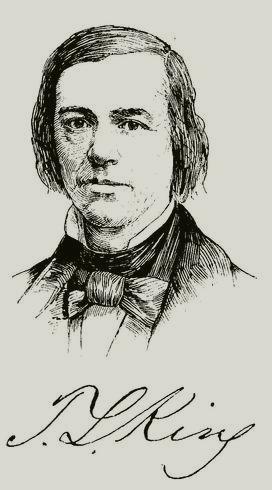
KING, Thomas Starr, clergyman, born in New York city, 17
December, 1824; died in San Francisco, California, 4 March, 1863. He was the son
of a Universalist clergyman, and his early life was spent in various towns where
his father preached. In 1835 the family settled in Charlestown, Massachusetts,
where, after the death of his father, he became a clerk in a dry-goodsstore. In
1840 he was appointed assistant teacher in the Bunker Hill grammar school, and
his time outside of his regular duties was spent in study. Two years later he
became principal of the West grammar school of Medford, Massachusetts, where he
studied for the ministry under Hosea Ballou Subsequently he was clerk in the
navy yard at Char lest own, and in September, 1845, he delivered his first
sermon in Woburn. He then preached for a Universalist society in Boston, and in
July. 1846, he was called to his father's former church in Charlestown. In 1848
he accepted a call from the Hollis street Unitarian church, where he continued
for eleven years. During this term of ministry he grew steadily in power and
reputation. He was not considered as profoundly learned; he was not a great
writer; nor could his unrivalled popularity be ascribed to his fascinating,
social, or intellectual gifts. " It was," says Dr. Henry W. Bellows, "the
hidden, interior man of the heart, the invisible character behind all the rich
possessions, intellectual and social, of this gifted man, that g, 'ave him his
real power and skill to control the wills, and to move the hearts, and to win
the unbounded confidence and affection of his fellow-beings." Mr. King also at
this time acquired great popularity as a lecturer in the northern states. His
first lecture was on "Goethe," and it was followed by one on "Substance and
Snow," which almost equalled in popularity that of Wendell Phillips on "The Lost
Arts." The subjects which he afterward selected, such as "Socrates," "Sight and
Insight," and "The Laws of Disorder," obtained almost as great a reputation.
His name soon became associated with the White mountains, for
it was there that he spent most of his summers, drawing in those inspirations,
descriptive of natural scenery, which abound in his discourses, and he was
familiar with every ravine and peak of that region. In 1853 he began to print
accounts of his explorations in the "Boston Transcript," and, having visited it
for ten years in winter as well as summer, he embodied the results of his
experience in a volume entitled "The White Hills, their Legends, Landscape, and
Poetry" (Boston, 1859; new ed., 1887). In 1860 he left Boston, and accepted a
call to San Francisco, California As in the east, he was soon asked to lecture
in California and Oregon. Letters of his experience found their way to the
Boston papers, and, as the White mountains became known largely through his
efforts, so too he was one of the first to call public attention to the beauties
of the Yosemite valley. In the presidential canvass of 1860, when the suggestion
of a Pacific republic was made, "taking the constitution and Washington for his
text, he went forth appealing to the people." He spoke on "Webster and the
Constitution," "Lexington and the New Struggle," and " Washington and the
Union," and his magnificent eloquence swept everything before it. Mr. King urged
the paramount duty of actively supporting the Union; "for," he contended,
"whatever of theory, of party, of personal ambition, or of prejudice, in this
great hour, may have to pass away, it seems to be the will of the' American
people that the grand inheritance of the fathers of the republic shall not pass
away."
To him credit is given for having preserved California to the
Union, and later, when the civil war had begun, he was active in his labors with
the sanitary commission. Meanwhile he was occupied with the building of a new
church, and in September, 1862, the corner stone was laid. On Christmas, 1863,
the church was finished, and it was dedicated on 10 January, 1864. Before March
came, he was stricken with diphtheria, and after a few days' illness died. His
remains were buried in the church that he had built, and remained there until
1887, when, on the sale of the church property, the sarcophagus was transferred
to the Masonic cemetery. A movement for the purpose of erecting a monument in
Golden Gate park, to cost $50,000, has taken shape in San Francisco during the
present year (1887), and the collection of funds is now in progress throughout
California. Mr. King received the degree of A. M. from Harvard in 1850. Several
volumes of his sermons appeared posthumously, including " Patriotism and Other
Papers "(Boston, 1865); "Christianity and Humanity," with a memoir by Edwin P.
Whipple (1877); and "Substance and Snow " (1877). See also "A Tribute to Thomas
Starr King," by Richard Frothingham (1865).
Unauthorized Site:
This site and its contents are not affiliated, connected,
associated with or authorized by the individual, family,
friends, or trademarked entities utilizing any part or
the subject's entire name. Any official or affiliated
sites that are related to this subject will be hyper
linked below upon submission
and Evisum, Inc. review.
Please join us in our mission to incorporate The Congressional Evolution of the United States of America discovery-based curriculum into the classroom of every primary and secondary school in the United States of America by July 2, 2026, the nation’s 250th birthday. , the United States of America: We The
People. Click Here