Daniel Boone - October 22, 1734 – September 26, 1820 was an
American pioneer and hunter whose frontier exploits made him one of the first
folk heroes of the United States. A Stan Klos Website
Daniel Boone
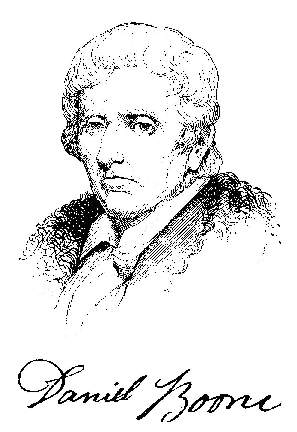
Image
Copyright© 2001 by
VirtualologyT
BOONE, Daniel, pioneer, born in Berks County, Pennsylvania, 22 October, 1734 (For more on Daniel Boone's birthplace
please visit his Homestead);
died in Missouri, 26 Sept., 1820. Among the immigrants that landed, 10 Oct.,
1717, at Philadelphia was George Boone, of Exeter, England, who came with his
wife and eleven children, bought land near Bristol, Bucks County, Pennsylvania,
and joined the society of Friends. His son, Squire Boone, married Sarah Morgan,
and Daniel was their son. Squire Boone, who was a farmer, moved, about 1748, to
Holman's Ford, on the Yadkin, in North Carolina.
Daniel's education was very limited ; he could read and
write, but beyond that all he knew related to the fields, the woods, the net,
the rifle, and hunting. He was a hunter born, and loved the solitude of the
forest. Strong, brave, lithe, inured to hardship and privation, he traced his
steps through the pathless forest, sought out the hiding places of panther,
bear, and wolf, and was the match of any Indian in the sagacity with which he
detected the footsteps of the red man. About 1755 he married Rebecca Bryan and
set up his own log cabin, but, displeased with the encroachments of civilization
on his solitude, and incited by the glowing accounts brought by John Finley, who
had penetrated into the unknown regions of Kentucky, formed a company of six
kindred spirits, and, bidding adieu to his family and the comforts of home, on 1
May, 1769, set out on his perilous journey of exploration.
After numerous adventures with the Indians, having become
intimately acquainted with the character of the country, established an enviable
reputation for sagacity and integrity on important frontier service assigned to
him by Lord Dunmore in the campaign against the Indians, usually called "Lord
Dunmore's War," and constructed a strong fort on the left bank of Kentucky
river, which he named "Boonesborough," he determined to bring his wife and
family to the new home. Some of his neighbors joined him, and he conducted the
party, numbering upward of thirty, safely to "Boonesborough" without having
encountered any other difficulties than such as are common to this passage. On
one occasion Boone, with an armed party of thirty men, had gone for a supply of
salt to a place called " Salt Licks," nearly 100 miles north of Boonesborough,
and was captured, with twenty-seven of his men, by a band of more than 100
Indian warriors led by two Frenchmen. They carried them first to Old
Chillicothe, on the Miami, and then to Detroit, where they surrendered for a
ransom all their prisoners except Boone ; him they took back to Old Chillicothe,
where the great Blackfish, a renowned Shawanese chief, adopted him into his
family under an imposing but painful ceremonial; all his hair, except a tuft
three or four inches in diameter on the crown of the head, was plucked out; that
tuft was allowed to grow to the length of the "warlock," dressed with feathers
and ribbons; an ablution in the river was supposed to cleanse him from the taint
of white blood; a coat of paint on his face, and a solemn charge from Blackfish,
completed the rite.
After a prolonged and anxious residence among them, during
which he was kindly treated, he discovered their intention of marching upon
Boonesborough, and resolved, at the peril of certain death in the event of
recapture, to attempt his escape and save his family and friends. Chased by 450
Indians, he performed that daring feat in the forty-third year of his age, and
thus simply records it: "On the 16th [of June], before sunrise, I departed in
the most secret manner, and arrived at Boonesborough on the 20th, after a
journey of 160 miles, during which I had but one meal." At the fort he learned
that his wife and children, despairing of ever seeing him again, had returned,
and safely reached her father's home in North Carolina. The Indians assailed the
fort, but were repelled with loss, and retreated. Boone then, in the autumn of
1778, rejoined his family on the Yadkin, and returned with them to Kentucky in
1780.
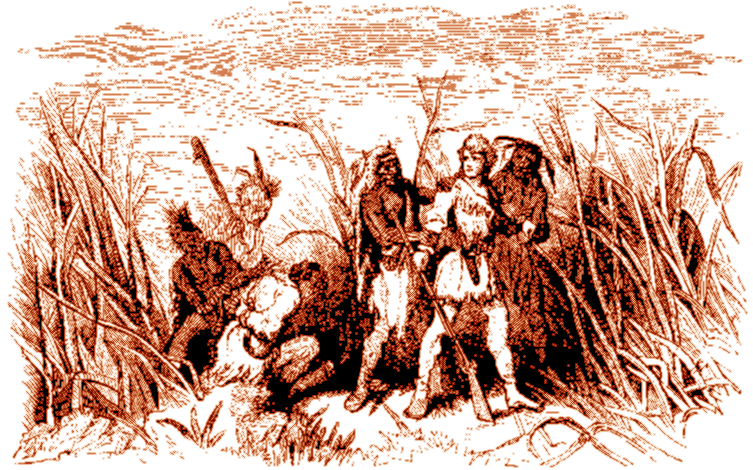
Boone and Stuart Capture
The country, though well settled, was still unsafe, and,
soon after his return, Boone and his brother, Squire, were surprised by Indians
; Squire was killed and scalped, and Daniel had a narrow escape. A sanguinary
engagement, called the "Battle of the Blue Licks," took place in 1782, in which
Boone's two sons fought at his side. One of them was killed, and the other
severely wounded. Boone was full of expedients, and on one occasion extricated
himself from four armed Indians by blinding them with tobacco dust. Kentucky was
admitted into the union, 4 Feb., 1791, and in the survey of the state the title
to Boone's land was disputed. The case was decided against him, and, stung to
the quick by the wrong, he had again to seek a new home, which he established at
Point Pleasant, between the Ohio and the Great Kanawha; but in 1795 he removed
to Missouri, then a Spanish possession, and received not only the appointment of
commandant of the Femme Osage district, but a grant of 8,000 acres. The Spanish
possessions passed into the hands of Napoleon, who sold them to the United
States, and, in the survey that followed, the Spanish grant of Boone's lands was
pronounced invalid. An appeal to the legislature of Kentucky, and another to
congress, resulted in a grant by the latter of 850 acres. Boone was then
seventy-five years of age, hale and strong. The charm of the hunter's life clung
to him to the last, and in his eighty-second year he went on a hunting excursion
to the mouth of Kansas river. He had made his own coffin and kept it under his
bed, and after his death they laid him in it to rest by the side of his wife,
who had passed away seven years before.
On 13 Sept., 1845, their remains were removed to the
cemetery near Frankfort, Kentucky, a few miles from the fort of Boonesborough,
by the concurrent action of the citizens of Frankfort and the legislature of
Kentucky. His son, Enoch, born in Boonesborough, Kentucky, in 1777 ; d. 8 March,
1862, was the first white male child born in Kentucky. Daniel Boone's wife, with
her daughters, went to live with her husband in his palisaded fort in June,
1776, and while there gave birth to this son; but after Boone's capture, on 7
Feb., 1778, his family returned to North Carolina.
Edited Appleton's American Biography
Copyright© 2001 by
VirtualologyTM





