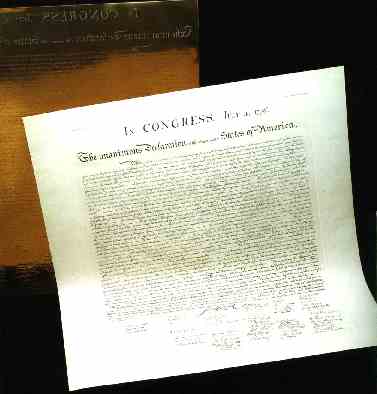
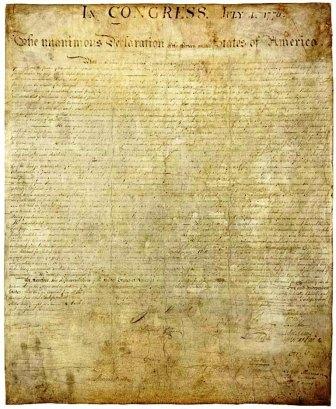
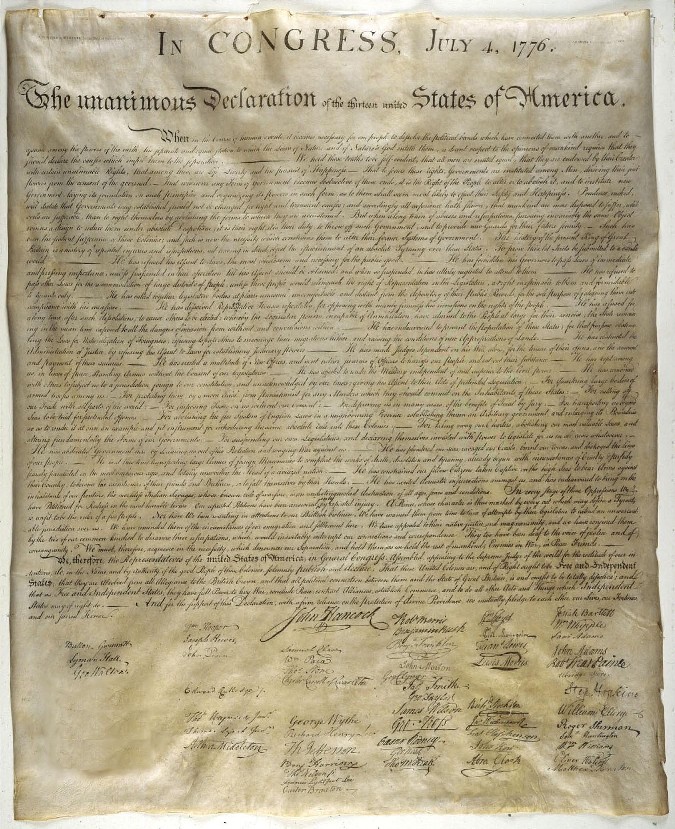
William J Stone Copper Plate and Printing of the
Declaration of Independence in 1976.
Printer and Engraver
William J. Stone was an engraver, lithographer, and sculptor and a political
friend of John Quincy Adams.
He was born in London, England and was brought to America as a child in 1804.
After studying engraving under Peter Maverick in New York, he established a firm
in Washington, D.C. in 1815 where he did a significant amount of work for the
federal government. He is best known for winning from Secretary of StateJohn
Quincy Adams the commission to
reproduce an exact copy of the Declaration of
Independence.
His 1823 copper plate engraving of the
Declaration of
Independence, according to independent scholar
Seth Kaller, "is as close to an exact copy of the original
manuscript as was humanly possible at that time, before the use of photographic
imagery." According to Kaller:
Stone worked on the engraving for close to three years, keeping
the original in his shop. Many still believe he used some sort of wet or
chemical process to transfer the ink to create such a perfect reproduction,
thus hastening the destruction of the original manuscript. In fact, he left
minute clues to distinguish the original from the copies, also providing
evidence of his painstaking engraving process. Stone’s engraving is the best
representation of the Declaration manuscript as it looked at the time of
signing. On April 11, 1823, Adams noted a visit from “Stone the Engraver, who
has finished his facsimile of the original Declaration of Independence.” By
May 10, the original engrossed manuscript was back in Adams’s hands, being
shown to visitors.
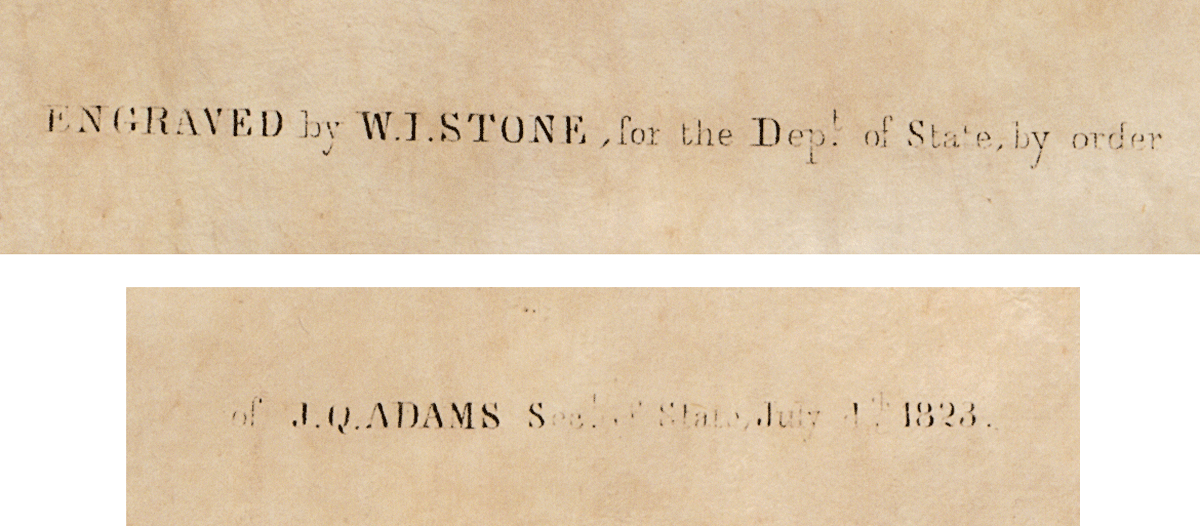
The top left and right sections of the imprint on the vellum
copies printed by W.J. Stone.
image Courtesy of Seth Kaller
Daniel Brent of the
Department of State wrote to Stone on May 28, 1823, requesting 200 copies of the
facsimile “from the engraved plate…now, in your possession, and then to
deliver the plate itself to this office to be afterwards occasionally used by
you, when the Department may require further supplies of copies from it.”
Stone proceeded to print 201 copies on vellum, one of which he kept for himself,
as was customary though perhaps not authorized in this case. Four copies
presently known on heavy wove paper are most likely proofs before printing on
the much more expensive vellum.
On May 26, 1824, Congress provided orders to
John Quincy Adams for distribution of
the Stone facsimile for distribution. The surviving three signers of the
Declaration, Thomas Jefferson,
John Adams, and
Charles Carroll of Carrollton,
each received two copies. Two copies each were also sent to President
James Monroe, Vice President Daniel D.
Thompkins, former President James Madison,
and the Marquis de Lafayette. The
Senate and the House of Representatives split twenty copies. The various
departments of government received twelve copies apiece. Two copies were sent to
the President’s house and to the Supreme Court chamber. The remaining copies
were sent to the governors and legislatures of the states and territories, and
to various universities and colleges in the United States.
All subsequent exact
facsimiles of the Declaration descend from the Stone plate. One of the ways to
distinguish the first edition is Stone’s original imprint, top left: “ENGRAVED
by W.J. STONE for the Dept. of State by order,” and continued top right: “of
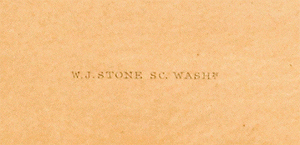
J. Q. Adams, Sec of State July 4, 1823.” Sometime after Stone completed his
original printing, his imprint at top was removed, and replaced with a shorter
imprint at bottom left, “W. J. STONE SC WASHn,” just below
George Walton’s printed
signature.
William J. Stone
retired to pursue artistic endeavors in 1840. He died in Washington in
1865.commissioned , William J. Stone a political friend, to create an official
facsimile of the engrossed version of the Declaration.
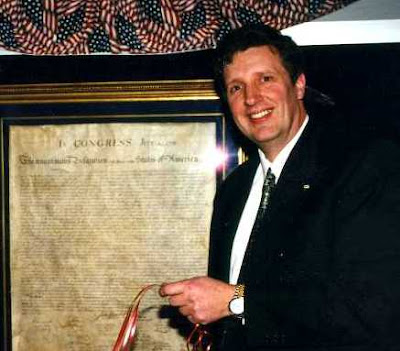
Stan Klos unveiling his
"Stone" Declaration of Independence at the MGM Grand Hotel Las Vegas
Authenticate your Declaration of IndependenceClick
Here
For Full Text of the Declaration of Independence Click
Here
According to the National Park Service:
Press copies were made by placing a damp sheet of thin paper on a manuscript and
pressing it until a portion of the ink was transferred. The thin paper copy was
retained in the same manner as a modern carbon copy. The ink was reimposed on a
copper plate, which was then etched so that copies could be run off the plate on
a press. This"wet transfer"method
may have been used by William J. Stone when in 1820 he was commissioned by
Secretary of State John Quincy Adams to make a facsimile of the entire"Declaration
of Independence.", signatures as well as text.
By June 5, 1823, almost exactly 47 years afterJefferson'sfirst
draft of the Declaration, the (Washington) National Intelligencer was able to
report"that Mr. William J. Stone,
a respectable and enterprising Engraver of this City, has, after a labor of
three years, completed a facsimile of the original of the Declaration of
Independence, now in the archives of the government; that it is executed with
the greatest exactness and fidelity; and that the Department of State has become
the purchaser of the plate."
As the Intelligencer went on to observe:"We
are very glad to hear this, for the original of that paper which ought to be
immortal and imperishable, by being so much handled by copyists and curious
visitors, might receive serious injury. The facility of multiplying copies of it
now possessed by the Department of State will render further exposure of the
original unnecessary."The
language of the newspaper report, like that of Rush's earlier comment, would
seem to indicate some fear of the deterioration of the Declaration even prior to
Stone's work.
The copies made from Stone's copperplate established the clear visual image of
the Declaration for generations of Americans. The 200 official parchment copies
struck from the Stone plate carry the identification"Engraved
by W. J. Stone for the Department of State, by order"in
the upper left corner followed by"of
J. Q. Adams, Sec. of State July 4th 1823."in
the upper right corner."Unofficial"copies
that were struck later do not have the identification at the top of the
document. Instead the engraver identified his work by engraving "W. J. Stone SC.
Washn." near the lower left corner and burnishing out the earlier
identification. -
Version Two:
Unfortunately, by 1820 the condition of the only signed
Declaration of
Independence was rapidly deteriorating. In
that year John Quincy Adams, then Secretary of State, commissioned William J.
Stone of Washington to create official copies of the Declaration using a new
Wet-Ink transfer process.
On April 24, 1903 the National Academy of Sciences reported its findings.
summarizing the physical history of the Declaration:"The
instrument has suffered very seriously from the very harsh treatment to which it
was exposed in the early years of the Republic. Folding and rolling have creased
the parchment. The wet press-copying operation to which it was exposed about
1820, for the purpose of producing a facsimile copy, removed a large portion of
the ink. Subsequent exposure to the action of light for more than thirty years,
while the instrument was placed on exhibition, has resulted in the fading of the
ink, particularly in the signatures. The present method of caring for the
instrument seems to be the best that can be suggested."
The Wet-Ink transfer Process called for the surface of the
Declaration to be moistened transferring some of the original ink to the surface
of a clean copper plate. Three and
one-half years later under the date of June 4, 1823, theNational
Intelligencerreported that:“the
City Gazette informs us that Mr. Wm. J. Stone, a respectable and enterprising
(sic) engraver of this City has, after a labor of three years, completed a
facsimile of the Original of the Declaration of Independence, now in the
archives of the government, that it is executed with the greatest exactness and
fidelity; and that the Department of State has become the purchaser of the
plate…The facility of multiplying copies of it, now possessed by the Department
of State will render furthur (sic) exposure of the original unnecessary.”
On May 26, 1824, a resolution by the Senate and House of
Representatives provided:“That
two hundred copies of the Declaration, now in the Department of State, be
distributed in the manner following: two copies to each of the surviving Signers
of the Declaration of Independence (John Adams, Thomas Jefferson, Charles
Carroll of Carrollton); two copies to the President of the United States
(Monroe); two copies to the Vice-President of the United States (Thompkins); two
copies to the late President, Mr. Madison; two copies to the Marquis de
Lafayette, twenty copies for the two houses of Congress; twelve copies for the
different departments of the Government (State, Treasury, Justice, Navy, War and
Postmaster); two copies for the President’s House; two copies for the Supreme
Court room, one copy to each of the Governors of the States; and one to each of
the Governors of the Territories of the United States; and one copy to the
Council of each Territory; and the remaining copies to the different
Universities and Colleges of the United States, as the President of the United
States may direct.”
The 201 official parchment copies struck from the Stone plate carry the
identification "Engraved by W. J. Stone for the Department of State, by
order" in the upper left corner followed by"of
J. Q. Adams, Sec. of State July 4th 1823."in
the upper right corner."Unofficial"copies
that were struck later do not have the identification at the top of the document
or are the printed on vellum. Instead the engraver identified his work by
engraving"W. J. Stone SC. Washn."near
the lower left corner and burnishing out the earlier identification.
Today 31 of the 201 Stone facsimiles printed in 1823 are
known to exist.
Only copies from the
original first edition run of 200 (actually 201) printed on vellum, as ordered
by Congress, are listed here.
Institutional:
1. Bangor Museum and Center for History
2. Boston Public Library
3. Carroll Foundation [Descendants of Signer Charles Carroll of Carrollton]
4. Colonial Williamsburg. Donated by Epstein, CA
5. Gilder Lehrman Collection on deposit at N-YHS
6. Henry Ford Museum and Greenfield Village
7. Harvard University, Houghton Library
8. Indiana University, Lilly Library
9. Jefferson County Court House, Kentucky. Donated by Mulloy family
10. Library of Congress (copy 1)
11. Library of Congress (copy 2)
12. Maryland Historical Society, Charles Carroll’s copy
13. Massachusetts Historical Society, Adams Papers (copy 1)
14. Massachusetts Historical Society, Adams Papers (copy 2)
15. New Hampshire Archives (copy 1)
16. New Hampshire Archives (copy 2)
17. New Haven Historical Society
18. Rhode Island State Archives (copy 1)
19. Rhode Island State Archives (copy 2)
20. Tennessee State Archives
21. University of Virginia. Lafayette’s copy, Albert H. Small Declaration of
Independence Collection
22. Smithsonian Institution. Donated by Stone family
23. Sweet Briar College
24. Virginia State Library Archives
25. The White House. Donated by William R. Coleman
26. U.S. Supreme Court. Rediscovered in late 2007
27. Ronald Reagan Presidential Library*. Donated by Harry & Esther Snyder
28. Richard Nixon Presidential Library*
29. John F. Kennedy Presidential Library*
30. to 52. We can confirm between 21-23 copies in private hands.
* Part of the National Archives and Records Administration: The census was
initially compiled by William R. Coleman, and published in Manuscripts, Spring
1991: “Counting the Stones: A Census of the Stone Facsimiles of the Declaration
of Independence.” At the time, Coleman knew of thirty-one copies, twelve of
which were in private hands; several of those private copies are now on the
institutional list above.
With new discoveries and our review of auction and dealer records, we currently
estimate 50-52 known copies, of which 23 copies are in private hands. However,
older auctions and dealer catalogs often did not include illustrations, so this
might include one or two duplicate listings.
The original plate, which was altered in 1824, was not used
again until seven copies were printed from it for the Bicentennial of the
Declaration of
Independence in 1976. Only three
printings were deemed acceptable. The
1823 copper plate will not be used again until the celebration of the
Tri-centennial in the year 2076.