Matthew Thornton
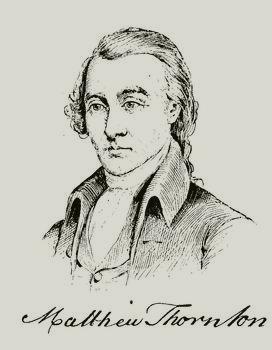
Click on an image to view full-sized
Signer of the Declaration of Independence
MATTHEW
THORNTON was born in Northern Ireland in 1714 and came to
America with his parents when he was four years old. The
family arrived in New England and resided for a few years in Wiscasset, Maine. Afterward
they moved to Worchester Massachusetts where Thornton received a classical
education. He went on to study
medicine and opened up his practice in Londonderry, New Hampshire in 1740, and
soon became wealthy as his practice flourished.
Five
years later and still unmarried, Thornton volunteered to serve as a military
surgeon for the Fort Louisburg expedition. It was a major campaign and ended
with the capture of the French Fort at the mouth of the St. Lawrence River.
Following his tour of duty, Thornton returned home to Londonderry, remained in
the local militia and rose in rank to colonel.
Thornton
was forty-four when he married Hannah Jack and he eventually fathered five
children. He took an active part in
the overthrow of the royal government in New Hampshire, being prominent in the
agitation against the Stamp Act. Thornton
was chosen president of the provincial convention when it assembled in 1775 and
for the next decade he held a number of responsible positions, including
chairman of the regional committee of safety and president of the constitutional
convention. He was most active in
securing weapons and recruiting militia for the colony. He
was allowed to sign his name to the Declaration of Independence, being in full
accord with the voting, although he was not elected until after its passage and
did not take his seat until November 1776.
Thornton
was tall, big-boned and handsome and he was a natural storyteller who could hold
the attention of his friends for hours on end. He
remained in the continental congress for another year, having been reelected to
represent New Hampshire in December 1776. Thornton
then returned to New Hampshire in 1779 and settled his family on a farm in
Merrimack County, relinquishing his medical practice. He
served as an associate justice of the superior court until he was sixty-eight
and when he was in his seventies, he was in the state senate. He
retired to his farm and wrote political articles for the newspapers, even after
the age of eighty. In his last days
he composed a metaphysical work on the origin of sin, which was never published.
Thornton
died on June 24, 1803 at the age ofeighty-nine.
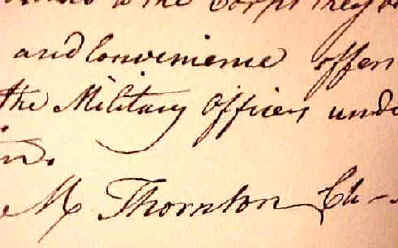
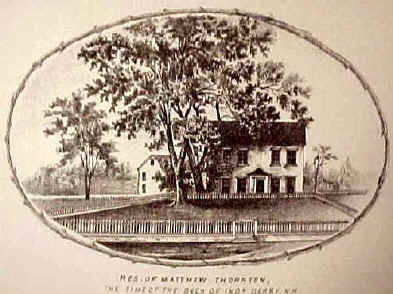
Source: Centennial
Book of Signers
For
a High-resolution version of the Stone
Engraving
For a High-resolution version of the Original
Declaration of Independence
We invite you to read a transcription
of the complete text of the Declaration as presented by the National Archives.
&
The article "The
Declaration of Independence: A History,"
which provides a detailed account of the Declaration, from its drafting through
its preservation today at the National Archives.
Virtualology
welcomes
the addition of web pages with historical documents and/or scholarly papers on
this subject. To submit a web link
to this page CLICK
HERE. Please be sure to
include the above name, your name, address, and any information you deem
appropriate with your submission.
THORNTON, Matthew, signer of the
Declaration of Independence, born in Ireland about 1714; died in Newburyport,
Massachusetts, 24 June, 1803. When he was two or three years old his father,
James, emigrated to New England, residing for a few years at Wiseasset, Maine,
and afterward at Worcester, Massachusetts, where the son received a classical
education. He studied medicine in Leicester, practiced in Londonderry, New
Hampshire, and soon became wealthy, he accompanied the New Hampshire troops in
the expedition against Louisburg in the capacity of surgeon. He was appointed a
justice of the peace, and before the Revolution was a colonel. Taking an active
part in the overthrow of the royal government in New Hampshire, Dr. Thornton was
chosen president of the Provincial convention when it assembled in 1775. He was
chief justice of the court of common pleas, and from 1776 till 1782 a judge of
the superior court of New Hampshire. He was elected speaker of the assembly on 5
January, 1776, and on 12 September the legislature chose him as a delegate to
the Continental congress. As in the case of the delegates from Pennsylvania, he
was allowed to affix his name to the engrossed copy of the Declaration of
Independence, although he was elected after its passage, and did not take his
seat till 4 November, 1776.
In December he was again chosen to represent New Hampshire in congress for
another year. He removed to Exeter in 1779, and shortly afterward settled on a
farm at Merrimack, relinquishing medical practice. He was elected a member of
the general court, then a state senator, and in 1785 was appointed a member of
the council. From the adoption of the state constitution till his death he was a
justice of the peace. He wrote political articles for the newspapers, even after
the age of eighty, and in his last days composed a metaphysical work on the
origin of sin, which was never published. In 1887 the legislature of New
Hampshire voted $1,000 for a monument to be placed over his grave in Merrimack.
Edited Appletons Encyclopedia, Copyright © 2001 VirtualologyTM





