Be Sure to Visit
The Woodrow Wilson House -
Click Here
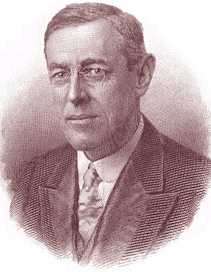
THOMAS WOODROW WILSON was born in
Staunton, Virginia on December 28, 1856. He was the first son and third child of
Joseph Ruggles Wilson, a Presbyterian minister, and Jessie Janet Woodrow. In
1859 the family moved when the elder Wilson was named pastor of a church in
Augusta, Georgia. The Civil War was difficult as Dr. Wilson was an ardent
Confederate sympathizer, and young Wilson witnessed the ruthless behavior of
General William T. Sherman’s federal troops who invaded Georgia and South
Carolina, and he remained an ardent Southerner throughout his lifetime.
Young Wilson was educated at home and at private schools in Augusta and
Columbia, South Carolina, where the Wilsons moved when Dr. Wilson accepted a
position as a professor. In 1873 they moved again, to Wilmington, North Carolina
where Wilson attended Davidson College, a small Presbyterian school where his
father was a trustee. The following year he enrolled at the College of New
Jersey (now Princeton University), where he pursued his interest in English
literature and politics. He studied the classic orators and the techniques of
public speech and was a leader among the school debaters. His vision of entering
national politics was revealed in his visiting cards, which was written
"Thomas Woodrow Wilson, senator from Virginia." During his senior year
at college he dropped the 'Thomas' from his name and he published an essay,
"Cabinet Government in the United States," in the International Review
(August 1879). The essay revealed his gift for embellishing ideas and giving
them simple and urgent form. He envisioned a government of strong and competent
legislators rather than a strong president, and he was encouraged by the
excellent reception his essay received He decided to become a lawyer and enter
politics and he enrolled in the University of Virginia law school. However, he
became inpatient with the fine points of law as he found public speaking and
political history more satisfying. He received his law degree and in 1882
settled in Atlanta, Georgia, where he opened a law office with Edward I. Renick,
another idealistic young Southerner. However, neither Renick nor Wilson were
skilled at the business side of their venture, and in 1883 Wilson relinquished
his law career and entered the graduate school of The Johns Hopkins University
to study history.
At John Hopkins, Wilson’s mentor, Professor Herbert Baxter Adams permitted him
to continue to analyze politics. The result was a book-length expansion of his
earlier essay which was accepted and published early in 1885. Congressional
Government earned Wilson his Ph.D. degree and enabled him to pursue a literary
and academic career.
Wilson had been engaged for several years to Ellen Louise Axson, daughter
of a Georgia clergyman, and they were married on June 24, 1885. She was cultured
and vivacious and was the perfect mate for him. The couple had three daughters,
Margaret Woodrow Wilson (1886 – 1944), Jessie Woodrow Wilson (1887 – 1933)
and Eleanor Randolph Wilson (1889 – 1967).
At that time, he also accepted a position with the newly opened Bryn Mawr
College, a school for women near Philadelphia, where he taught and pursued his
writing for the next three years. In 1888 he accepted a professorship in history
and political economy at Wesleyan University in Connecticut. There, in 1889, he
published a lengthy textbook analyzing the political nature of society, The
State. In 1890 he was offered and accepted a professorship at his alma mater,
the College of New Jersey. He began a program of publishing and public
appearances and became one of the leading academic personalities of the era. His
essays appeared in many magazines and he brought an excitement to his subjects
that stirred his students, his colleagues, and the outside reader. He seemed to
have abandoned any hope for a political career, but he continued to follow
political affairs. Responding to the strong demand for his work, he wrote A
History of the American People, published in five volumes in 1902 and his name
became familiar and respected
Wilson was unanimously elected to the presidency of the college in 1902,
which had now become Princeton University. During his tenure as president, his
innovation and reforms brought wide impact on national university education.
In 1909 Wilson's progressive approach to education attracted the attention
of the Democratic political machine. They helped elect him Governor of New
Jersey, but learned to regret it when he ended up cleaning house and riding the
state house of corruption. Success in New Jersey made him a contender for the
Democratic presidential nomination. Although he entered the 1912 Democratic
National Convention a poor second to Speaker of the House Champ Clark, he won
the nomination after 46 ballots. Offering a program of reform he called the New
Freedom, Wilson ran against a divided Republican party. In November, Wilson won
only 41.85 percent of the popular vote but polled 435 electoral votes, compared
with Roosevelt's 88 and President Taft's 8.
With a Democratic majority in Congress, Wilson pushed through many
reforms, including the graduated income tax, a lower tariff, laws restricting
child labor and the Federal Reserve Act. However, he proved to be less decisive
on other reform issues. He had little confidence in the ability of women to vote
and participate in politics, but for political reasons he was slow to oppose the
determined suffragettes. Similarly, he fought for the child labor law with
obvious reluctance and supported the Adamson Act only to head off a threatened
strike by railroad workers. Wilson’s most obvious failure at reform was his
policy toward blacks. Segregation had never been the custom in federal
government offices in Washington, D.C. However, faced with strong pressure from
his fellow Southerners, Wilson allowed segregation in the capital. Challenged
with his vague promises before election that he would treat blacks with
fairness, he could only say that the new policy of segregation was in the best
interests of blacks and he would angrily end the interview when he was disputed.
Wilson suffered a severe personal loss on August 6, 1914, with the death
of his wife. Combined with the sickness and tension that had plagued him for
most of his life, her death was almost more than he could bear. He sought solace
in more intensive work and leaned heavily on his few friends. The following year
he met Edith Bolling Galt, a southerner and the widow of a Washington jeweler.
She and Wilson were married on December 18, 1915.
In 1916, the war in Europe was the major issue of the day. Wilson opposed
intervention and narrowly won re-election. Soon after, Germany’s mounting
aggression against the United States forced Wilson to declare war, to “make
the world safe for democracy.”
After the Allied victory, Wilson’s “Fourteen Points” peace plan
paved the way for the creation of the League of Nations. Against the advisement
of his doctor, Wilson set out on a national tour to generate public demand for
ratification of the League. The physical strain was too great for his frail
body. He nearly collapsed following a speech at Pueblo, Colo., on September 25,
1919. He returned to Washington, and suffered a severe stroke and paralysis of
the left side on October 2. He never fully recovered. On November 19 the
Republican controlled Senate rejected the League’s Treaty of Versailles.
Wilson's stroke left him physically incapacitated but his condition was not made
public. Mrs. Wilson jealously guarded her husband, and most likely feared that
his resignation would sap his will to live. To her he was "first my beloved
husband whose life I was trying to save ... after that he was the president of
the United States." As a result, his Cabinet members were denied access to
him. His wife decided what printed materials he could see, and his state papers
became few and unsatisfactory.
The Democratic Party, at its 1920 convention, bestowed lavish praise on
Wilson, who was awarded the Nobel Peace Prize for 1919, but decided to nominate
James M. Cox for president.
After leaving office Wilson retired to a house on S Street in Washington,
D.C., where he lived in virtual seclusion. He died on February 3, 1924 and was
buried in the National Cathedral in Washington, D.C.
Presidents
of the Continental Congress
United Colonies of The United States
Peyton
Randolph September 5, 1774 to October 22, 1774
and May 20 to May 24, 1775
Henry Middleton October 22, 1774 to October 26, 1774
The Vice President
Speaker of the House
President pro tempore of the Senate
Secretary of State
Secretary of the Treasury
Secretary of Defense
Attorney General
Secretary of the Interior
Secretary of Agriculture
Secretary of Commerce
Secretary of Labor
Secretary of Health and Human Services
Secretary of Housing and Urban Development
Secretary of Transportation
Secretary of Energy
Secretary of Education
Secretary of Veterans Affairs
Research
Links
Virtualology is
not affiliated with the authors of these links nor responsible for its content.
Franklin
D. Roosevelt Library and Museum - Repository of the records of President
Franklin Roosevelt and his wife Eleanor Roosevelt, managed by the National
Archives and Records Administration.
Dwight
D. Eisenhower Presidential Library - preserves and makes available for
research the papers, audiovisual materials, and memorabilia of Dwight and Mamie
D. Eisenhower
Unauthorized Site:
This site and its contents are not affiliated, connected,
associated with or authorized by the individual, family,
friends, or trademarked entities utilizing any part or
the subject's entire name. Any official or affiliated
sites that are related to this subject will be hyper
linked below upon submission
and Evisum, Inc. review.
Please join us in our mission to incorporate The Congressional Evolution of the United States of America discovery-based curriculum into the classroom of every primary and secondary school in the United States of America by July 2, 2026, the nation’s 250th birthday. , the United States of America: We The
People. Click Here