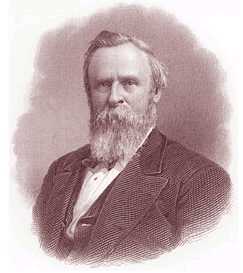
RUTHERFORD BIRCHARD HAYES was
born on October 22, 1822 in Delaware, Ohio, nearly three months after the death
of his father, Rutherford Hayes. The elder Hayes had left his native Vermont in
1817 to emigrate to the West, bringing with him his wife, Sophia Birchard of
Wilmington, Vermont, his two young children and his wife’s brother, Sardis
Birchard. They settled in the town of Delaware, Ohio, where he purchased an
interest in a distillery and built a considerable house. He died of the malarial
epidemic that swept the region, leaving his wife with a child on the way, to the
care of her brother.
Rutherford B. Hayes was a sickly child and when he was three years old,
his older brother Lorenzo drowned, leaving his mother very apprehensive of young
Rutherford’s health and well-being. She kept him from school in his early
childhood and he became timid with an aversion to the rough and mischievous ways
of other boys. The boy’s sole companion was his sister Fanny, a bright active
tomboy, two years older than himself. When he did attend school, he was an
excellent student and gave his teachers no trouble. His uncle Birchard, who had
been devoted to the family, took a strong interest in the boy’s schooling and
decided to send young Hayes to a tutor in Connecticut where he remained for a
year. On his return, he was sent to Kenyon College in Gambier, Ohio and he
graduated first in his class in 1842.
Hayes decided to pursue a law profession and began his studies at the
office of Mr. Thomas Sparrow in Columbus. With his uncle’s approval, he
attended Harvard Law School and received his degree in 1845. He was admitted to
the Ohio bar and went into practice with Ralph P. Buckland in Fremont. This
partnership lasted three years. Hayes uncle Sardis Birchard had by this time
become a wealthy banker and the Hayes family was benefiting from his wealth. In
1849, young Hayes moved to Cincinnati, where he established his practice and
made contact with some of the leading men of the city. He also renewed his
friendship with his college schoolmate, Stanley Matthews and entered local
politics in the new Republican Party. Within a few years he had made a name for
himself as a criminal lawyer. Hayes mother had chosen a girl for him. She was
Lucy Ware Webb, whom Hayes had first met at his home in Delaware when she was
15. They became engaged after she was graduated from Wesleyan Female College in
Cincinnati and they were married in December 1852. Hayes was then 30 and Lucy,
although only 21 was warmhearted, popular and very religious. Their first son,
Birchard Austin, was born in 1853.
Hayes was a strong supporter of the Union, despite his hopes for a
compromise on the issue of the Civil War. When the War broke out, he answered
the call for troops in April 1861 and served the Union well for the next four
years. He was wounded four times and had four horses shot out from under him. In
the spring of 1865 he was placed in command of an expedition against Lynchburg
when the war was brought to a close by Lee’s surrender.
Hayes was nominated and elected to Congress while still in the army, but
he refused to leave his command until the war was over. He took his seat I the
House in December 1865 and was reelected in 1866. He made few speeches and took
no part in the debates over reconstruction and always voted along party lines.
In 1867 and again in 1869, Hayes was elected Governor of Ohio. He proved a
capable and economical administrator, taking great interest in prison reform and
in hospitals for the mentally ill. His beloved sister Fanny had been
hospitalized more than once for mental illness.
In 1873 Hayes decided he was finished with politics and he retired with is
family to his uncle’s house, Spiegel Grove, in Fremont. His uncle died the
following year and left the bulk of his large estate (mostly land) to Hayes. The
Hayeses now had five children (three had died in childhood). The oldest boys,
Birchard, Webb and Rutherford were at college. At home were Fanny, seven and
Scott Russell, four. Hayes was the leading citizen of Fremont and was listed in
the directory as a “capitalist”. His retirement was brief, however, after
one year he was persuaded to run for Congress. He was defeated, but he ran
again, this time for Governor of Ohio in 1875. Hayes defeated Democratic
Governor William Allen, but only by 5,500 votes out of nearly 600,000 cast.
Although his victory was narrow, his success made him a strong presidential
possibility in 1876. The Republican Party liked him for many reasons, his
integrity being one, and Hayes himself thought he had a good chance and actively
sought and received their nomination.
Hayes Democratic opponent in 1876 was Samuel J. Tilden, the Governor of
New York. When the election returns were counted, Tilden had won the popular
vote by about 247,448 out of a total cast of 8,320,592. However, both men
claimed an electoral vote victory. There had been a controversy pending for some
time in Congress regarding the manner that the Electoral votes of several states
were counted and declared. The dispute was settled by the appointment of the
Electoral Commission of 1877. On March 2, 1877, the result of the proceedings
was the declaration of Rutherford B. Hayes by a vote of 185 electoral votes to
Tilden’s 184.
On March 5, 1877, Hayes was inaugurated. He realized that the presidency
was weak and the Congress strong, and he did not please many legislators with
the tone of his inauguration speech. “He serves his party best who serves his
country best” was his much-quoted statement. In April the last of the federal
troops were withdrawn from the South and the long period of reconstruction after
the Civil War was finally ended.
In June 1877, Hayes issued an executive order directing federal workers
not to take part in the management of political parties and campaigns and
forbade the parties to demand contributions from federal employees. His
administration uncovered a civil service scandal in the New York Custom House.
Many of its employees (Chester a. Arthur, later president of the United States,
and Alonzo B. Cornell, later Governor of New York, among them) ignored their
jobs and worked instead at Republican Party politics. Hayes sponsored a bill in
Congress for broad civil service reform and although the bill was defeated, it
brought public awareness to the need for reform.
Hayes firmness and disregard of all matters but those of principle and
conviction were displayed on many occasions. His purity of purpose, courage and
consistency were rarely questioned, but his Democratic opposition was bitter and
the support of Republicans was at best mediocre. He opposed the reelection of
Presidents and affirmed his not being a candidate for reelection under any
circumstances. He advocated an amendment to the constitution extending the
president’s term to six years and prohibiting reelections. At the end of his
term, Hayes retired quietly to his home in Fremont, Ohio. His public career
ended with his retirement and he led a tranquil life, appearing as a
distinguished guest at many public celebrations and reunions.
Hayes died on January 17, 1893 at Spiegel Grove, his home in
Fremont, Ohio, after suffering an apparent heart attack.
Presidents
of the Continental Congress
United Colonies of The United States
Peyton
Randolph September 5, 1774 to October 22, 1774
and May 20 to May 24, 1775
Henry Middleton October 22, 1774 to October 26, 1774
The Vice President
Speaker of the House
President pro tempore of the Senate
Secretary of State
Secretary of the Treasury
Secretary of Defense
Attorney General
Secretary of the Interior
Secretary of Agriculture
Secretary of Commerce
Secretary of Labor
Secretary of Health and Human Services
Secretary of Housing and Urban Development
Secretary of Transportation
Secretary of Energy
Secretary of Education
Secretary of Veterans Affairs
Research
Links
Virtualology is
not affiliated with the authors of these links nor responsible for its content.
Franklin
D. Roosevelt Library and Museum - Repository of the records of President
Franklin Roosevelt and his wife Eleanor Roosevelt, managed by the National
Archives and Records Administration.
Dwight
D. Eisenhower Presidential Library - preserves and makes available for
research the papers, audiovisual materials, and memorabilia of Dwight and Mamie
D. Eisenhower
Unauthorized Site:
This site and its contents are not affiliated, connected,
associated with or authorized by the individual, family,
friends, or trademarked entities utilizing any part or
the subject's entire name. Any official or affiliated
sites that are related to this subject will be hyper
linked below upon submission
and Evisum, Inc. review.
Please join us in our mission to incorporate The Congressional Evolution of the United States of America discovery-based curriculum into the classroom of every primary and secondary school in the United States of America by July 2, 2026, the nation’s 250th birthday. , the United States of America: We The
People. Click Here