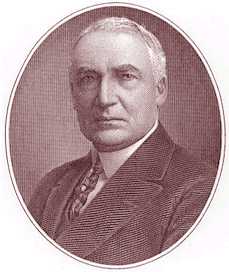
WARREN GAMALIEL HARDING was born on
November 2, 1865, in Blooming Grove near Corsica, Ohio, the first child of
George Tryon Harding II, and Phoebe Dickerson. The elder Harding was a Civil War
veteran, farmer, horse trader, and later rural doctor who was descended from the
English Puritan Richard Harding, who came to New England in 1623. His wife,
Phoebe, out of financial necessity was a midwife and was quite religious. The
family moved to nearby Caledonia, where young Harding went to school, played the
cornet in the village band and worked for a time for his father at the local
newspaper, the Caledonia Argus, as a printer’s devil, showing no enthusiasm for
farm work. In 1879, at the age of 14, he entered Ohio Central College, spending
his vacation time working on the family farm, at the local sawmill and briefly
on the Toledo and Ohio Central Railroad. Shortly before his graduation in 1882,
the family moved to Marion, Ohio, which was to become Harding’s lifelong home.
In Marion, he studied law, sold insurance, and taught school, but he didn't
enjoy any of these. Finally, because he had managed his college newspaper and
had previously worked at the Argus, young Harding took a job as a printer,
pressman, and reporter at the Marion Democratic Mirror. In 1884, together with a
friend, Harding bought an unsuccessful four-page newspaper, the Marion Star, and
as the town grew so did their paper. Harding bought out his partner and on July
8, 1891, when he was 26 years old, he married a wealthy widow, Mrs. Florence
Kling De Wolfe, who was five years his senior. The new Mrs. Harding was the
daughter of Marion’s leading banker and with her assistance the weekly Star
became an influential daily newspaper.
Not so robust as he seemed, Harding as a young man had several nervous
breakdowns. His wife, the Duchess--as he referred to her – was also neurasthenic
and formidably domineering. She brought him very little domestic happiness, and
he established relationships with other women. His most enduring affair was with
Carrie Phillips, the wife of a Marion merchant, with whom he maintained a
liaison from 1905 to 1920.
In 1917, Harding formed a relationship with Nan Britton, an impetuous young
woman from Marion who was 31 years his junior. She visited him from time to time
in Washington when he was a senator and even in the White House. Their daughter
Elizabeth Ann Christian was born in 1919.
In the 1890s Harding enlarged his social and business connections in Marion.
He joined the Masons, the Elks, and other fraternal orders. He served as a
director of the Marion County Bank, the Marion County Telephone Company, and
Marion Lumber Company, and he was a trustee of the Trinity Baptist Church.
Harding developed a knack for public speaking. He found he could captivate the
audiences of his day with his mellow delivery. He came to the attention of Harry
M. Daughtery, an Ohio lobbyist and political manipulator. After an early defeat
for county auditor, Harding was elected as the Republican state senator in 1899.
He quickly became one of the most popular senators in Columbus. During his
second term he was chosen Republican floor leader, and at its conclusion he was
elected in 1902 to the figurehead post of lieutenant governor.
In 1914 he was chosen as candidate for the U. S. Senate to oppose the
Irish-Catholic Democratic attorney general, Timothy S. Hogan. Although Harding
himself refused to exploit Hogan's religion, his followers played up the issue
of popery so successfully in rural Ohio that Harding won easily.
In his six years in the Senate, Harding was a friendly nonentity--genial, a
noted poker player, and much in demand as a speaker. No bill of any consequence
bore his name, nor did he champion any measure worth recalling. Long before the
Republican convention of 1920, Harding's mentor, Daughterty, persuaded the
reluctant senator to announce his candidacy and to appoint him political
manager. Daugherty toured the country to secure the support of Republican
leaders for Harding as a candidate. Harding was nominated on the 10th ballot. He
waged a "front porch" campaign, straddling the chief issue of the League of
Nations with vague rhetoric. He won 404 electoral votes to 127 for his
Democratic opponent, James M. Cox, and 16,153,785 popular votes to Cox's
9,147,353.
During Harding’s term, the White House took on the laidback atmosphere of his
frequent poker evenings. Corruption grew blatantly -- in the Department of
Justice, in the Bureau of Investigation, in the Prohibition Bureau of the
Treasury Department, and in the Veterans' Bureau. Harding followed the
congressional Republicans’ lead, approving bills that cut taxes, raised tariffs,
ended wartime controls and restricted immigration. In the two years following
his election, the country seemed to be on the road to prosperity. Then, on
August 2, 1923, during a campaign visit to San Francisco, Harding died suddenly
of a heart attack and the nation was stunned by revelations of widespread
corruption in his Administration.
Presidents of the Continental
Congress
United Colonies of The United States
Peyton Randolph September 5, 1774 to October
22, 1774
and May 20 to May 24, 1775
Henry Middleton October 22, 1774 to October 26, 1774
The Vice President
Speaker of the House
President pro tempore of the Senate
Secretary of State
Secretary of the Treasury
Secretary of Defense
Attorney General
Secretary of the Interior
Secretary of Agriculture
Secretary of Commerce
Secretary of Labor
Secretary of Health and Human Services
Secretary of Housing and Urban Development
Secretary of Transportation
Secretary of Energy
Secretary of Education
Secretary of Veterans Affairs
Research Links
Virtualology is not affiliated with the authors of these links nor responsible
for its content.
Franklin D. Roosevelt Library and Museum - Repository of the records of
President Franklin Roosevelt and his wife Eleanor Roosevelt, managed by the
National Archives and Records Administration.
Dwight D. Eisenhower Presidential Library - preserves and makes available
for research the papers, audiovisual materials, and memorabilia of Dwight and
Mamie D. Eisenhower
Unauthorized Site:
This site and its contents are not affiliated, connected,
associated with or authorized by the individual, family,
friends, or trademarked entities utilizing any part or
the subject's entire name. Any official or affiliated
sites that are related to this subject will be hyper
linked below upon submission
and Evisum, Inc. review.
Please join us in our mission to incorporate The Congressional Evolution of the United States of America discovery-based curriculum into the classroom of every primary and secondary school in the United States of America by July 2, 2026, the nation’s 250th birthday. , the United States of America: We The
People. Click Here