Who was
the First U.S. President? There were actually four first
Presidents
of the United Colonies and States of America Click Here
New Page 1
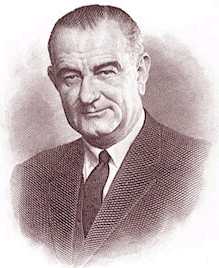
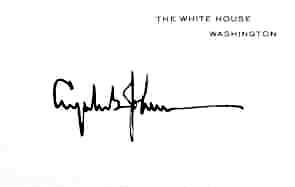
Lyndon B. Johnson
46th President of the United States
36th under the US Constitution
LYNDON BAINES JOHNSON was born on
August 27, 1908 near Stonewall, Gillespie County, Texas. His paternal
grandfather had moved to Texas from his birthplace in Georgia and had become a
cattle rancher in the Pedernales River Valley west of Austin. Johnson was the
eldest of the five children of Sam Ealy Johnson, Jr. and Rebekah Baines Johnson.
His father struggled on the family cattle ranch and being politically active,
served five terms in the Texas legislature. In 1913, the Johnson family
abandoned the family ranch and moved to Johnson City, a nearby town named for
his ancestors. Johnson attended public schools in Johnson City and graduated
from Johnson City High School, one of six in the class of 1924.
Johnson decided to make his way to California with a five friends in an
automobile he had purchased. There he performed odd jobs, picking fruit, washing
cars and one as an elevator operator. A year later he hitchhiked home where he
worked on a road construction gang. His mother had impressed the importance of a
college education on him while he was growing up and in 1927 he decided to
follow her advice. He enrolled in nearby Southwest Texas State Teachers College
where he eventually received his B.S. after interrupting his education to teach
Mexican children in the town on Cotulla in South Texas. After graduation, he
accepted a teaching position at Sam Houston High School in Houston, where his
uncle was chairman of the History department. In 1931, at the beginning of his
second year teaching, he accepted a political appointment, going to Washington
as secretary to Democratic Texas congressman, Richard M. Kleberg. He soon gained
prominence in Washington Democratic political circles during the early days of
Roosevelt’s administration. In 1933 he was elected speaker of an organization of
congressional workers called the “Little Congress”
On a trip home to Texas, Johnson met a women he almost immediately knew
was to be his wife. Two months later she agreed and on November 17, 1934,
Johnson married Claudia Alta Taylor, known as “Lady Bird”, a member of a
prosperous Texas family and a recent graduate of the University of Texas. The
couple had two daughters, Lynda bird, born in 1944 and Luci Baines, born in
1947.
On July 25, 1935, Johnson resigned as Secretary to Representative Kleberg
and accepted Roosevelt’s appointment as the Texas Director of the National Youth
Administration. At the age of 26, he was the youngest of the state directors. In
1937, the seat of the incumbent congressman James P. Buchanan in Johnson’s 10th
Texas district became vacant due to the congressman’s sudden death. With $10,00
borrowed by his wife, and aided by many local friends, Johnson ran against nine
opponents. On April 10, 1937, Johnson won with more than 3,000 votes than the
next highest candidate. Johnson was an all out supporter of President Roosevelt
and he was appointed to the House Committee on Naval Affairs at the request of
the President. Johnson worked hard for public housing, rural electrification and
eliminating government waste. He won reelection to each succeeding Congress
until 1948.
In the spring of 1941, Senator Morris Sheppard died and Johnson announced
his candidacy for the remaining term. Johnson once again ran as an enthusiastic
supporter of Roosevelt’s. The election in June was very close, but Johnson lost
by 1,311 votes out of nearly 600,000 cast. After the Japanese attack on Pearl
Harbor in December 1941, Johnson was on of the first congressman to enlist,
joining the Navy. He saw action in the Pacific and received the Silver Star for
gallantry. He returned to Washington in July 1942 where he headed a special
investigating subcommittee of the Naval Affairs Committee. The death of
President Roosevelt in April 1945 was a personal loss for him, telling a
reporter that the President has been his “second daddy.”
In 1948, Johnson again ran for the Senate, this time winning the primary
with a final victory by a margin of 87 votes, out of nearly 900,000 cast, giving
him the nickname “Landslide Lyndon”. He won easily over his Republican opponent,
Jack Porter, in the election and returned to Washington and immediately became a
member of the Senate Armed Services Committee. He advanced rapidly in the
Senate, in 1951 becoming party whip, providing leadership for his party and
developing his peace-making powers. In 1953, he was elected Minority Leader of
the Senate and in 1955, the Majority Leader. During his tenure as Senate
Majority Leader, Johnson served as Chairman of the Democratic Policy Committee,
Democratic Steering Committee, and Democratic Conference of the Senate. On July
2, 1955 Johnson suffered a severe heart attack and entered Bethesda Naval
Hospital. He was released from the hospital and returned home to the LBJ Ranch
to recuperate. He did not return to Washington until December. Johnson resumed
his duties on the Hill, helping to secure the passage of the Civil Rights Act of
1957. He was active as Chairman of the Senate Preparedness Investigating
Subcommittee, beginning hearings on the American space program.
On July 13, 1960, Johnson was nominated for President at the Democratic
National Convention, but he did not count on the superbly managed campaign of
John F. Kennedy, loosing the first-ballot nomination to the young Senator from
Massachusetts. Kennedy then surprised many people by offering Johnson the
vice-presidential nomination. A surprised Johnson accepted and threw himself
into he campaign, working in the South to overcome the Southern Democrats
suspicion of a Roman Catholic candidate. The election was very close, with the
Kennedy/Johnson ticket winning by a narrow margin over the Nixon/Lodge
Republicans.
Johnson was an unusually active vice president, participating
significantly in the decision-making process, and visiting 33 countries on
behalf of the administration. In November 1963, Johnson and Kennedy went to
Texas and on the 22nd, they were riding in separate cars in the motorcade in
Dallas when the assassin’s bullets stuck the President. Johnson was administered
the oath of office as the 36th president aboard Air Force One, the presidential
airplane as it sat in Love Field about 112 minutes after Kennedy had died.
The new president quickly took command, placing great emphasis on
continuity of the Kennedy Program. He signed the Civil Rights Act of 1964 in a
televised ceremony at the White House. He ordered retaliatory air strikes
against North Vietnam after the attacks on the USS Maddox and her escort the USS
C. Turner Joy. He signed the Southeast Asia Resolution on August 10th, giving
him authority to take “all necessary measures to repel any armed attack against
the forces of the United States and to prevent further aggression.” In November
he was elected President of the United States with the greatest percentage of
the total popular vote (61%) ever attained by a candidate. Hubert Humphrey was
elected Vice President.
Johnson introduced his own “Great Society” program, declaring a “war on
poverty” and calling for urban renewal, aid to education and Medicare for the
elderly. But the situation in South Vietnam deteriorated and Johnson began
enlarging the military commitment. Though never declared, the war in South
Vietnam came to dominate his Presidency. It escalated steadily costing thousands
of American lives and causing bitter protests at home. On March 31, 1968 Johnson
announced that he would not be a candidate for another term as President.
Following the inauguration of Richard M. Nixon in January 1969, Johnson
returned to the LBJ Ranch in Texas. He devoted his time to writing his
presidential memoirs. He again suffered from his heart ailment and on January
22, 1973, he died at this ranch near Johnson City, Texas.
Presidents of the Continental
Congress
United Colonies of The United States
Peyton Randolph September 5, 1774 to
October 22, 1774
and May 20 to May 24, 1775
Henry Middleton October 22, 1774 to October 26, 1774
The Vice President
Speaker of the House
President pro tempore of the Senate
Secretary of State
Secretary of the Treasury
Secretary of Defense
Attorney General
Secretary of the Interior
Secretary of Agriculture
Secretary of Commerce
Secretary of Labor
Secretary of Health and Human Services
Secretary of Housing and Urban Development
Secretary of Transportation
Secretary of Energy
Secretary of Education
Secretary of Veterans Affairs
Research Links
Virtualology is not affiliated with the authors of these links nor responsible
for its content.
Franklin D. Roosevelt Library and Museum - Repository of the records of
President Franklin Roosevelt and his wife Eleanor Roosevelt, managed by the
National Archives and Records Administration.
Dwight D. Eisenhower Presidential Library - preserves and makes available
for research the papers, audiovisual materials, and memorabilia of Dwight and
Mamie D. Eisenhower
Unauthorized Site:
This site and its contents are not affiliated, connected,
associated with or authorized by the individual, family,
friends, or trademarked entities utilizing any part or
the subject's entire name. Any official or affiliated
sites that are related to this subject will be hyper
linked below upon submission
and Evisum, Inc. review.
Please join us in our mission to incorporate The Congressional Evolution of the United States of America discovery-based curriculum into the classroom of every primary and secondary school in the United States of America by July 2, 2026, the nation’s 250th birthday. , the United States of America: We The
People. Click Here