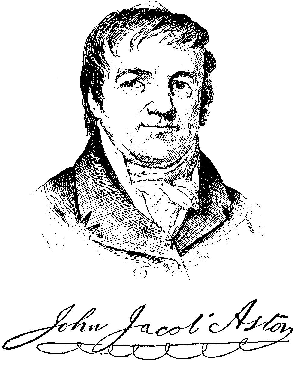
ASTOR,
John Jacob, merchant, born in Walldorf, near Heidelberg,
Germany, 17 July 1768; died in New York, 29 March 1848. He was the fourth son of
a butcher in Walldorf, and until he was sixteen years of age he worked with his
father. He then joined an elder brother in London, who was employed in the
piano and flute factory of their uncle, of the firm of Astor & Broadwood,
widely known afterward as Broadwood & Co. His brother Henry had settled in
New York, and his intention was to emigrate to the United States as soon as he
could save enough money.
In
1783 he sailed for Baltimore with a small invoice of musical instruments to sell
on commission. On shipboard he met with a furrier, who told him of the profits
to be made in buying furs from the Indians and frontiersmen and selling them
to the large dealers, and, in order to become familiar with the fur business, he
entered into the employ of a Quaker furrier in New York and, when he had
mastered the numerous details of the trade, began business on his own account,
opening a shop in Water street, in which he worked early and late, except when
absent on his purchasing trips. Soon after he established himself in New York
he visited London, formed connections with houses in the fur trade, and made
arrangements with Astor & Broadwood to become their agent in America.
After
his return to New York he opened a wareroom for the sale of musical instruments,
becoming the first regular dealer in such articles in the United States. He
married Sarah Todd, who brought him a dowry of only $300, but who possessed a
frugal mind and a business judgment that he declared to be better than that of
most merchants, and she assisted him in the practical details of his business.
Before the close of the century Astor possessed, as the result of fifteen years
of constant work, a fortune of $250,000. He then for the first time took a house
separate from his store. With sagacious management the business prospered to
such an extent that he was able to ship furs in his own vessels and bring back
European goods. He made frequent voyages up the Mohawk, to buy directly from
the Indians, and also dealt largely with the great English fur companies. About
1809 he conceived a national scheme to render American trade independent of
the Hudson Bay Company, and to carry civilization into the wilderness, for which
he asked the aid of congress.
His
project was to establish a chain of trading posts from the lakes to the Pacific,
to plant a central depot at the mouth of Columbia river, and to acquire one of
the Sandwich islands and establish a line of vessels between the western coast
of America and the ports of China and India. Two expeditions were sent, one by
land and the other' by sea, to open up intercourse with the Indians of the
Pacific coast. In 1811 the settlement of Astoria was planted at the mouth of the
Columbia River, but the war of 1812 interfered with Astor's gigantic enterprise
and caused its abandonment.
The
story of this far-reaching scheme has been well told in Irving's "Astoria."
At this time Astor bought American government securities at 60 or 70 cents,
which after the war doubled in value. After the conclusion of peace he carried
on his operations without government support, and established a trade with
many countries, particularly China, but never realized the project of founding
settlements in the Northwest.
He
invested his gains in real estate outside the compact portion of the city of New
York, and as the city extended he erected many handsome buildings. His
judgment in business was remarkably sagacious, his habits industrious and
methodical, and his memory exceedingly tenacious, retaining the slightest
details. For the last twenty-five years of his life he lived in quiet
retirement. In this period, in consultation with literary and practical men, he
matured a plan for establishing a public library in New York, the first
suggestion of which had come from Washington Irving. He left $400,000 for
founding the Astor library, which provision was carried out by his son, William
B. Astor.
He
made other bequests for benevolent objects, in addition to liberal gifts during
his lifetime, one of which was 850.000 to found the Astor House in Walldorf, his
birthplace, an institute for the education of poor children, combined with an
asylum for the aged and needy. His fortune at the time of his death was
estimated at $20,000,000. Fitz-Greene Halleck, the poet, who was his secretary
for seventeen years, expressed the opinion that Mr. Astor would have been
eminently successful in any profession -- Edited
Appleton's American Biography Copyright©
2000 by VirtualologyTM







