Francis Scott Key: Francis Scott Key. ... View the Star Spangled Banner
Manuscript signed, Francis Scott Key Stan Klos Biography
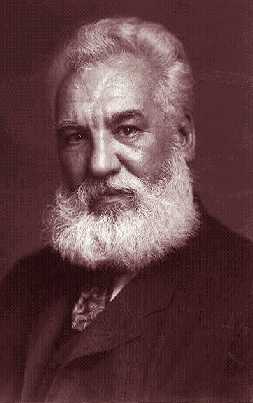
BELL, Alexander Graham,
physicist, born in Edinburgh, Scotland, 3 March 1847. He is a son of Alexander
Melville Bell, mentioned below, and was educated at the Edinburgh high school
and Edinburgh University, receiving special training in his father's system for
removing impediments in speech. He removed to London in 1867, and entered the
University there, but left on account of his health, and went to Canada with his
father in 1870. In 1872 he took up his residence in the United States,
introducing with success his father's system of deaf-mute instruction, and
became professor of vocal physiology in Boston University. He had been
interested for many years in the transmission of sound by electricity, and had
devised many forms of apparatus for the purpose, but the first public exhibition
of his invention was at Philadelphia in 1876. Its complete success has made him
wealthy. His invention of the "photophone," in which a vibratory beam of
light is substituted for a wire in conveying speech, has also attracted much
attention, but has never been practically used. It was first described by him
before the American association for the advancement of science in Boston, 27
August 1880.
After the shooting of President Garfield, Professor Bell, together with
Sumner Tainter, experimented with an improved form of Hughes's induction
balance, and endeavored to find the exact location of the ball, but failed.
Professor Bell has put forth the theory that the present system of educating
deaf-mutes is wrong, as it tends to restrict them to one another's society, so
that marriages between the deaf are common, and therefore the number of
deaf-mute children born is on the increase. His latest experiments relate to the
recording of speech by means of photographing the vibrations of a jet of water.
He is a member of various learned societies, and has published many scientific
papers. He has lived for some time in Washington, District of Columbia.
The online version of the Alexander Graham Bell Family Papers at
the Library of Congress will comprise a selection of approximately 4700 items
(totaling about 38,000 images). This second release contains about 4650 items
consisting of correspondence, scientific notebooks, journals, blueprints,
articles, and photographs documenting Bell's invention of the telephone
and his involvement in the first telephone company, his family life, his
interest in the education of the deaf, and his aeronautical and other scientific
research. Dates span from 1862 to 1939, but the bulk of the materials are from
1865 to 1920. Included among Bell's papers are pages from his experimental
notebook from March 10, 1876, describing the first successful experiment with
the telephone, during which he spoke through the instrument to his assistant the
famous words, "Mr. Watson--Come here--I want to see you." Bell's various roles
in life as teacher, inventor, celebrity, and family man are covered extensively
in his papers. The digitization of this selection of the Bell Family
Papers is made possible through the generous support of the AT&T Foundation.
The mission of the Library of Congress is to make its
resources available and useful to Congress and the American people and to
sustain and preserve a universal collection of knowledge and creativity for
future generations. The goal of the Library's National Digital Library Program
is to offer broad public access to a wide range of historical and cultural
documents as a contribution to education and lifelong learning.
The Library of Congress presents these documents as part of the record of the
past. These primary historical documents reflect the attitudes, perspectives,
and beliefs of different times. The Library of Congress does not endorse the
views expressed in these collections, which may contain materials offensive to
some readers.
Dec 9, 2008 ... A unique exhibit
complex where models, replicas, photo displays, artifacts, and films
describe the fascinating life and work of
Alexander...
Baddeck, Cape Breton Island, is where
Alexander Graham Bell, mostly famed as the inventor of the telephone
chose to build his Canadian residence. Why?
...
Alexander Graham Bell was born in Edinburgh, Scotland on 3rd March,
1847. His father was
Alexander Melville
Bell, a leading authority in elocution and
...
Alexander Graham Bell (3 March 1847 – 2 August 1922) was an eminent
scientist,
inventor
and innovator
who is widely credited with inventing the first practical
telephone.
Bell's father, grandfather, and brother had all been associated with work on
elocution
and speech, and
both his mother and wife were deaf, profoundly influencing Bell's life's work.[1]
His research on hearing and speech further led him to experiment with hearing
devices which eventually culminated in Bell being awarded the first U.S. patent
for the telephone in 1876.[2]
In retrospect, Bell considered his most famous invention an intrusion on his
real work as a scientist and refused to have a telephone in his study.[3]
Upon Bell's death, all telephones throughout the United States "stilled their
ringing for a silent minute in tribute to the man whose yearning to communicate
made them possible".[4]
Many other inventions marked Bell's later life, including groundbreaking work
in hydrofoils
and
aeronautics. In 1888, Alexander Graham Bell became one of the founding
members of the
National Geographic Society.[5]
Early years
Alexander Bell was born in
Edinburgh,
Scotland on
3 March 1847.[6]
Throughout his early life, Bell was a British subject. The family home was at 16
South Charlotte Street, Edinburgh, Scotland, and now has a commemorative marker
at the doorstep, marking it as Alexander Graham Bell's birthplace. He had two
brothers: Melville James Bell (1845–1870) and Edward Charles Bell (1848–1867).
Both of his brothers died of
tuberculosis.[7]
His father was Professor
Alexander Melville Bell, and his mother was Eliza Grace (née Symonds).[8]
Although he was born "Alexander", at age ten, he made a plea to his father to
have a middle name like his two brothers.[9]
For his 11th birthday, his father acquiesced and allowed him to adopt the middle
name "Graham", chosen out of admiration for Alexander Graham, a Canadian being
treated by his father and boarder who had become a family friend.[10]
To close relatives and friends he remained "Aleck" which his father continued to
call him into later life.[11]
First invention
As a child, young Aleck Bell displayed a natural curiosity about his world,
resulting in gathering
botanical
specimens as well as
experimenting even at an early age. His best friend was Ben Herdman, a
neighbour whose family operated a flour
mill, the
scene of many forays. When their typical child's play had caused a racket one
day, John Herdman admonished the two boys, "Why don't you do something useful?"
Young Aleck asked what needed to be done at the mill. He was told wheat had to
be dehusked through a laborious process and at the age of 12, Bell built a
homemade device that combined rotating paddles with sets of nail brushes,
creating a simple dehusking machine that was put into operation and used
steadily for a number of years.[12]
In return, John Herdman gave both boys the run of a small workshop within which
to "invent".[12]
From his early years, Bell showed a sensitive nature and a talent for art,
poetry and music that was encouraged by his mother. With no formal training, he
mastered the piano and became the family's pianist.[13]
Despite being normally quiet and introspective, he revelled in mimicry and
"voice tricks" akin to ventriloquism that constantly entertained family guests.[13]
Bell was also deeply affected by his mother's gradual deafness, (she began to
lose her hearing when he was 12) and learned a manual finger language so he
could sit at her side and tap out silently the conversations swirling around the
family parlour.[14]
He also developed a technique of speaking in clear, modulated tones directly
into his mother's forehead wherein she would hear him with reasonable clarity.[15]
Bell's preoccupation with his mother's deafness led him to study
acoustics.
His family was long associated with the teaching of
elocution:
his grandfather, Alexander Bell, in
London, his
uncle in Dublin,
and his father, in Edinburgh, were all elocutionists. His father published a
variety of works on the subject, several of which are still well known,
especially his The Standard Elocutionist (1860)[13]
Mackay 1997, , which appeared in Edinburgh in 1868. The Standard Elocutionist
appeared in 168 British editions and sold over a quarter of a million copies in
the United States alone. In this treatise, his father explains his methods of
how to instruct
deaf-mutes
(as they were then known) to articulate words and read other people's lip
movements to decipher meaning. Aleck's father taught him and his brothers not
only to write Visible Speech but also to identify any symbol and its
accompanying sound.[16]
Aleck became so proficient that he became a part of his father's public
demonstrations and astounded audiences with his abilities in deciphering
Latin,
Gaelic and even
Sanskrit
symbols.[16]
Education
As a young child, Bell, like his brothers, received his early schooling at
home from his father. At an early age, however, he was enrolled at the
Royal High School, Edinburgh, Scotland, which he left at age 15, completing
the first four forms only.[17]
His school record was undistinguished, marked by absenteeism and lacklustre
grades. His main interest remained in the sciences, especially biology, while he
treated other school subjects with indifference, to the dismay of his demanding
father.[18]
Upon leaving school, Bell travelled to London to live with his grandfather,
Alexander Bell. During the year he spent with his grandfather, a love of
learning was born, with long hours spent in serious discussion and study. The
elder Bell took great efforts to have his young pupil learn to speak clearly and
with conviction, the attributes that his pupil would need to become a teacher
himself.[19]
At age 16, Bell secured a position as a "pupil-teacher" of
elocution
and music, in Weston House Academy, at
Elgin,
Moray, Scotland.
Although he was enrolled as a student in Latin and Greek, he instructed classes
himself in return for board and £10 per session.[20]
The following year, he attended the
University of Edinburgh; joining his older brother Melville who had enrolled
there the previous year.
First experiments with sound
Bell's father encouraged Aleck's interest in speech and, in 1863, took his
sons to see a unique
automaton,
developed by Sir
Charles Wheatstone based on the earlier work of
Baron Wolfgang von Kempelen.[21]
The rudimentary "mechanical man" simulated a human voice. Aleck was fascinated
by the machine and after he obtained a copy of von Kempelen's book, published in
German, and had laboriously translated it, he and his older brother Melville
built their own automaton head. Their father, highly interested in their
project, offered to pay for any supplies and spurred the boys on with the
enticement of a "big prize" if they were successful.[21]
While his brother constructed the
throat and
larynx, Aleck
tackled the more difficult task of recreating a realistic skull. His efforts
resulted in a remarkably lifelike head that could "speak", albeit only a few
words.[21]
The boys would carefully adjust the "lips" and when a
bellows
forced air through the
windpipe, a very recognizable "Mama" ensued, to the delight of neighbors who
came to see the Bell invention.[22]
Intrigued by the results of the automaton, Bell continued to experiment with
a live subject, the family's Skye terrier, "Trouve".[23]
After he taught it to growl continuously, Aleck would reach into its mouth and
manipulate the dog's lips and
vocal
cords to produce a crude-sounding "Ow ah oo ga ma ma." With little
convincing, visitors believed his dog could articulate "How are you grandma?"
More indicative of his playful nature, his experiments convinced onlookers that
they saw a "talking dog."[24]
However, these initial forays into experimentation with sound led Bell to
undertake his first serious work on the transmission of
sound, using
tuning
forks to explore
resonance.
At the age of 19, he wrote a report on his work and sent it to Alexander Ellis,
a colleague of his father.[24]
Ellis immediately wrote back indicating that the experiments were similar to
existing work in
Germany. Dismayed to find that groundbreaking work had already been
undertaken by
Hermann von Helmholtz who had conveyed vowel sounds by means of a similar
tuning fork "contraption",
he pored over the German scientist's book, Sensations of Tone. From his
translation of the original German edition, Aleck then made a deduction that
would be the underpinning of all his future work on transmitting sound, "Without
knowing much about the subject, it seemed to me that if
vowel sounds
could be produced by
electrical means so could
consonants,
so could articulate
speech."[25]
Family tragedy
In 1865, when the Bell family moved to
London,[26]
Bell returned to Weston House as an assistant master and, in his spare hours,
continued experiments on sound using a minimum of laboratory equipment. Bell
concentrated on experimenting with electricity to convey sound and later
installed a
telegraph wire from his room in Somerset College to that of a friend.[27]
Throughout the fall and winter, his health faltered mainly through exhaustion.
His younger brother, Edward "Ted," was similarly bed-ridden, suffering from
tuberculosis. While Bell recovered (by then referring to himself in
correspondence as "A.G. Bell") and served the next year as an instructor at
Somerset College,
Bath,
Somerset,
England, his brother's condition deteriorated. Edward would never recover.
Upon his brother's passing, Bell returned home in 1867. His older brother, "Melly"
had married and moved out. With aspirations to obtain a degree at the
University College London, Bell considered his next years as preparation for
the degree examinations, devoting his spare time at his family's residence to
studying.
Helping his father in Visible Speech demonstrations and lectures brought Bell
to Susanna E. Hull's private school for the deaf in
South Kensington,
London. His
first two pupils were "deaf mute" girls who made remarkable progress under his
tutelage. While his older brother seemed to achieve success on many fronts
including opening his own elocution school, applying for a patent on an
invention, and starting a family, Bell continued as a teacher. However, in May
1870, Melville died from complications due to tuberculosis, causing a family
crisis. His father had also suffered a debilitating illness earlier in life and
had been restored to health by a convalescence in
Newfoundland. Bell's parents embarked upon a long-planned move when they
realized that their remaining son was also sickly. Acting decisively, Alexander
Melville Bell asked Bell to arrange for the sale of all the family property,[28]
conclude all of his brother's affairs (Bell took over his last student, curing a
pronounced lisp),[29]
and join his father and mother in setting out for the "New
World."[30]
Reluctantly, Bell also had to conclude a relationship with Marie Eccleston, who,
he had surmised, was not prepared to leave England with him.[30]
Canada
In 1870, at age 23, Bell, his brother's widow, Caroline (Margaret Ottaway),[31]
and his parents travelled on the SS Nestorian to Canada.[32]
After landing at
Quebec
City, the Bells boarded a train to
Montreal
and later to
Paris, Ontario to stay with the Reverend Thomas Henderson, a family friend.
After a brief stay with the Hendersons, the Bell family purchased a
10-and-a-half acre farm at Tutelo Heights (now called Tutela Heights), near
Brantford,
Ontario. The property consisted of an orchard, larger farm house, stable,
pigsty, hen-house and a carriage house, which bordered the
Grand River.[33]
At the homestead, Bell set up his own workshop in the converted
carriage house[34]
near to what he called his "dreaming place", a large hollow nestled in trees at
the back of the property above the river.[35]
Despite his frail condition upon arriving in Canada, Bell found the climate and
environs to his liking, and rapidly improved.[36]
He continued his interest in the study of the human voice and when he discovered
the
Six Nations Reserve across the river at
Onondaga,
he learned the Mohawk language and translated its unwritten vocabulary into
Visible Speech symbols. For his work, Bell was awarded the title of Honorary
Chief and participated in a ceremony where he donned a
Mohawk
headdress and danced traditional dances.[37]
After setting up his workshop, Bell continued experiments based on
Helmholtz's work with electricity and sound.[34]
He designed a piano,
which, by means of electricity, could transmit its music at a distance. Once the
family was settled in, both Bell and his father made plans to establish a
teaching practice and in 1871, he accompanied his father to Montreal, where
Melville was offered a position to teach his System of Visible Speech.
Returning home to Brantford after six months abroad, Bell continued his
experiments with his "harmonic telegraph".[40]
The basic concept behind his device was that messages could be sent through a
single wire if each message was transmitted at a different pitch, but work on
both the transmitter and receiver as needed.[41]
Unsure of his future, he first contemplated returning to London to complete his
studies, but decided to return to Boston as a teacher.[42]
His father helped him set up his private practice by contacting
Gardiner Greene Hubbard, the president of the Clarke School for the Deaf for
a recommendation. Teaching his father's system, in October 1872 Alexander Bell
opened a school in Boston named the "Vocal Physiology and Mechanics of Speech"
which attracted a large number of deaf pupils.[43]
His first class numbered 30 students.[44]
Working as a private tutor, one of his most famous pupils was
Helen
Keller, who came to him as a young child, unable to see, hear, or speak. She
later was to say that Bell dedicated his life to the penetration of that
"inhuman silence which separates and estranges."[45]
Continuing experimentation
In the following year, Bell became professor of Vocal Physiology and
Elocution at the
Boston University School of Oratory. During this period, he alternated
between Boston and Brantford, spending summers in his Canadian home. At Boston
University, Bell was "swept up" by the excitement engendered by the many
scientists and inventors residing in the city. He continued his research in
sound and endeavored to find a way to transmit musical notes and articulate
speech, but although absorbed by his experiments, he found it difficult to
devote enough time to experimentation. While days and evenings were occupied by
his teaching and private classes, Bell began to stay awake late into the night,
running experiment after experiment in rented facilities at his boarding house.
Keeping up "night
owl" hours, he worried that his work would be discovered and took great
pains to lock up his notebooks and laboratory equipment. Bell had a specially
made table where he could place his notes and equipment inside a locking cover.[46]
Worse still, his health deteriorated as he suffered severe headaches.[41]
Returning to Boston in fall 1873, Bell made a fateful decision to concentrate on
his experiments in sound.
Bell speaking into prototype model of the telephone
Deciding to give up his lucrative private Boston practice, Bell only retained
two students, six-year old "Georgie" Sanders, deaf from birth and 15-year old
Mabel Hubbard. Each pupil would serve to play an important role in the next
developments. George's father, Thomas Sanders, a wealthy businessman, offered
Bell a place to stay at nearby
Salem with Georgie's grandmother, complete with a room to "experiment".
Although the offer was made by George's mother and followed the year-long
arrangement in 1872 where her son and his nurse had moved to quarters next to
Bell's boarding house, it was clear that Mr. Sanders was backing the proposal.
The arrangement was for teacher and student to continue their work together with
free room and board thrown in.[47]
Mabel was a bright, attractive girl who was ten years his junior but became the
object of Bell's affection. Losing her hearing after a bout of
scarlet fever at age five, she had learned to read lips but her father,
Gardiner Greene Hubbard, Bell's
benefactor
and personal friend, wanted her to work directly with her teacher.[48]
By 1874, Bell's initial work on the harmonic telegraph had entered a
formative stage with progress it made both at his new Boston "laboratory" (a
rented facility) as well as at his family home in Canada a big success.[49]
While working that summer in Brantford, Bell experimented with a "phonautograph,"
a pen-like machine that could draw shapes of sound waves on
smoked
glass by tracing their vibrations. Bell thought it might be possible to
generate undulating electrical currents that corresponded to sound waves.[50]
Bell also thought that multiple metal reeds tuned to different frequencies like
a harp would be able to convert the undulatory currents back into sound. But he
had no working model to demonstrate the feasibility of these ideas.[51]
In 1874, telegraph message traffic was rapidly expanding and in the words of
Western Union President William Orton, had become "the nervous system of
commerce". Orton had contracted with inventors
Thomas Edison and
Elisha
Gray to find a way to send multiple
telegraph
messages on each telegraph line to avoid the great cost of constructing new
lines.[52]
When Bell mentioned to Gardiner Hubbard and Thomas Sanders that he was working
on a method of sending multiple tones on a telegraph wire using a multi-reed
device, the two wealthy patrons began to financially support Bell's experiments.[53]
Patent matters would be handled by Hubbard's patent attorney, Anthony Pollok.[54]
In March 1875, Bell and Pollok visited the famous scientist
Joseph
Henry, who was then director of the
Smithsonian Institution, and asked Henry's advice on the electrical
multi-reed apparatus that Bell hoped would transmit the human voice by
telegraph. Henry replied that Bell had "the germ of a great invention". When
Bell said that he did not have the necessary knowledge, Henry replied, "Get it!"
That declaration greatly encouraged Bell to keep trying, even though he did not
have the equipment needed to continue his experiments, nor the ability to create
a working model of his ideas. However, a chance meeting in 1874 between Bell and
Thomas A. Watson, an experienced electrical designer and mechanic at the
electrical machine shop of
Charles Williams, changed all that.
With financial support from Sanders and Hubbard, Bell was able to hire Thomas
Watson as his assistant and the two of them experimented with
acoustic telegraphy. On 2 June 1875, Watson accidentally plucked one of the
reeds and Bell, at the receiving end of the wire, heard the overtones of the
reed; overtones that would be necessary for transmitting speech. That
demonstrated to Bell that only one reed or armature was necessary, not multiple
reeds. This led to the "gallows"
sound-powered telephone, which was able to transmit indistinct, voice-like
sounds, but not clear speech.
In 1875, Bell developed an acoustic telegraph and drew up a patent for it.
Since he had agreed to share US profits with his investors, Gardiner Hubbard and
Thomas Sanders, he had an associate attempt to patent it in Britain, instructing
his lawyers to only patent it in the US once they received word from Britain.
(Britain would only issue patents for discoveries not previously patented
elsewhere.)
Excerpts from Elisha Gray's patent caveat of February 14 and Alexander
Graham Bell's lab notebook entry of March 8, demonstrating their
surprising similarity.
Meanwhile, Elisha Gray was also experimenting with acoustic telegraphy and
thought of a way to transmit speech using a water transmitter. On 14 February
1876, Gray filed a
caveat with the U.S. Patent Office for a telephone design that used a water
transmitter. That same morning, Bell's lawyer filed Bell's application with the
patent office. There is considerable debate about who arrived first and Gray
later challenged the primacy of Bell's patent.[55]
The patent examiner, Zenas Fisk Wilber, later stated in a sworn affidavit
that he was an alcoholic who much in debt to Bell's lawyer,
Marcellus Bailey, with whom he had fought in the Civil War. He claims he
showed Gray's patent to Bailey. (Bell and Gardiner vehemently deny Wilber's
testimony.) For whatever reason, Bell then left Boston for DC, where Wilber says
he also showed Bell the patent Gray filed in return for $100. Bell claims they
only discussed the patent in general terms, although in a letter to Gray, Bell
admitted that he learned some of the technical details.
An addition about Bell's patent also covering "the method of, and apparatus
for, transmitting vocal or other sounds telegraphically… by causing electrical
undulations, similar in form to the vibrations of the air accompanying the said
vocal or other sound"[56]
appears handwritten in the margin of Bell's patent and does not appear in any of
the other copies, leading some to claim Bell added it based on what he learned
in DC.
After numerous irregularities, patent 174,465, including the claim on
transmitting vocal sounds, was issued to Bell on 7 March 1876 by the
U.S. Patent Office. Bell returned to Boston the same day and the next day
resumed work, drawing a diagram suspiciously similar to that in Gray's patent in
his notebook.
Three days after his patent was issued, Bell succeeded in getting his
telephone to work. Vibration of the diaphragm caused a needle to vibrate in the
water which varied the electrical resistance in the circuit. When Bell spoke the
famous sentence "Mr Watson — Come here — I want to see you" into the liquid
transmitter,[57]
Watson, listening at the receiving end in an adjoining room, heard the words
clearly.[5
Forgotten Founders Historic Documents and Coins of Freedom - By Stanley
L. Klos - Last Exhbit at the 2008 GOP Convention:
http://www.pinellasrepublican.org/
Forgotten Founders Historic Documents and Coins of Freedom - By Stanley
L. Klos
Uncommon Sense: President Obama and
US China Trade 1784-2009
The United Colonies 1st
government began in a Philadelphia Tavern
and the United States 1st federal government ended in a
NYC Tavern!
The Founders convened the government in 11 different capitol buildings and
experienced 15 years of challenges that
included war,
hyper-inflation, a failed
constitution, judicial corruption, armed citizen and U.S. Army rebellions.
Unauthorized Site:
This site and its contents are not affiliated, connected,
associated with or authorized by the individual, family,
friends, or trademarked entities utilizing any part or
the subject's entire name. Any official or affiliated
sites that are related to this subject will be hyper
linked below upon submission
and Evisum, Inc. review.