Wild animals of North America: Intimate studies of big and
little creatures
By Edward William Nelson 1918 Edited By Stanley L. Klos
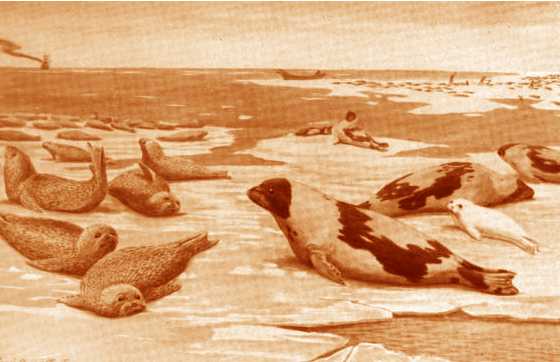
The harbor seal, one of the
smallest of the hair seals, attaining a length of
only 5 or 6 feet, is one of the most widely distributed and best known of its
kind. It is a circumpolar species, formerly ranging well south on the European
coast and to the Carolinas on the American side of the Atlantic, though now more
restricted in its southern extension. On the North Pacific it ranges south to
the coast of Japan on the Asiatic side and to Lower California on the American
side.
Throughout its range the harbor
seal haunts the coast-line, frequenting rocky points, islets, bays,
harbors, and the lower courses of rivers. It commonly frequents the sandy bars
exposed at low tide about the mouths of rivers, and has been known to ascend the
St. Lawrence to Lake Champlain and Lake Ontario, and the Yukon to several
hundred miles above its mouth. It is still a common and well-known animal on the
coast of Maine and eastern Canada and about many harbors on the Pacific coast.
It appears to be a non-migratory species and in northern waters frequents the
pack ice along shore in winter. Where the pack is unbroken, the seal makes
breathing holes through the ice, which it visits at intervals, and where it is
hunted by the Eskimos.
It is not polygamous and is not so strongly gregarious as some
of the other seals. That it has some social
instinct is evident, however, since it commonly gathers in small herds on the
same sand spits, rocky points, and islets. The young are born in early spring
and at first are entirely covered with a woolly white coat. The mother is
devoted to the "pup" and shows the deepest anxiety if danger threatens.
The flesh and blubber of this seal are highly prized by the
Eskimos as the most palatable of
all the seals, and the skin is valued for clothing and for making
strong rawhide lines used for nets and other purposes. On the Alaskan coast of
Bering Sea in fall the Eskimos capture many seals
in nets set off rocky points, just as gill nets are set in the same
places in spring for salmon.
Owing to the presence of this seal along so many inhabited
coasts, much has been written concerning its habits, especially as observed
about the shores of the British Isles. Where not disturbed it shows little fear
and will swim about boats or ships, raising its head high out of water and
gazing steadily with large intelligent eyes at the object of its curiosity; but
when hunted it becomes exceedingly shy and wary. All who have held the harbor seal in captivity agree in prating its
intelligence. It becomes very docile, often learning a variety of amusing
tricks, and develops great affection for its keeper.
The small size of this seal'iand its limited numbers are
elements which save it from extens^ commercial hunting and may preserve it far
into the future to add life and interest to many a rocky coast. The black head, gray body, and large dorsal ring of the male
harp seal are strongly distinctive markings in a group generally characterized
by plain dull colors. The harp seal is a large species, the old males weighing
from 6oo to 8oo pounds.
It is nearly circumpolar in distribution, but its area of
greatest abundance extends from the Gulf of St. Lawrence to Greenland, and
thence eastward in that part of the Arctic Ocean lying north of Europe and
western Siberia. Its reported presence in the Arctic basin north of Bering
Straits or along the coasts to the southward is yet to be confirmed. It is an
offshore species, migrating southward with the ice pack in fall to the coast of
Newfoundland and returning northward with the pack after the breeding season in
spring. For a day or two during the fall migration, when these seals are passing certain points on the coast of
Labrador, the sea is said to be thickly dotted with their heads as far as the
eye can reach, all moving steadily southward.
The harp seal is extremely gregarious and gathers on the pack
ice well offshore during March and April to breed. The main breeding grounds are
off Newfoundland and off Jan Mayen Land in the Arctic. During the breeding
season, in the days of their abundance, they gathered in enormous closely packed
herds, sometimes containing several hundred thousand animals and covering the
ice for miles.
From all accounts it is evident that originally there were
millions of these animals in the North Atlantic and Arctic Oceans. Their
gregarious habits made them an easy prey, and the value of their skins and
blubber formed
the basis for a
great industry. Hundreds of vessels were sent out from north European and
American ports and nearly 1,ooo,ooo harp seals were
killed during each breeding season. This tremendous slaughter and its attendant
waste has resulted in the disappearance of these seals
from many of their former haunts and has alarmingly reduced their numbers
everywhere. Some are still killed off the coast of Newfoundland, but the sealing
industry, now insignificant as compared with its former estate, is practically
dead.
The hunting of harp and other seals
on the pack ice is an occupation calling for such splendid qualities of
virile hardihood in the face of constant danger to life that its brutality has
been little considered. In this perilous work great numbers of hunters have been
cast away and frozen miserably on the drifting ice and many a sealing ship has
been lost with all hands.
Off Newfoundland the young harp seal is born early in March,
wearing a woolly white coat. At first it is tenderly cared for by its mother,
but before the end of April it has learned to swim and is left to care for
itself. The young do not enter the water until they are nearly two weeks old and
require several days of practice before they learn to swim well. The adults are
notable for their swiftness in the water. In the tremendous herds of these seals the continual cries uttered by old and young is
said to produce a steady roar which may be heard for several miles. Their food
is mainly fish. Man is their worst enemy, but they are also preyed upon by
sharks and killer whales.
Unauthorized Site:
This site and its contents are not affiliated, connected,
associated with or authorized by the individual, family,
friends, or trademarked entities utilizing any part or
the subject's entire name. Any official or affiliated
sites that are related to this subject will be hyper
linked below upon submission
and Evisum, Inc. review.
Please join us in our mission to incorporate The Congressional Evolution of the United States of America discovery-based curriculum into the classroom of every primary and secondary school in the United States of America by July 2, 2026, the nation’s 250th birthday. , the United States of America: We The
People. Click Here