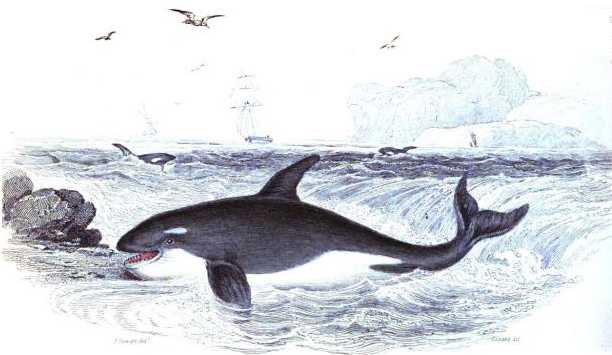
One of the largest, and at the same time the most ferocious, of
all the dolphin family is the killer, or killer whale, frequently also known
as the grampus (Orca gladiator). It is characterized as a genus by its
large size, and the conical and depressed head, devoid of a beak. The back-fin
is of great length, especially in the males; and the flippers are large and
broadly ovate. The teeth (as shown in our figure) are comparatively few in
number, varying from ten to thirteen on each side of the jaws, and are much
larger than in any dolphins yet noticed, being often an inch or more in
diameter, and having an oval-section. The coloration is .striking, the
upper-parts and fins being black, while the lower jaw, chest, and under-parts
are whitish. The white area of the under-parts does not, however, extend to
the flukes, but ends posteriorly in a trident, of which the lateral and
shorter prongs extend obliquely upwards on the flanks. There is a large white
streak above and behind the eye; and frequently at least a purple crescentic
area extends across the back behind the fin. The killer attains a length of at
least 20 feet.
In spite of many nominal species having been recognized, there
can be little doubt that the killer has a cosmopolitan distribution; ranging
from Greenland in the north to the coasts of Australia in the south. Although
chiefly keeping to the open sea, killers occasionally ascend tidal rivers: and
three specimens were observed in the Thames in the spring of 1890. These
individuals entered the river during the night, and on the following morning
were seen swimming up and down the reach between Battersea and Chelsea
Bridges. After continuing there for several hours, they at length headed for
the sea, which they probably reached, as there is no record of their having
been attacked.
When at sea, killers may always be recognised by their tall and
nearly vertical back-fin. They generally associate in small parties; and
subsist not only on fish, but likewise on the flesh of other members of their
own order, as well as on that of seals. Captain Scammon writes that " the
killers exhibit a boldness and cunning peculiar to their carnivorous
propensities. At times they are seen in schools, undulating over the
waves,—two, three, six, or eight abreast,—and, with the long, pointed fins
above their arched backs, together with their varied marks and colours, they
present a pleasing and somewhat military aspect. But generally they go in
small squads,—less than a dozen,—alternately showing themselves above the
surface of the water, or gliding just below, when nothing will be visible but
their projecting dorsals; or they disport themselves by rolling, tumbling, and
leaping nearly out of the water, or cutting various antics with their flukes.
At such times, they usually move rapidly over the surface of the sea, and soon
disappear in the distance." It appears that at times both the
long-finned males and the shorter-firmed females may be found in the same
school, while at other times the two sexes keep apart. The swiftness of the
killer is very great, as it is able to overtake the smaller dolphins, which it
swallows alive. Its voracity is apparently insatiable; Eschricht stating that
one of these animals was known to swallow four porpoises in succession, while
from the stomach of another individual, whose length did not exceed 16 feet,
were taken fourteen seals, whales attacked Like the other larger members of
the order, the Greenland whale by Killers. js
sometimes attacked by a party of killers. Writing on the subject of these
attacks Captain Scammon says that " three or four of these voracious animals
do not hesitate to grapple with the largest baleen-whale; and it is surprising
to see those leviathans of the deep so completely paralysed by the presence of
their natural, although diminutive enemies. Frequently the terrified animal—
comparatively of enormous size and superior strength—evinces no effort to
escape, but lies in a helpless condition, or makes but little resistance to
the assaults of its merciless destroyers. The attack of these wolves of the
ocean upon their gigantic prey may be likened in some respects to a
pack of hounds holding a stricken deer at bay. They cluster about the animal's
head, some of their number breaching over it, while others seize it by the
lips and draw the bleeding monster under water; and when captured, should the
mouth be open, they eat out its tongue. We once saw an attack made by three
killers upon a cow whale and her calf, in a lagoon on the coast of California
in the spring of 1858. The whale was of the California grey species, and her
young was grown to three times the bulk of the largest killers engaged in the
contest, which lasted for an hour or more. They made alternate assaults upon
the old whale and her offspring, finally killing the latter, which sank to the
bottom, where the water was five fathoms deep. During the struggle the mother
became nearly exhausted, having received several deep wounds about the mouth
and lips. As soon as their prize had settled to the bottom, the three killers
descended, bringing up large pieces of flesh in their mouths, which they
devoured after coming to the surface. While gorging themselves in this wise,
the old whale made her escape, leaving a track of gory water behind." On the
9th of September 1893, when off the coast of Minas Geraes, Brazil, at no great
distance from the islands of Los Abrolhos, in long. 39° W., lat. 18° S., the
attention of the present writer was attracted by the appearance of a whale and
some other creatures at a distance of apparently something less than a quarter
of
a mile from the ship. The whale was a firmer, or humpback, of no very great
size, and was seen spouting, and again descending. Immediately after its first
descent there appeared above the surface of the sea what seemed to be the
tail-fin of some animal unknown. This supposed fin was raised in a vertical
position, where it remained vibrating for some seconds and then suddenly
disappeared. In colour it was a pure glistening white; while in form it
appeared to be laterally compressed, with sharp edges and an acute
termination. It gave the impression of belonging to some animal which was
engaged in attacking the whale beneath the surface; and I should estimate its
height above the water approximately at 5 or 6 feet. Soon after the
disappearance of this strange white object, the broad black head of what I
presume to have been a killer was seen above the water; and in a few seconds
the whale itself again rose to spout. That these black animals, which appeared
to be harrassing and attacking the whale, were killers, I have no reasonable
doubt; but the question arises as to the nature of the animal to which the
strange white tail-like object seen standing above the water could have
belonged. My impression at the time was that it must be the upper lobe of the
tail of some enormous shark allied to the threshers (Alopecias); and
this impression has been confirmed by a subsequent examination of the stuffed
specimens of that genus in the British Museum. The thresher is, however, a
black shark; while the minute size of its teeth seems to discredit the common
accounts of its attacking whales. Unless, however, it could have been the
flipper of a humpback, I am at a loss to imagine to what other animal the
aforesaid white tail-like object could have belonged, save to some gigantic
shark allied to the thresher, but of a white colour, and probably armed with
much larger teeth.
Unauthorized Site:
This site and its contents are not affiliated, connected,
associated with or authorized by the individual, family,
friends, or trademarked entities utilizing any part or
the subject's entire name. Any official or affiliated
sites that are related to this subject will be hyper
linked below upon submission
and Evisum, Inc. review.
Please join us in our mission to incorporate The Congressional Evolution of the United States of America discovery-based curriculum into the classroom of every primary and secondary school in the United States of America by July 2, 2026, the nation’s 250th birthday. , the United States of America: We The
People. Click Here