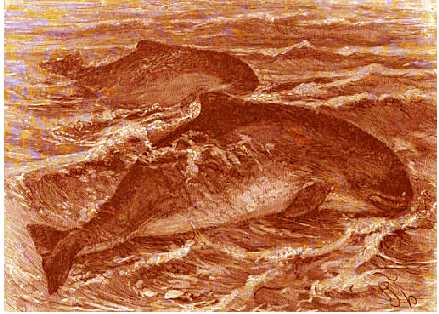
The common porpoise (Phoccena communis), of the European seas, is the best known
representative of a genus readily distinguished from all the others by the
characters of the teeth. These are from sixteen to twenty-six in number on each
side of the jaws, and are very small, with flattened spade-like crowns separated
from the roots by a distinct neck; sometimes the upper border of the crown is
entire, but in other cases it is divided into two or three distinct lobes. In
size, porpoises are small; and the head has a rounded muzzle, without a beak.
There is generally a fin on the back, although this is wanting in one species.
The skull has a very broad palate, and the union between the two branches of the
lower jaw is very short. There are frequently one or more rows of horny
tubercles 011 the front edge of the back-tin, or of the ridge which takes its
place.
common The common porpoise is by far the best-known of all the Cetaceans
Porpoise. frequenting the British coasts, generally keeping near the shores, and
often ascending the larger rivers to considerable distances. It is characterized
by having twenty-five to twenty-six teeth on each side of the jaws, by the
sloping head, the equality in the length of the upper and lower jaws, and by the
length of the mouth exceeding half that of the flipper. There is a large fin on
the back, which is triangular in shape, and situated somewhat in advance of the
middle of the total length of the animal. In length, the common porpoise
measures about 5 feet, or rather more. The color of the upper-parts is dark
slate, or blackish, while the sides become gradually lighter till the color
fades into the pure white of the under parts. In some cases there is a yellowish
or pinkish tinge on the flukes.
The distribution of this species is extensive, comprising the North Atlantic and
North Pacific Oceans, the North Sea, and the coasts of Europe. In Davis Strait
it extends as far northwards as latitude 67° or 69°, and it also occurs on the
Alaskan coasts; while southwards it extends in America to the shores of New
Jersey and Mexico. In the Mediterranean it is comparatively rare. Porpoises
associate in shoals or herds of considerable size; and their sportive gambols
are probably familiar to most of our readers.
Distribution.
Few sights are, indeed, more interesting than to watch a shoal of these animals
diving and sporting round a vessel, whether it be making rapid headway, or lying
at anchor. At one moment will be seen the roll of the arched back, surmounted by
the tin, as the porpoise swims along in a series of gentle curves; while at
another the white belly will flash in the sunlight as the creature turns on its
side, or leaps completely out of the water. In the ordinary undulating mode of
swimming, the porpoise just brings its blowhole to the surface, breathes without
checking its course,
and then dips downwards, to expose the back-fin in the manner represented iu our
second illustration; this elegant motion being continued without intermission.
Throughout its course, the flukes are the propelling instrument; the flippers
being laid close against the sides during the onward movement, and only spread
out to check its speed when the animal desires to stop. The food of the porpoise
apparently consists exclusively of fish; mackerel, pilchards, and herrings,
being its especial favourites, although it also consumes salmon. On the British
coasts porpoises may frequently be seen in pursuit of shoals of mackerel and
herrings, and when thus engaged are often caught in the nets set for the latter.
The pairing season is said to be in the summer, and it is believed that the
single offspring is produced after a period of six months' gestation. Three
porpoises which were enclosed by a fence in the Wareham River in Dorsetshire,
many years ago, are reported to have incessantly uttered the most distressing
cries, which were continued by night as well as by day.
Porpoise- Formerly porpoises were esteemed in England for their flesh,
Hunting. but they are now taken mainly for their oil, although the skin is also
sometimes used. The leather commonly known as porpoise-hide is, however, as we
have already had occasion to mention, generally made from the skin of the white
whale. On parts of the coast of North America, porpoise-shooting is regularly
practiced by the Indians; and this pursuit affords to the Passamaquody tribe
their chief means of support. The average yield of oil will be about three
gallons, and in a good season an Indian may kill .from one hundred to one
hundred and fifty porpoises. "To make a successful porpoise-hunter," writes Mr.
C. C. Ward, " requires five or six years of constant practice. Boys, ten or
twelve years of age, are taken out in the canoes by the men, and thus early
trained in the pursuit of that which is to form their main support in after
years. Porpoise-shooting is followed at all seasons and in all kinds of
weather—in the summer sea, in the boisterous autumn gales, and in the dreadful
icy seas of mid-winter. In a calm summer day, the porpoise can be heard blowing
for a long distance. The Indians, guided by the sound long before they can see
the game, paddle rapidly in the direction from which the sound comes, and rarely
fail to secure the porpoise. They use long smooth-bored guns, loaded with a
handful of powder, and a heavy charge of double-B shot. As soon as the porpoise
is shot, they paddle rapidly up to him and kill him with a spear, to prevent his
flopping about and upsetting the canoe after they have taken him aboard. The
manner of taking a porpoise on board is to insert two fingers of the right hand
into the blowhole, take hold of the pectoral fin with the left hand, and lift
the creature up until at least one half of his length is above the gunwale of
the canoe, and then drag him aboard. This is comparatively easy to accomplish in
smooth water, but when the feat is performed in a heavy sea, one can hardly
realize the skill and daring required. In rough weather, with a high sea
running, the Indian is compelled to stand up in his canoe when he fires,
otherwise he could not see his game. In such work as this, one would suppose
that upsets would be unavoidable; but, strange to say, they seldom happen, and
only under circumstances where the Indian's skill or foresight is unavailing."
Although Mr. True believes that there are two other species of Indian Porpoise.
porpoise with back-fins inhabiting American waters, it will be unnecessary to
allude further to them here; and we accordingly pass on to the Indian porpoise
(P. phocccnoides). This species is readily distinguished by the absence of the
back-fin, and the reduced number of the teeth, of which there are about eighteen
on each side of the jaws. Of small size, it is less than 4 feet in length, and
is of a uniform black color. It inhabits the shores of the Indian Ocean, from
the Cape of Good Hope to Japan; and has been taken in many of the tidal rivers
of India, and in the Yang-tse-Kiang, at a distance of nearly one thousand miles
from its mouth.
The following account of the habits of this species is given by Mr. F. W.
Sinclair, who states that it " frequents the tidal creeks, not ascending very
far, and the sounds among the reefs and islands. It feeds chiefly on prawns,
also on small cephalopods and fish. It does not appear to herd in schools, more
than four or five, being rarely, if ever, seen together. Usually it is solitary;
the pairs seem to consist of female and calf, more often than male and female.
The young (one in number) are born, apparently, about October. The roll of this
porpoise is like that of P. communis. It does not jump or turn somersaults, and
is, on the whole, a sluggish little porpoise." It appears to be found only in
shallow water. -
The Royal Natural History: Mammals, birds By Richard Lydekker - 1895 Edited by
Stanley L. Klos 1999
Unauthorized Site:
This site and its contents are not affiliated, connected,
associated with or authorized by the individual, family,
friends, or trademarked entities utilizing any part or
the subject's entire name. Any official or affiliated
sites that are related to this subject will be hyper
linked below upon submission
and Evisum, Inc. review.
Please join us in our mission to incorporate The Congressional Evolution of the United States of America discovery-based curriculum into the classroom of every primary and secondary school in the United States of America by July 2, 2026, the nation’s 250th birthday. , the United States of America: We The
People. Click Here