Crab-A crustacean of the order Decapoda and suborder Brachyura,
characterized by the small size of the abdomen, which resembles a short tail
curved under the thora
CRAB
CRАВ (AS. krabba, Icel. krabbi, Ger. Krabbe).
A crustacean of the order Decapoda and suborder Brachyura, characterized by the
small size of the abdomen, which resembles a short tail curved under the thorax,
all important viscera being included in the thorax. The term extends also to
some of the suborder Anomura (purse-crabs, hermit-crabs, etc.), characterized by
a condition of abdomen intermediate between that of the Brachyura and that of
the Macrura, or long-tailed decapod crustaceans, such as the lobster, crayfish,
etc. All the crabs, besides many other crustaceans, were comprehended in the
Linmvan genus Cancer; but the number of species is very great, considerably more
than 1000, and the Brachyura alone are now arranged in many genera and families.
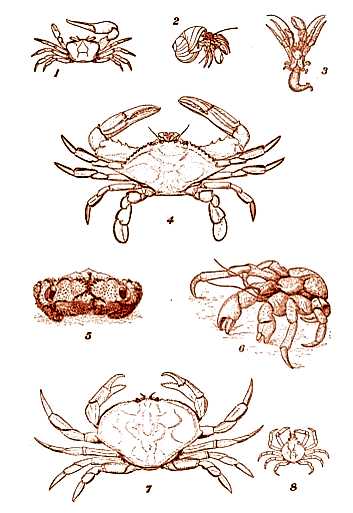
1. FIDDLER CRAB (Qelaslmus pugnax).
2. HERMIT CRAB I Eupagurus longlcarpus)
3. HERMIT, out of Its borrowed shell, showing reduced and defenseless posterior
parts.
4. EASTERN EDIBLE O" BLUE CRAB iCallinectes hastatus).
5. A DEEP-SEA CRAB (North Atlantic) Its arms closed Into Natica héros. a
defensive box.
6. COCOANUT CRAB (Blrgus latro).
7. COMMON CRAB OF PACIFIC COAST (Cancer maglster).
8. SPIDER CRAB (Liblnla emarglnata).
These various crabs differ very much in the form of the carapace
(the back), which in some is orbicular or nearly so; in some, much broader than
it is long; in others, longer than broad; in some, prolonged in front into a
kind of beak, etc. ; also in its smoothness, or roughness with hairs, tubercles,
or spines; in the length of the legs. etc. The eyes are compound, with hexagonal
facets, and are elevated on stalks, which are generally short, but sometimes
considerably lengthened, and which have the power of motion, so as to turn the
eye in different directions. The first pair of limbs are not vised for
locomotion, but exhibit in great perfection the characteristic claws or pincers
(chclœ) of the decapod crustaceans. Crabs are inhabitants of almost all seas;
most of them, however, are found C'hielly near the coast. Some crabs inhabit
fresh water, particularly in the warmer parts of the world; and others, known as
land-crabs, live among moist herbage, or burrow in sand or earth. Crabs are
generally flesh or carrion eaters, though some forms seem to prefer a
vegetarian's diet. They are always active and are noted for running sideways,
rather than straight ahead. Some have the last pair of limbs expanded at the
extremity into a broad blade for swimming, and some have even all the four pairs
of limbs intended for locomotion Unis expanded, and sometimes occur far out at
sea.
Crabs, like all arthropods (see Arthropoda), molt or change their shell, not at
fixed intervals or seasons, but according to the exigencies of their growth, the
change being made with great frequency when they are very young, but rarely in
advanced age; indeed, from the mollusks and other animals sometimes found
adhering to the carapace, it is inferred that the same covering is sometimes
worn for a number of years.
Crabs become interesting in the aquarium, from their readiness in seizing food,
their activity in tearing and eating it, and their pugnacity. The number of
specimens is apt, however, to be soon diminished by the stronger killing and
eating the weaker. Crabs vary greatly in size and color, as might be expected
from the great number of species and their wide distribution. The giant crab of
Japan (ifacroctiira Kœmpfcri), although only a foot across the disk, which is 18
inches long, has such long legs as occasionally to be 15 to 18 feet from tip to
tip of the first pair. The great stone-crab of Tasmania, which has short and
very thick legs, has been known to reach a weight of over 30 pounds. On the
other hand, many species of crab are only a fraction of an inch across. In
color, crabs vary from black to white, through all the colors of the rainbow.
Shades of green, blue, and gray are perhaps the most common, but the brightest
shades of red and yellow are by no means rare. The sexes of crabs are easily
distinguished, as the females arc usually larger, and their abdomens broader
anil more oval, while males have the chehe more powerfully developed—notably so
in the fiddlers.
Economic Importance of Crabs.—These animals supply food for food-fishes, are of
great service as scavengers, and are used as human food in various parts of the
world. In the United States the principal crab so used is the blue crab (Callincctcs
hautains), hundreds of thousands of which are sent to market every year from the
waters of Chesapeake Bay alone. The little pea-crabs (Pinnotheres) often found
in oysters (see COMMEN8ALISM) are regarded as a great luxury. In К u ropo the
species most frequently used are those of the genus Cancer, especially the great
Cancer panurus, and there is no reason why the two eastern American species of
this genus, the 'rock' and 'lonah' crabs (qq.v.l. should not he far more
utilized as food than they are. To this group belong the principal edible crab
of the American Pacific coast (Cancer maaistcr), and others smaller which are
eaten by the Chinese, etc. This species usually measures 7 to 9 inches in
breadth of body, and abounds from Alaska to Mexico, usually below low-tide level
on sandy bottom. Crabs which have just shed their shell, and are covered only by
a soft skin, are regarded as best, and are called 'shedders* or 'soft-shelled.'
The ways of fishing are various. Many are taken in wicker traps or 'pots.'
baited with ment or offal ; another common method is to sink shallow hoop-nets
of coarse material and mesh, which «re baited and hauled up rapidly at
intervals, bringing the crabs with them. Hand-line fishing, with bundles of meat
to which the crabs cling until lifted out of water, is more a sport than a
method of market-fishing; but in the Gulf of Mexico trawls or 'trot-lines' are
set in several ways, and vast quantities of crabs are thus taken. They are kept
for market in floating pens or 'cars,' and shipped alive packed in wet seaweed.
They are also preserved by canning, etc. -- The
New international encyclopaedia, Volume 5 edited by Daniel Coit Gilman, Harry
Thurston Peck, Frank Moore Colby: 1920 and Stanley L. Klos 1999
Unauthorized Site:
This site and its contents are not affiliated, connected,
associated with or authorized by the individual, family,
friends, or trademarked entities utilizing any part or
the subject's entire name. Any official or affiliated
sites that are related to this subject will be hyper
linked below upon submission
and Evisum, Inc. review.
Please join us in our mission to incorporate The Congressional Evolution of the United States of America discovery-based curriculum into the classroom of every primary and secondary school in the United States of America by July 2, 2026, the nation’s 250th birthday. , the United States of America: We The
People. Click Here